Li Xin, Li Yan, Wan Li, Chen Rui, Chen Fei
Department of Pharmacology, School of Pharmaceutical Sciences, Guangzhou Medical University, Guangzhou.
Department of Ophthalmology and Otorhinolaryngology, Lecong Hospital of Guangzhou Medical University, Foshan.
Onco Targets Ther. 2017 Sep 11;10:4455-4464. doi: 10.2147/OTT.S130378. eCollection 2017.
This study aimed to explore the effect of miR-509-5p on pancreatic cancer progression and clarify the underlying mechanisms.
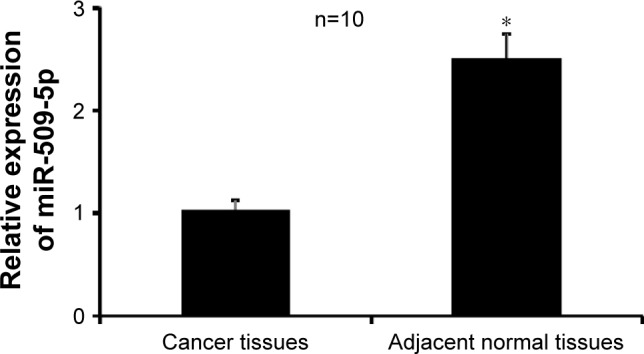
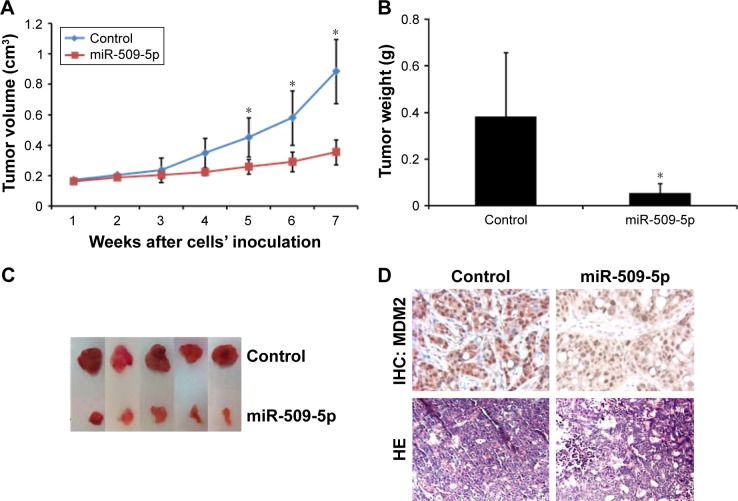
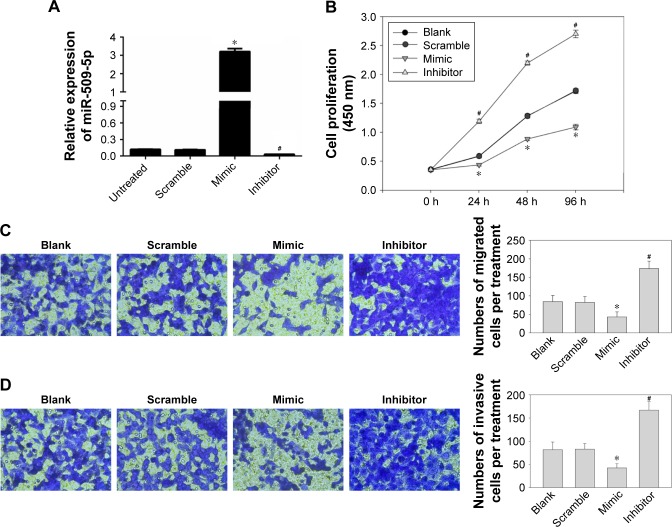
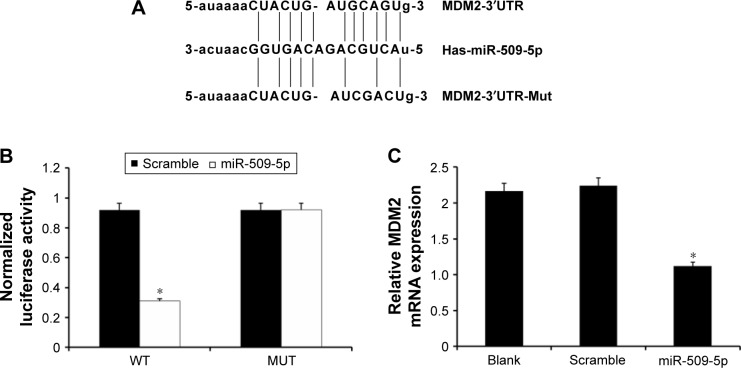
Real-time quantitative reverse transcription polymerase chain reaction was employed to determine miR-509-5p expression in pancreatic cancer tissues and noncancerous adjacent tissues. CCK-8 and Transwell experiments were employed to examine cellular proliferation, migration, and invasion after miR-509-5p mimic or inhibitor transfection. Bioinformatics tools were used to identify the target gene of miR-509-5p, and cotransfection of the target gene and miR-509-5p mimic was performed to determine the effect on the proliferation and migration of pancreatic cancer cells. A xenograft mouse model and histological analysis were also used to test the effect of miR-509-5p on tumor growth in vivo.
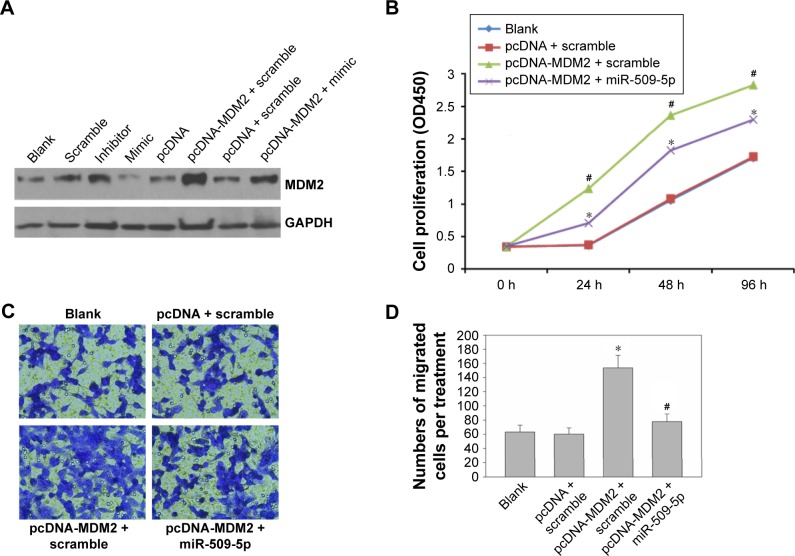
miR-509-5p expression was dramatically downregulated in pancreatic cancer tissues and in pancreatic cancer cell lines. miR-509-5p mimic markedly inhibited PANC-1 cell proliferation, migration, and invasion. Conversely, miR-509-5p inhibitor promoted PANC-1 cell proliferation, migration, and invasion. Furthermore, the 3'UTR-specific target site luciferase reporter assay also showed that miR-509-5p negatively regulated MDM2 at the post-transcriptional level. miR-509-5p effectively reversed the MDM2 overexpression-induced increase in PANC-1 cell proliferation and invasion. Moreover, miR-509-5p inhibited tumor growth and accelerated cell death in the tumor samples.
Our results suggested that miR-509-5p served as a new tumor suppressor via targeting the MDM2 gene, inhibiting pancreatic cancer progression.
本研究旨在探讨miR-509-5p对胰腺癌进展的影响,并阐明其潜在机制。
采用实时定量逆转录聚合酶链反应来测定胰腺癌组织和癌旁非癌组织中miR-509-5p的表达。在转染miR-509-5p模拟物或抑制剂后,采用CCK-8和Transwell实验检测细胞增殖、迁移和侵袭能力。利用生物信息学工具鉴定miR-509-5p的靶基因,并进行靶基因与miR-509-5p模拟物的共转染,以确定对胰腺癌细胞增殖和迁移的影响。还使用异种移植小鼠模型和组织学分析来检测miR-509-5p对体内肿瘤生长的影响。
miR-509-5p在胰腺癌组织和胰腺癌细胞系中的表达显著下调。miR-509-5p模拟物显著抑制PANC-1细胞的增殖、迁移和侵袭。相反,miR-509-5p抑制剂促进PANC-1细胞的增殖、迁移和侵袭。此外,3'UTR特异性靶位点荧光素酶报告基因检测还表明,miR-509-5p在转录后水平上对MDM2起负调控作用。miR-509-5p有效逆转了MDM2过表达诱导的PANC-1细胞增殖和侵袭增加。此外,miR-509-5p抑制肿瘤生长并加速肿瘤样本中的细胞死亡。
我们的结果表明,miR-509-5p通过靶向MDM2基因作为一种新的肿瘤抑制因子,抑制胰腺癌进展。