Wu Lingdan, Kirmse Ursula, Flaisch Tobias, Boiandina Ganna, Kenter Anna, Schupp Harald T
Department of Psychology, University of KonstanzKonstanz, Germany.
Front Hum Neurosci. 2017 Sep 20;11:465. doi: 10.3389/fnhum.2017.00465. eCollection 2017.
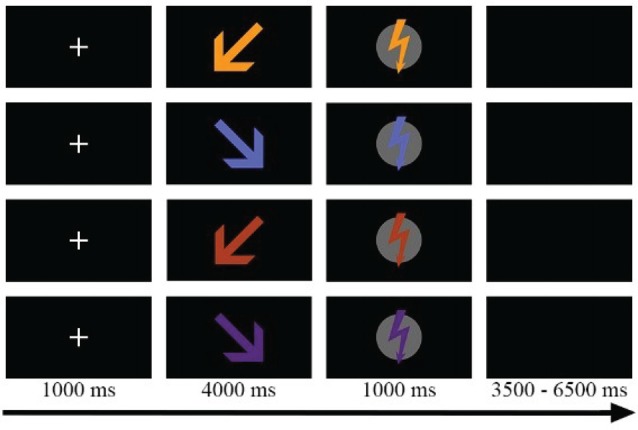
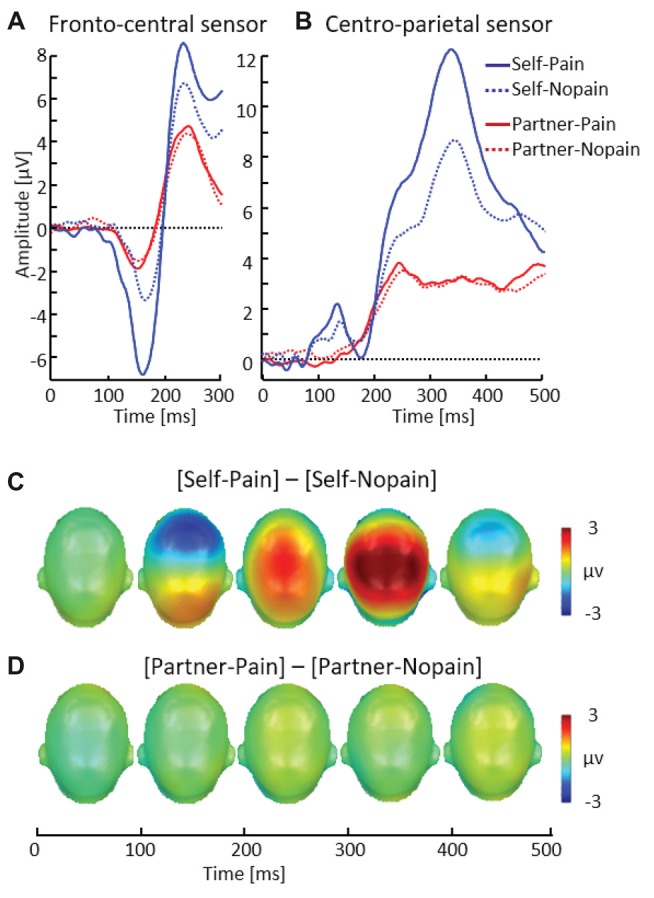
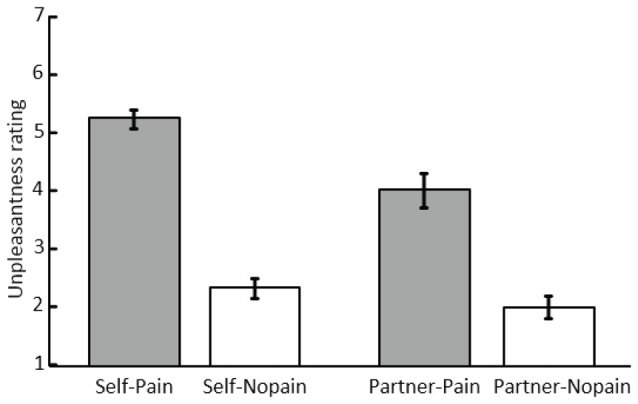
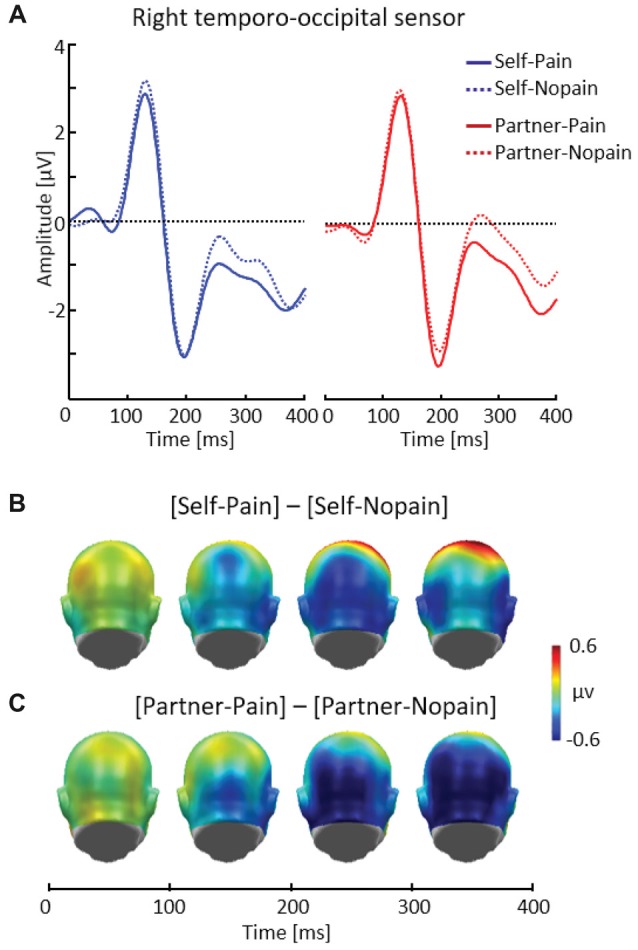
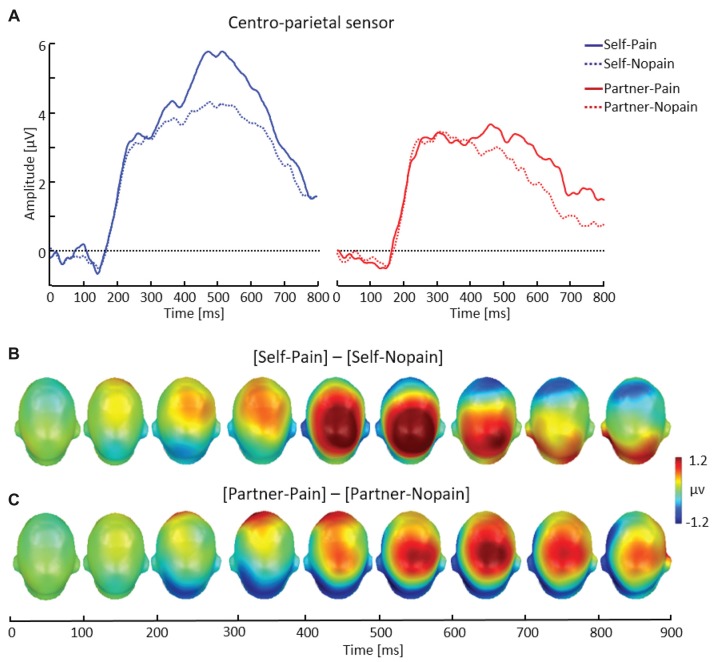
Empathy motivates helping and cooperative behaviors and plays an important role in social interactions and personal communication. The present research examined the hypothesis that a state of empathy guides attention towards stimuli significant to others in a similar way as to stimuli relevant to the self. Sixteen couples in romantic partnerships were examined in a pain-related empathy paradigm including an anticipation phase and a stimulation phase. Abstract visual symbols (i.e., arrows and flashes) signaled the delivery of a Pain or Nopain stimulus to the partner or the self while dense sensor event-related potentials (ERPs) were simultaneously recorded from both persons. During the anticipation phase, stimuli predicting Pain compared to Nopain stimuli to the partner elicited a larger early posterior negativity (EPN) and late positive potential (LPP), which were similar in topography and latency to the EPN and LPP modulations elicited by stimuli signaling pain for the self. Noteworthy, using abstract cue symbols to cue Pain and Nopain stimuli suggests that these effects are not driven by perceptual features. The findings demonstrate that symbolic stimuli relevant for the partner capture attention, which implies a state of empathy to the pain of the partner. From a broader perspective, states of empathy appear to regulate attention processing according to the perceived needs and goals of the partner.
同理心激发助人及合作行为,在社会互动和人际交流中发挥着重要作用。本研究检验了这样一种假设:同理心状态会以与引导关注与自身相关刺激相似的方式,引导人们关注对他人具有重要意义的刺激。研究采用与疼痛相关的同理心范式,对16对处于恋爱关系中的情侣进行了研究,该范式包括一个预期阶段和一个刺激阶段。抽象视觉符号(如箭头和闪光)指示向伴侣或自身施加疼痛或无疼痛刺激,同时从两人身上同步记录密集的传感器事件相关电位(ERP)。在预期阶段,与向伴侣施加无疼痛刺激相比,预测疼痛的刺激会引发更大的早期后负波(EPN)和晚期正电位(LPP),其在地形和潜伏期上与向自身发出疼痛信号的刺激所引发的EPN和LPP调制相似。值得注意的是,使用抽象线索符号来提示疼痛和无疼痛刺激表明,这些效应并非由感知特征驱动。研究结果表明,与伴侣相关的符号刺激会吸引注意力,这意味着对伴侣疼痛的同理心状态。从更广泛的角度来看,同理心状态似乎会根据对伴侣感知到的需求和目标来调节注意力处理。