Department of Health Sciences, Community and Occupational Medicine, University Medical Center Groningen, University of Groningen, Hanzeplein 1, Postbus 30001, 9700 RB, Groningen, The Netherlands.
Department of Evidence-based Occupational Health, Workplace Health Management, Federal Institute for Occupational Safety and Health (BAuA), Berlin, Germany.
J Occup Rehabil. 2018 Sep;28(3):393-417. doi: 10.1007/s10926-017-9730-1.
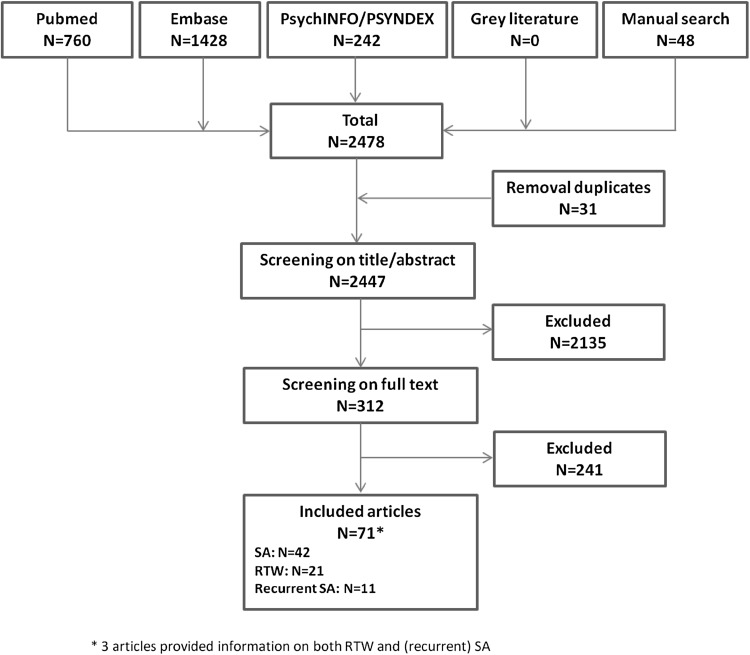
Purpose To present an overview of the existing evidence on prognostic factors of (recurrent) sickness absence (SA) and return to work (RTW) among workers with a common mental disorder (CMD). This scoping review provides information about determinants for SA and RTW, which could be used to develop better interventions aimed at the prevention of SA and promotion of RTW among workers with a CMD. Methods Relevant articles were identified in PubMed, Embase, PsycINFO, PSYNDEX, and SINGLE up to October 2016. In order to be included, studies should provide insight into prognostic factors of SA or RTW of workers with a CMD. We classified all factors according to the domains of the International Classification of Functioning, Disability and Health. Results Our searches identified 2447 possible relevant articles, of which 71 were included for data extraction. There is consistent evidence in ≥3 studies that previous episodes of CMD, higher symptom severity, previous absenteeism, co-morbidity, high job demands, low job control, high job strain, female gender, lower educational level, smoking behavior, and low perceived general health are predictors of SA in people with CMDs. Earlier RTW is consistently predicted by lower symptom severity, having no previous absenteeism, younger age, and positive expectations concerning sick-leave duration or RTW. Conclusions The amount of research on determinants for SA and RTW in workers with CMD has increased dramatically in recent years, although most studies are from the Netherlands and Scandinavia. There are some research gaps identified in this scoping review that need further attention in primary and secondary studies. Based on the summary of the evidence, we provide guidance for policy, practice and research.
对患有常见精神障碍(CMD)的工人(复发性)病假(SA)和重返工作(RTW)的预后因素的现有证据进行综述。这一范围界定综述提供了关于 SA 和 RTW 的决定因素的信息,这些信息可用于制定更好的干预措施,以预防 CMD 工人的 SA 和促进其 RTW。
在 2016 年 10 月之前,我们在 PubMed、Embase、PsycINFO、PSYNDEX 和 SINGLE 中检索了相关文章。为了纳入研究,这些研究应该提供有关 CMD 工人 SA 或 RTW 的预后因素的见解。我们根据国际功能、残疾和健康分类的领域对所有因素进行了分类。
我们的搜索共确定了 2447 篇可能相关的文章,其中有 71 篇被纳入数据提取。有≥3 项研究一致表明,先前的 CMD 发作、较高的症状严重程度、先前的缺勤、合并症、高工作要求、低工作控制、高工作压力、女性、较低的教育水平、吸烟行为和较低的总体健康感知是 CMD 患者 SA 的预测因素。症状严重程度较低、没有先前缺勤、年龄较小、对病假期限或 RTW 的积极期望,可预测较早的 RTW。
近年来,对 CMD 工人 SA 和 RTW 的决定因素的研究数量急剧增加,尽管大多数研究来自荷兰和斯堪的纳维亚。本范围界定综述确定了一些研究空白,需要在初级和二级研究中进一步关注。根据证据的总结,我们为政策、实践和研究提供了指导。