Ellison Michael A, Gearheart Christy M, Porter Christopher C, Ambruso Daniel R
Department of Pediatrics, University of Colorado Denver, The Anschutz Medical Campus, Aurora, Colorado, United States of America.
Department of Pediatrics, Emory University School of Medicine, Atlanta, Georgia, United States of America.
PLoS One. 2017 Oct 5;12(10):e0185956. doi: 10.1371/journal.pone.0185956. eCollection 2017.
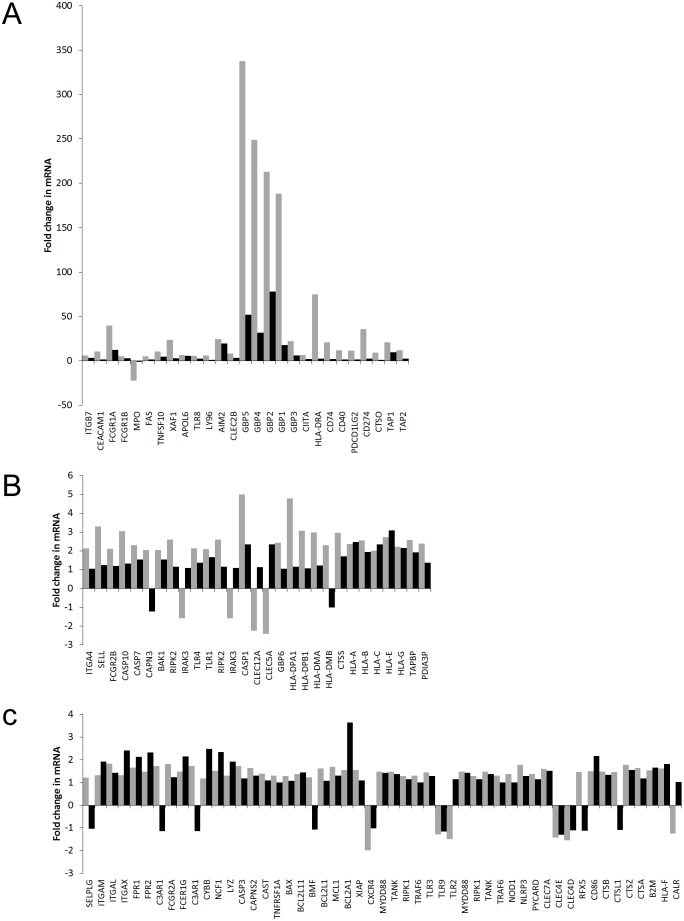
The cytokine interferon-γ (IFN-γ) is approved as a drug to treat chronic granulomatous disease (CGD) and osteopetrosis and is also used in hyperimmunoglobulin E syndromes. Patients with CGD have defects in proteins of the NOX2 NADPH oxidase system. This leads to reduced production of microbicidal ROS by PMNs and recurrent life threatening infections. The goal of this study was to better understand how IFN-γ might support phagocyte function in these diseases, and to obtain information that might expand potential uses for IFN-γ. Neutrophils mature in the bone marrow and then enter the blood where they quickly undergo apoptotic cell death with a half-life of only 5-10 hours. Therefore we reasoned that IFN-γ might exert its effects on neutrophils via prolonged exposure to cells undergoing maturation in the marrow rather than by its brief exposure to short-lived circulating cells. To explore this possibility we made use of PLB-985 cells, a myeloblast-like myeloid cell line that can be differentiated into a mature, neutrophil-like state by treatment with various agents including DMSO. In initial studies we investigated transcription and protein expression in PLB-985 cells undergoing maturation in the presence or absence of IFN-γ. We observed IFN-γ induced differences in expression of genes known to be involved in classical aspects of neutrophil function (transmigration, chemotaxis, phagocytosis, killing and pattern recognition) as well as genes involved in apoptosis and other mechanisms that regulating neutrophil number. We also observed differences for genes involved in the major histocompatibility complex I (MHCI) and MHCII systems whose involvement in neutrophil function is controversial and not well defined. Finally, we observed significant changes in expression of genes encoding guanylate binding proteins (Gbps) that are known to have roles in immunity but which have not as yet been linked to neutrophil function. We propose that changes in the expression within these classes of genes could help explain the immune supportive effects of IFN-γ. Next we explored if the effect of IFN-γ on expression of these genes is dependent on whether the cells are undergoing maturation; to do this we compared the effects of IFN-γ on cells cultured with and without DMSO. For a subset of genes the expression level changes caused by IFN-γ were much greater in maturing cells than non-maturing cells. These findings indicate that developmental changes associated with cell maturation can modulate the effects of IFN-γ but that this is gene specific. Since the effects of IFN-γ depend on whether cells are maturing, the gene expression changes observed in this study must be due to more than just prolonged application of IFN-γ and are instead the result of interplay between cell maturation and changes caused by the chemokine. This supports our hypothesis that the effects of IFN-γ on developing neutrophils in the bone marrow may be very different from its effects on mature cells in the blood. Collectively the findings in this study enhance our understanding of the effects of IFN-γ on maturing myeloid cells and indicate possible mechanisms by which this cytokine could support immune function.
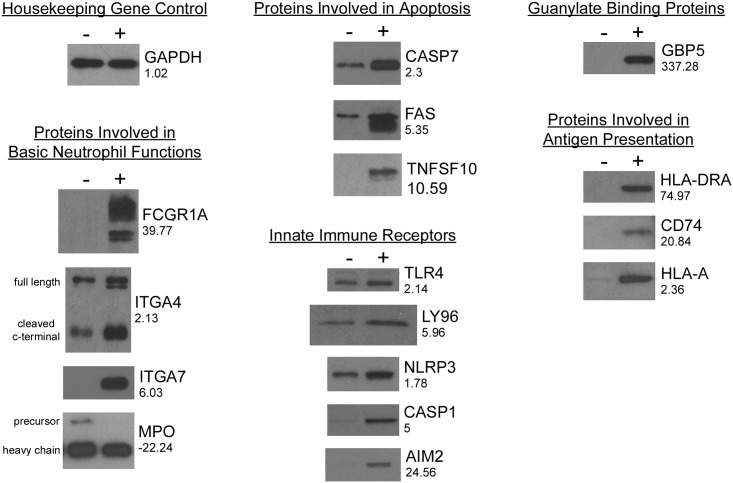
细胞因子干扰素-γ(IFN-γ)已被批准作为治疗慢性肉芽肿病(CGD)和骨质石化症的药物,也用于高免疫球蛋白E综合征。CGD患者的NOX2 NADPH氧化酶系统蛋白存在缺陷。这导致中性粒细胞(PMN)产生的杀菌性活性氧(ROS)减少,并引发危及生命的反复感染。本研究的目的是更好地了解IFN-γ如何在这些疾病中支持吞噬细胞功能,并获取可能扩大IFN-γ潜在用途的信息。中性粒细胞在骨髓中成熟,然后进入血液,在血液中它们很快经历凋亡性细胞死亡,半衰期仅为5-10小时。因此,我们推断IFN-γ可能通过长时间作用于在骨髓中正在成熟的细胞,而不是通过短暂作用于寿命短暂的循环细胞来对中性粒细胞发挥作用。为了探究这种可能性,我们利用了PLB-985细胞,这是一种成髓细胞样髓系细胞系,通过用包括二甲亚砜(DMSO)在内的各种试剂处理,可以分化为成熟的、中性粒细胞样状态。在初步研究中,我们研究了在有或没有IFN-γ存在的情况下正在成熟的PLB-985细胞中的转录和蛋白质表达。我们观察到IFN-γ诱导了已知参与中性粒细胞功能经典方面(迁移、趋化性、吞噬作用、杀伤和模式识别)的基因以及参与凋亡和其他调节中性粒细胞数量机制的基因表达差异。我们还观察到参与主要组织相容性复合体I(MHCI)和MHCII系统的基因存在差异,其在中性粒细胞功能中的作用存在争议且尚未明确界定。最后,我们观察到编码鸟苷酸结合蛋白(Gbps)的基因表达有显著变化,已知这些蛋白在免疫中起作用,但尚未与中性粒细胞功能联系起来。我们认为这些类别基因表达的变化有助于解释IFN-γ的免疫支持作用。接下来我们探究IFN-γ对这些基因表达的影响是否取决于细胞是否正在成熟;为此我们比较了IFN-γ对用DMSO培养和未用DMSO培养的细胞的影响。对于一部分基因,IFN-γ引起的表达水平变化在正在成熟的细胞中比未成熟细胞中要大得多。这些发现表明与细胞成熟相关的发育变化可以调节IFN-γ的作用,但这是基因特异性的。由于IFN-γ的作用取决于细胞是否正在成熟,本研究中观察到的基因表达变化必定不仅仅是由于IFN-γ的长时间作用,而是细胞成熟与趋化因子引起的变化之间相互作用的结果。这支持了我们的假设,即IFN-γ对骨髓中正在发育的中性粒细胞的作用可能与其对血液中成熟细胞的作用非常不同。本研究的这些发现共同增强了我们对IFN-γ对正在成熟的髓系细胞作用的理解,并指出了这种细胞因子支持免疫功能的可能机制。