Rat Cédric, Hild Sandrine, Gaultier Aurelie, Khammari Amir, Bonnaud-Antignac Angelique, Quereux Gaelle, Dreno Brigitte, Nguyen Jean Michel
Departmentof General Practice, Faculty of Medicine, Nantes, France.
French National Institute of Health and Medical Research (INSERM) Unit 1232, team 2, Nantes, France.
BMJ Open. 2017 Oct 5;7(10):e016071. doi: 10.1136/bmjopen-2017-016071.
The aim of the study was to assess whether adherence to annual clinical skin monitoring is dependent on patient sociodemographic characteristics or personality traits.
The study was a questionnaire survey.
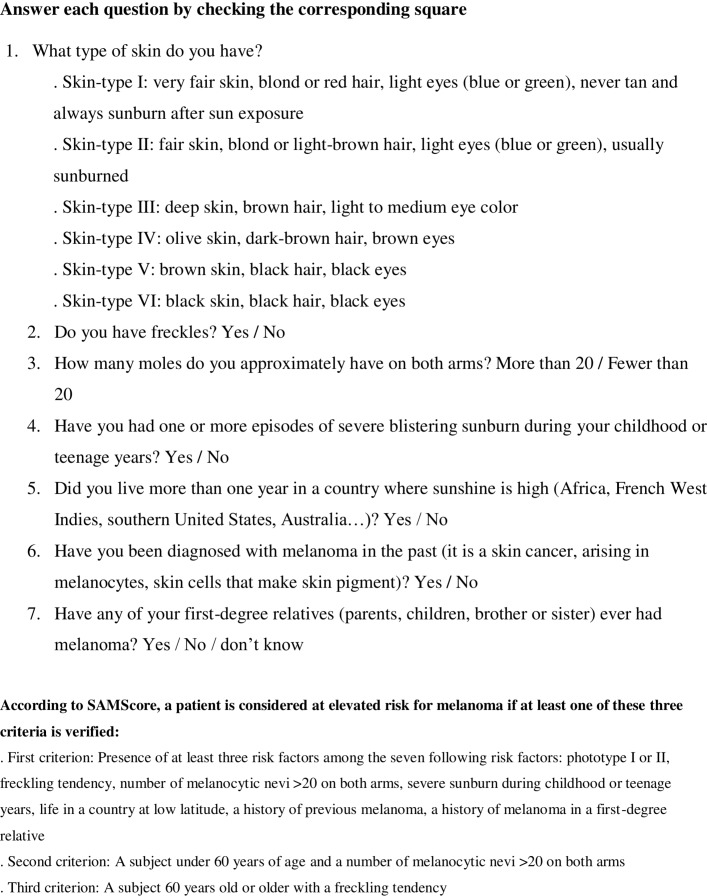
Data were collected between February and April 2013 in a sample of 1000 patients at high risk of melanoma who participated in a pilot-targeted screening programme in western France.
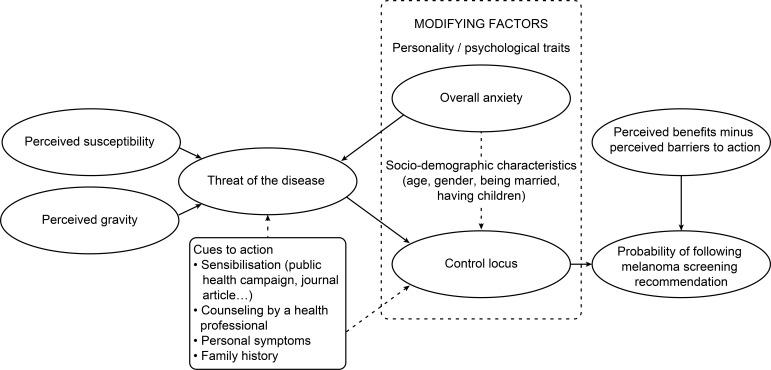
Sociodemographic data, overall anxiety level (State-Trait Anxiety Inventory questionnaire), locus of control (Multidimensional Health Locus of Control scale) and levels of anxiety specifically associated with screening and melanoma were collected. Actual participation in the skin monitoring examination was reported by 78 general practitioner investigators.
Statistical analysis was performed using R statistical software. Factors associated with non-adherence were identified by multivariate analysis.
Our analysis included 687 responses (526 adherent patients and 161 non-adherent patients). Non-adherence was higher in younger patients and in men (OR=0.63 (0.41-0.99)). Viewing health status as dependent on external persons (OR=0.90, 95% CI 0.83 to 0.97) or determined by chance (OR=0.89, 95% CI 0.80 to 0.98) and overall anxiety (OR=0.98, 95% CI 0.97 to 0.99) were also factors associated with non-adherence. In contrast, there was no link between anxiety specifically associated with the screening performed or melanoma and patient adherence to monitoring. Adherence was higher in married patients (OR=1.68 95% CI 1.08 to 2.60).
The results of this study suggest that sociodemographic and psychological characteristics should be considered when including patients at elevated risk of melanoma in a targeted screening programme.
NCT01610531; Post-results.
本研究旨在评估坚持年度临床皮肤监测是否取决于患者的社会人口学特征或人格特质。
本研究为问卷调查。
2013年2月至4月间,在法国西部参加一项试点靶向筛查项目的1000名黑色素瘤高危患者样本中收集数据。
收集社会人口学数据、总体焦虑水平(状态-特质焦虑量表问卷)、控制点(多维健康控制点量表)以及与筛查和黑色素瘤具体相关的焦虑水平。78名全科医生调查员报告了实际参与皮肤监测检查的情况。
使用R统计软件进行统计分析。通过多变量分析确定与不坚持相关的因素。
我们的分析纳入了687份回复(526名坚持的患者和161名不坚持的患者)。年轻患者和男性的不坚持率更高(比值比=0.63(0.41 - 0.99))。将健康状况视为依赖外部人员(比值比=0.90,95%置信区间0.83至0.97)或由机遇决定(比值比=0.89,95%置信区间0.80至0.98)以及总体焦虑(比值比=0.98,95%置信区间0.97至0.99)也是与不坚持相关的因素。相比之下,与所进行的筛查或黑色素瘤具体相关的焦虑与患者坚持监测之间没有关联。已婚患者的坚持率更高(比值比=1.68,95%置信区间1.08至2.60)。
本研究结果表明,在将黑色素瘤高危患者纳入靶向筛查项目时,应考虑社会人口学和心理特征。
NCT01610531;结果后。