Miyaoka Tsuyoshi, Wake Rei, Hashioka Sadayuki, Hayashida Maiko, Oh-Nishi Arata, Azis Ilhamuddin Abdul, Izuhara Muneto, Tsuchie Keiko, Araki Tomoko, Arauchi Ryosuke, Abdullah Rostia Arianna, Horiguchi Jun
Department of Psychiatry, School of Medicine, Shimane University, Izumo, Japan.
Front Psychiatry. 2017 Sep 21;8:174. doi: 10.3389/fpsyt.2017.00174. eCollection 2017.
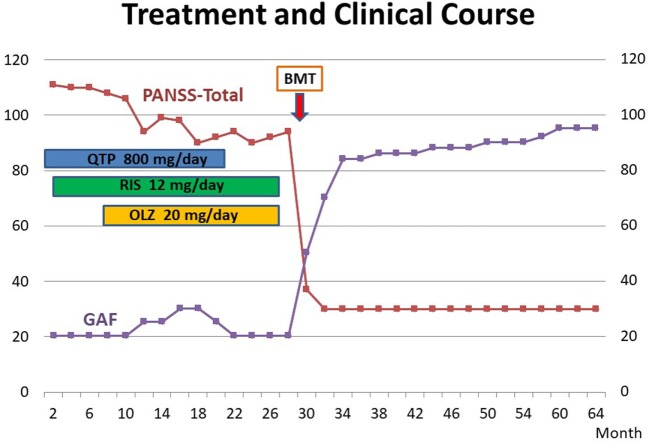
The authors present the case of a 24-year-old male with treatment-resistant schizophrenia, with predominant severe delusion and hallucination, who received bone marrow transplantation (BMT) for acute myeloid leukemia. After BMT, he showed a remarkable reduction in psychotic symptoms without administration of neuroleptics. He also showed drastic improvement in social functioning. Follow-up evaluations 2 and 4 years after BMT showed persistent significant improvement of the psychotic state and social functioning. Recent findings show that the major underlying pathogenic mechanism of schizophrenia is immune dysregulation. Thus, conceptually, BMT, a cellular therapy, that facilitates the counteractive processes of balancing inflammation by immune regulation, could produce beneficial clinical effects in patients with treatment-resistant schizophrenia. Further studies are required to define the true benefits of BMT for the possible curative treatment of schizophrenia.
作者报告了一例24岁患有难治性精神分裂症的男性病例,其主要症状为严重的妄想和幻觉,该患者因急性髓系白血病接受了骨髓移植(BMT)。骨髓移植后,在未使用抗精神病药物的情况下,他的精神病症状显著减轻。他的社会功能也有了显著改善。骨髓移植后2年和4年的随访评估显示,其精神状态和社会功能持续显著改善。最近的研究结果表明,精神分裂症的主要潜在致病机制是免疫失调。因此,从概念上讲,骨髓移植作为一种细胞疗法,通过免疫调节促进平衡炎症的对抗过程,可能对难治性精神分裂症患者产生有益的临床效果。需要进一步的研究来确定骨髓移植对精神分裂症可能的治愈性治疗的真正益处。