Howes O D, McCutcheon R
Department of Psychosis Studies, Institute of Psychiatry, Psychology & Neuroscience, King's College London, London, UK.
MRC London Institute of Medical Sciences, Hammersmith Hospital, London, UK.
Transl Psychiatry. 2017 Feb 7;7(2):e1024. doi: 10.1038/tp.2016.278.
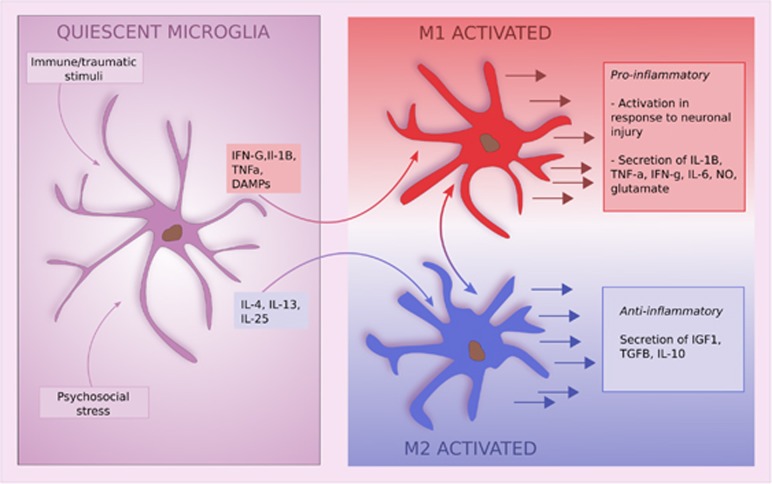
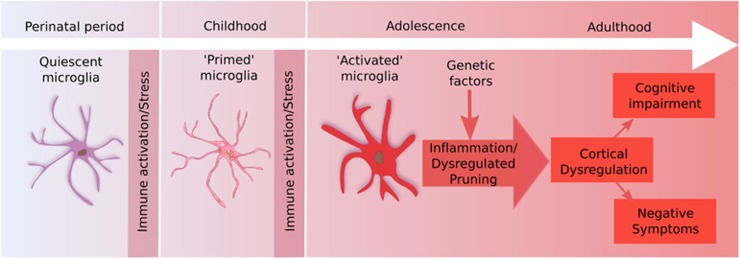
An interaction between external stressors and intrinsic vulnerability is one of the longest standing pathoaetiological explanations for schizophrenia. However, novel lines of evidence from genetics, preclinical studies, epidemiology and imaging have shed new light on the mechanisms that may underlie this, implicating microglia as a key potential mediator. Microglia are the primary immune cells of the central nervous system. They have a central role in the inflammatory response, and are also involved in synaptic pruning and neuronal remodeling. In addition to immune and traumatic stimuli, microglial activation occurs in response to psychosocial stress. Activation of microglia perinatally may make them vulnerable to subsequent overactivation by stressors experienced in later life. Recent advances in genetics have shown that variations in the complement system are associated with schizophrenia, and this system has been shown to regulate microglial synaptic pruning. This suggests a mechanism via which genetic and environmental influences may act synergistically and lead to pathological microglial activation. Microglial overactivation may lead to excessive synaptic pruning and loss of cortical gray matter. Microglial mediated damage to stress-sensitive regions such as the prefrontal cortex and hippocampus may lead directly to cognitive and negative symptoms, and account for a number of the structural brain changes associated with the disorder. Loss of cortical control may also lead to disinhibition of subcortical dopamine-thereby leading to positive psychotic symptoms. We review the preclinical and in vivo evidence for this model and consider the implications this has for treatment, and future directions.
外部应激源与内在易损性之间的相互作用是对精神分裂症由来已久的病理病因学解释之一。然而,来自遗传学、临床前研究、流行病学和影像学的新证据为其潜在机制带来了新的启示,表明小胶质细胞是一个关键的潜在介导因素。小胶质细胞是中枢神经系统的主要免疫细胞。它们在炎症反应中起核心作用,还参与突触修剪和神经元重塑。除了免疫和创伤刺激外,小胶质细胞激活也会对心理社会应激作出反应。围产期小胶质细胞的激活可能使其在日后生活中易受应激源的过度激活。遗传学的最新进展表明,补体系统的变异与精神分裂症有关,且该系统已被证明可调节小胶质细胞的突触修剪。这提示了一种遗传和环境影响可能协同作用并导致病理性小胶质细胞激活的机制。小胶质细胞过度激活可能导致过度的突触修剪和皮质灰质丢失。小胶质细胞介导的对前额叶皮质和海马体等应激敏感区域的损伤可能直接导致认知和阴性症状,并解释了与该疾病相关的一些脑结构变化。皮质控制的丧失也可能导致皮质下多巴胺的去抑制,从而导致阳性精神病性症状。我们综述了该模型的临床前和体内证据,并考虑了其对治疗的意义以及未来的研究方向。