Woo Young Sik, Lee Kwang Hyuck, Lee Kyu Taek, Lee Jong Kyun, Kim Jong Man, Kwon Choon Hyuck David, Joh Jae-Won, Kang Danbee, Cho Juhee
Department of Interanl Medicine, Kangnam Sacred Heart Hospital, Hallym University College of Medicine Department of Medicine Department of Surgery Center for Clinical Epidemiology, Samsung Medical Center, Sungkyunkwan University School of Medicine Department of Health Sciences and Technology, SAIHST, Sungkyunkwan University, Seoul, Republic of Korea Departments of Epidemiology and Social, Behavior and Society, Johns Hopkins Bloomberg School of Public Health Department of Epidemiology, Johns Hopkins Medical Institutions, Baltimore, USA.
Medicine (Baltimore). 2017 Oct;96(40):e6892. doi: 10.1097/MD.0000000000006892.
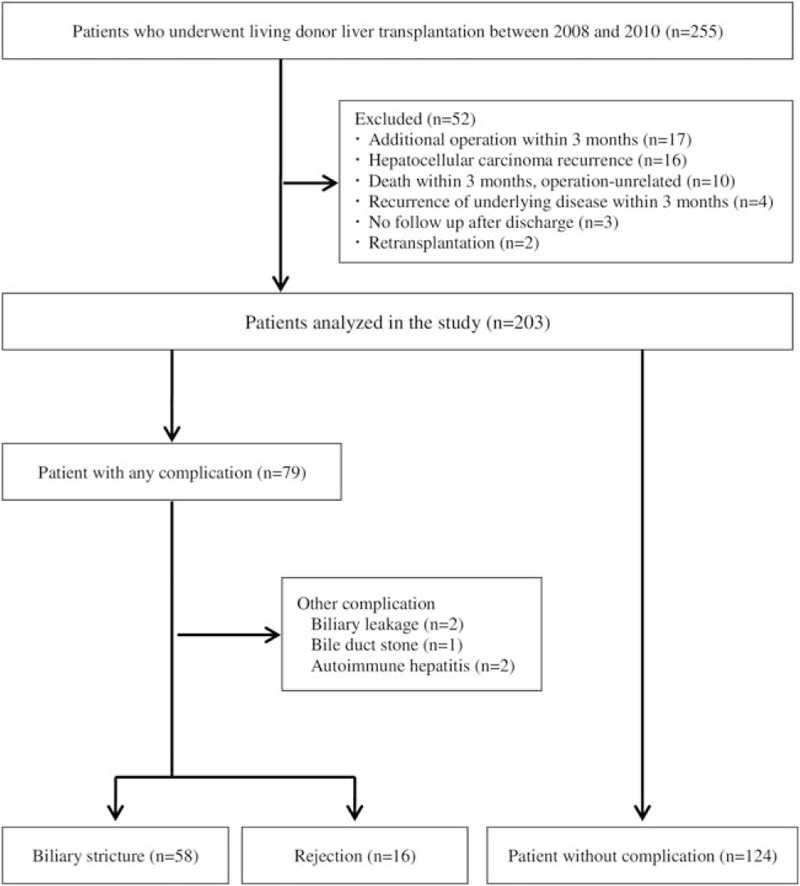
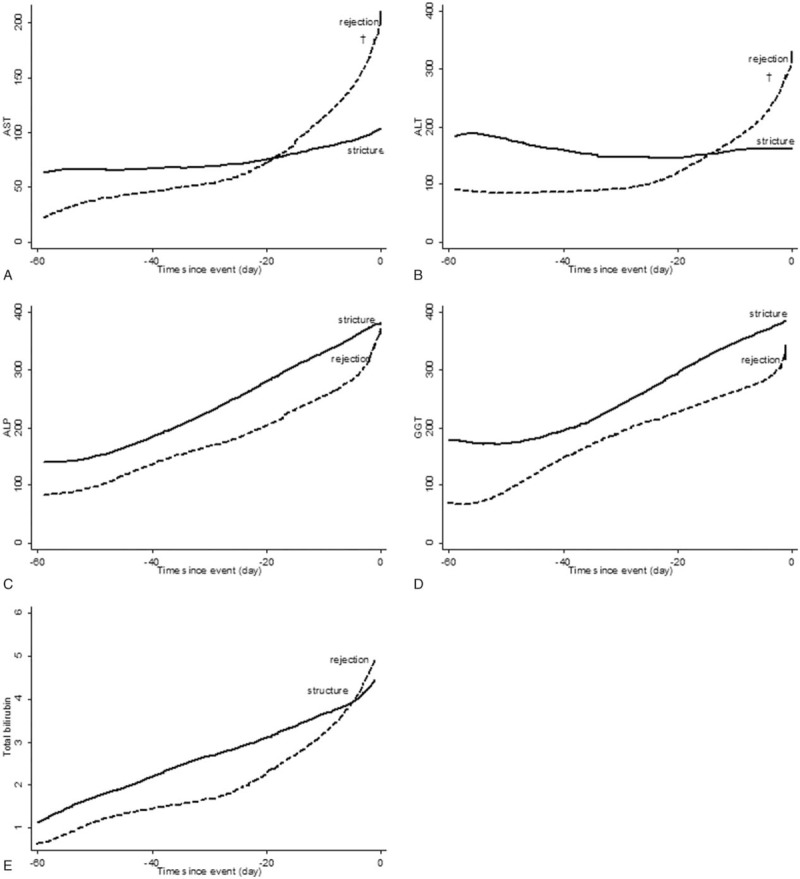
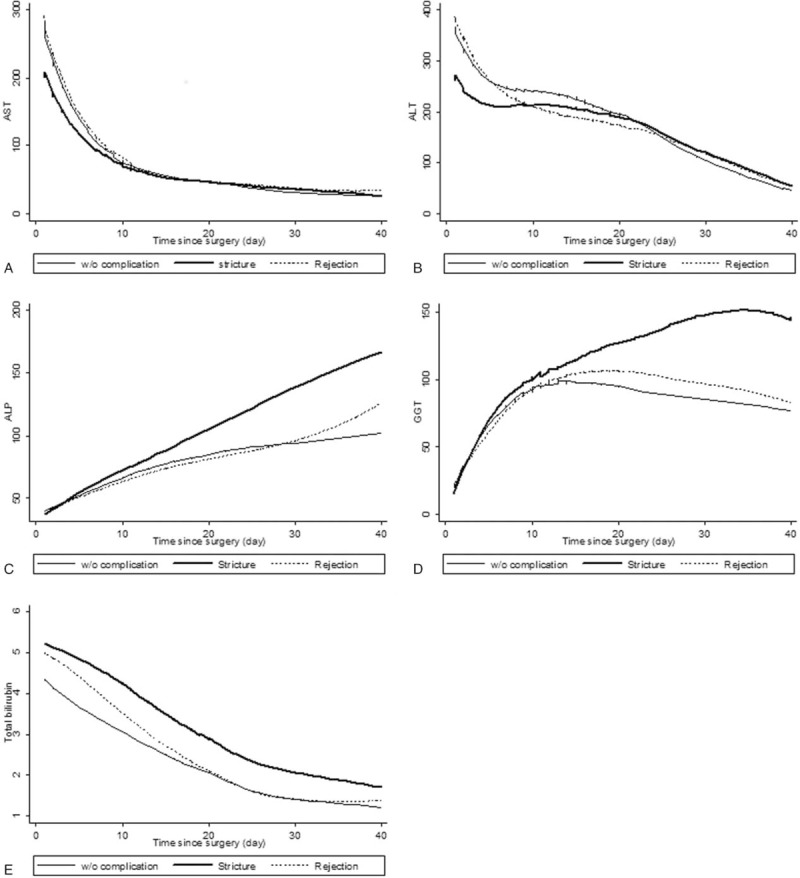
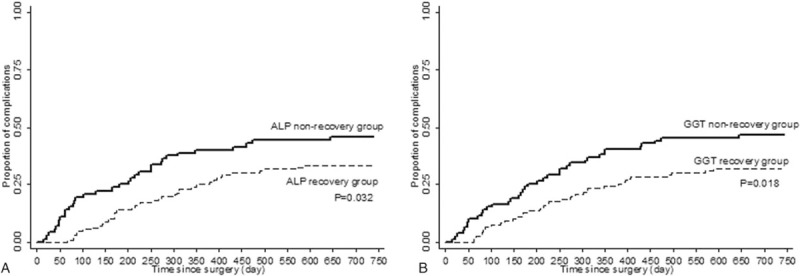
There is no known useful clinical parameter that can specifically predict a biliary stricture and differentiate it from other related complications after living donor liver transplantations (LDLT). The aims of this study were to determine whether the changes of liver enzymes can predict postoperative biliary stricture apart from other complications. We reviewed the medical records of 203 patients who underwent LDLT with duct to duct anastomosis from 2008 to 2010. The longitudinal changes of liver enzyme over time and the occurrence of complication were evaluated. A total of 124 patients had no complication up to 2 years after LDLT, and 74 patients had complications including biliary stricture and graft rejection. Complications developed more frequently in patients who's alkaline phosphatase (ALP) and gamma-glutamyl transpeptidase (GGT) did not return to the baseline plateau at 30 days after LDLT (ALP; P = .045, GGT; P = .047). Aspartate transaminase (AST) and alanine transaminase (ALT) increased continuously until the diagnosis of complication in both stricture and rejection groups with more rapid increase in enzymes in the rejection versus stricture group (P < .05). In addition, AST and ALT were 2-fold higher in the rejection than the stricture group at the diagnosis of each complication (AST; P < .05, ALT; P < .05). The increasing slope and final levels of AST and ALT are potentially helpful parameters to differentiate rejection and stricture, the 2 most common posttransplantation complications.
目前尚无已知的有用临床参数能够特异性预测活体肝移植(LDLT)术后的胆管狭窄,并将其与其他相关并发症区分开来。本研究的目的是确定肝酶变化能否预测术后胆管狭窄以及与其他并发症相鉴别。我们回顾了2008年至2010年接受胆管对胆管吻合术的203例LDLT患者的病历。评估了肝酶随时间的纵向变化以及并发症的发生情况。共有124例患者在LDLT术后2年内无并发症,74例患者出现包括胆管狭窄和移植排斥反应在内的并发症。在LDLT术后30天碱性磷酸酶(ALP)和γ-谷氨酰转肽酶(GGT)未恢复至基线平台的患者中,并发症发生更为频繁(ALP;P = 0.045,GGT;P = 0.047)。在狭窄组和排斥反应组中,天冬氨酸转氨酶(AST)和丙氨酸转氨酶(ALT)在并发症诊断前持续升高,且排斥反应组酶升高速度比狭窄组更快(P < 0.05)。此外,在每种并发症诊断时,排斥反应组的AST和ALT比狭窄组高2倍(AST;P < 0.05,ALT;P < 0.05)。AST和ALT的升高斜率及最终水平可能是区分排斥反应和狭窄这两种最常见移植后并发症的有用参数。