Tanaka Miwa, Yoshimoto Toyoki, Nakamura Takuro
Division of Carcinogenesis, The Cancer Institute, Japanese Foundation for Cancer Research, Tokyo, Japan.
Department of Pathology, Toranomon Hospital, Tokyo, Japan.
Cancer Sci. 2017 Dec;108(12):2319-2325. doi: 10.1111/cas.13413. Epub 2017 Oct 25.
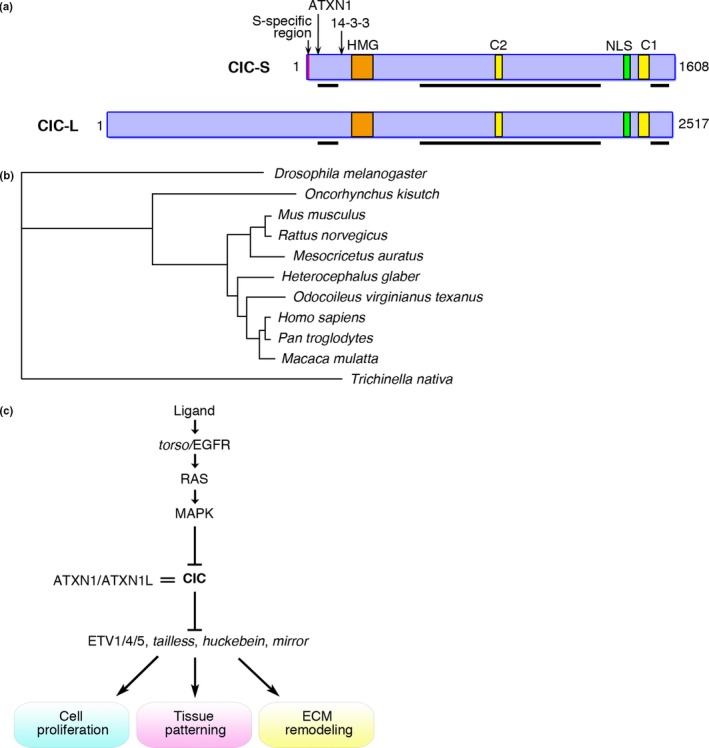
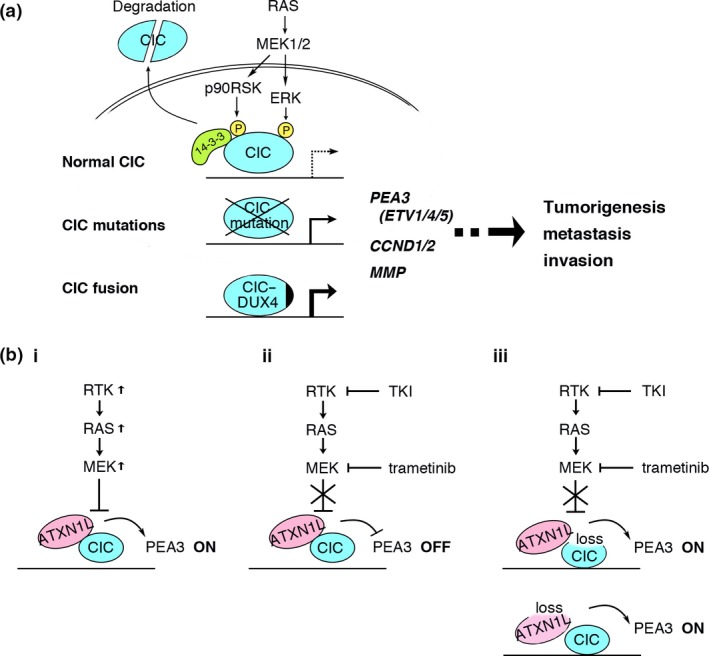
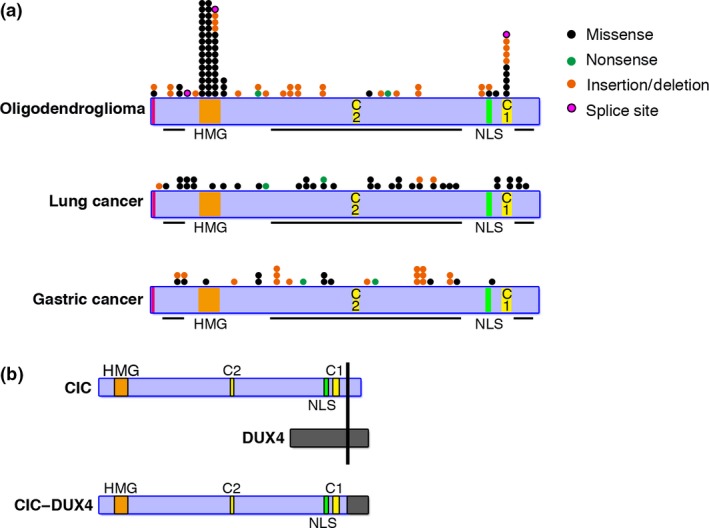
CIC/Capicua is an HMG-box transcription factor that is well conserved during evolution. CIC recognizes the T(G/C)AATG(A/G)A sequence and represses its target genes, such as PEA3 family genes. The receptor tyrosine kinase/RAS/MAPK signals downregulate CIC and relieves CIC's target genes from the transrepressional activity; CIC thus acts as an important downstream molecule of the pathway and as a tumor suppressor. CIC loss-of-function mutations are frequently observed in several human neoplasms such as oligodendroglioma, and lung and gastric carcinoma. CIC is also involved in chromosomal translocation-associated gene fusions in highly aggressive small round cell sarcoma that is biologically and clinically distinct from Ewing sarcoma. In these mutations, PEA3 family genes and other important target genes are upregulated, inducing malignant phenotypes. Downregulation of CIC abrogates the effect of MAPK inhibitors, suggesting its potential role as an important modifier of molecular target therapies for cancer. These data reveal the importance of CIC as a key molecule in signal transduction, carcinogenesis, and developing novel therapies.
CIC/Capicua是一种在进化过程中高度保守的HMG盒转录因子。CIC识别T(G/C)AATG(A/G)A序列并抑制其靶基因,如PEA3家族基因。受体酪氨酸激酶/RAS/MAPK信号下调CIC并解除CIC对靶基因的反式抑制活性;因此,CIC作为该信号通路的重要下游分子和肿瘤抑制因子发挥作用。CIC功能丧失突变在几种人类肿瘤中经常出现,如少突胶质细胞瘤、肺癌和胃癌。CIC还参与了高侵袭性小圆细胞肉瘤中与染色体易位相关的基因融合,这种肉瘤在生物学和临床上与尤因肉瘤不同。在这些突变中,PEA3家族基因和其他重要靶基因上调,诱导恶性表型。CIC的下调消除了MAPK抑制剂的作用,表明其作为癌症分子靶向治疗重要调节因子的潜在作用。这些数据揭示了CIC作为信号转导、致癌作用和开发新疗法的关键分子的重要性。