Centre for Gerontology and Rehabilitation, School of Medicine, University College Cork, Cork, Ireland.
Mercy University Hospital, Cork, Ireland.
Age Ageing. 2018 Jan 1;47(1):61-68. doi: 10.1093/ageing/afx149.
screening for cognitive impairment in Emergency Department (ED) requires short, reliable tools.
to validate the 4AT and 6-Item Cognitive Impairment Test (6-CIT) for ED dementia and delirium screening.
diagnostic accuracy study.
SETTING/SUBJECTS: attendees aged ≥70 years in a tertiary care hospital's ED.
trained researchers assessed participants using the Standardised Mini Mental State Examination, Delirium Rating Scale-Revised 98 and Informant Questionnaire on Cognitive Decline in the Elderly, informing ultimate expert diagnosis using Diagnostic and Statistical Manual of Mental Disorders (DSM-V) criteria for dementia and delirium (reference standards). Another researcher blindly screened each participant, within 3 h, using index tests 4AT and 6-CIT.
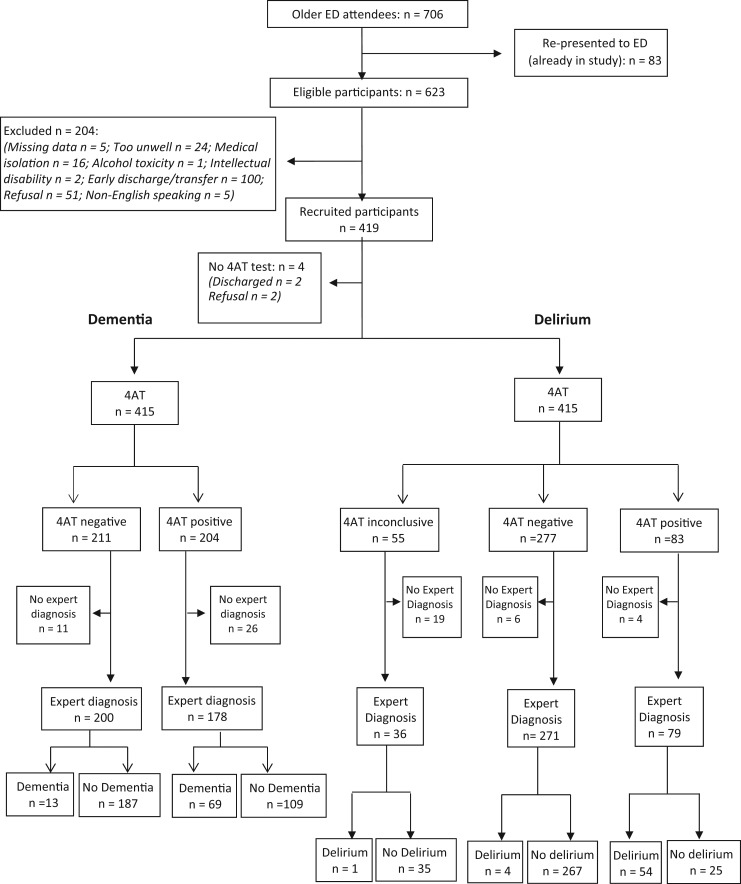
of 419 participants (median age 77 years), 15.2% had delirium and 21.5% had dementia. For delirium detection, 4AT had positive predictive value (PPV) 0.68 (95% confidence intervals: 0.58-0.79) and negative predictive value (NPV) 0.99 (0.97-1.00). At a pre-specified 9/10 cut-off (9 is normal), 6-CIT had PPV 0.35 (0.27-0.44) and NPV 0.98 (0.95-0.99). Importantly, 52% of participants had no family present. A novel algorithm for scoring 4AT item 4 where collateral history is unavailable (score 4 if items 2-3 score ≥1; score 0 if items 1-3 score is 0) proved reliable; PPV 0.65 (0.54-0.76) and NPV 0.99 (0.97-1.00). For dementia detection, 4AT had PPV 0.39 (0.32-0.46) and NPV 0.94 (0.89-0.96); 6-CIT had PPV 0.46 (0.37-0.55) and NPV 0.94 (0.90-0.97).
6-CIT and 4AT accurately exclude delirium and dementia in older ED attendees. 6-CIT does not require collateral history but has lower PPV for delirium.
在急诊部(ED)进行认知障碍筛查需要使用简短且可靠的工具。
验证 4AT 和 6 项认知障碍测试(6-CIT)在 ED 痴呆和谵妄筛查中的作用。
诊断准确性研究。
地点/对象:在一家三级护理医院的 ED 中,年龄≥70 岁的就诊者。
经过培训的研究人员使用标准化简易精神状态检查、修订后的 98 项谵妄评定量表和认知衰退简易量表-知情者问卷评估参与者,使用《精神障碍诊断与统计手册》(DSM-V)标准诊断痴呆和谵妄(参考标准)告知最终的专家诊断。另一位研究人员在 3 小时内使用 4AT 和 6-CIT 等指标对每位参与者进行盲筛。
419 名参与者(中位数年龄为 77 岁)中,15.2%患有谵妄,21.5%患有痴呆。在检测谵妄时,4AT 的阳性预测值(PPV)为 0.68(95%置信区间:0.58-0.79),阴性预测值(NPV)为 0.99(0.97-1.00)。在预先指定的 9/10 切点(9 分正常)下,6-CIT 的 PPV 为 0.35(0.27-0.44),NPV 为 0.98(0.95-0.99)。重要的是,52%的参与者没有家属在场。对于无法获取旁证病史的 4AT 项目 4 打分的新算法(如果项目 2-3 的得分≥1,则记 4 分;如果项目 1-3 的得分为 0,则记 0 分)被证明是可靠的;PPV 为 0.65(0.54-0.76),NPV 为 0.99(0.97-1.00)。在检测痴呆时,4AT 的 PPV 为 0.39(0.32-0.46),NPV 为 0.94(0.89-0.96);6-CIT 的 PPV 为 0.46(0.37-0.55),NPV 为 0.94(0.90-0.97)。
6-CIT 和 4AT 可准确排除老年 ED 就诊者的谵妄和痴呆。6-CIT 不需要旁证病史,但对谵妄的阳性预测值较低。