Regional Geriatric Program of Toronto and Sunnybrook Health Sciences Centre, Toronto, Ontario, Canada.
Department of Medicine, Faculty of Medicine, University of Toronto, Toronto, Ontario, Canada.
Age Ageing. 2018 Jan 1;47(1):112-119. doi: 10.1093/ageing/afx128.
older patients admitted to hospitals are at risk for hospital-acquired morbidity related to immobility. The aim of this study was to implement and evaluate an evidence-based intervention targeting staff to promote early mobilisation in older patients admitted to general medical inpatient units.
the early mobilisation implementation intervention for staff was multi-component and tailored to local context at 14 academic hospitals in Ontario, Canada. The primary outcome was patient mobilisation. Secondary outcomes included length of stay (LOS), discharge destination, falls and functional status. The targeted patients were aged ≥ 65 years and admitted between January 2012 and December 2013. The intervention was evaluated over three time periods-pre-intervention, during and post-intervention using an interrupted time series design.
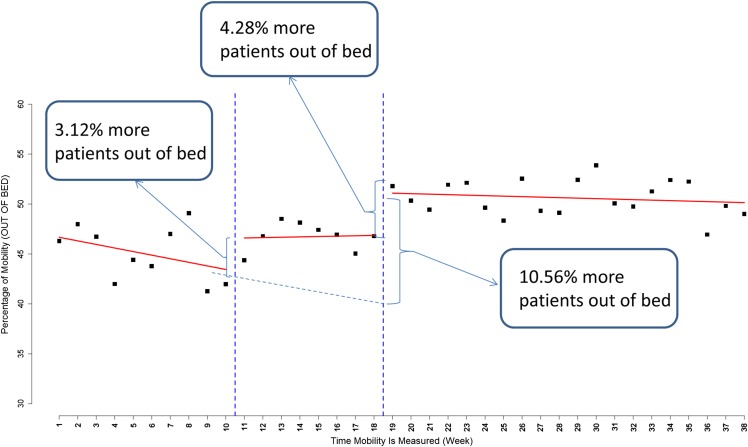
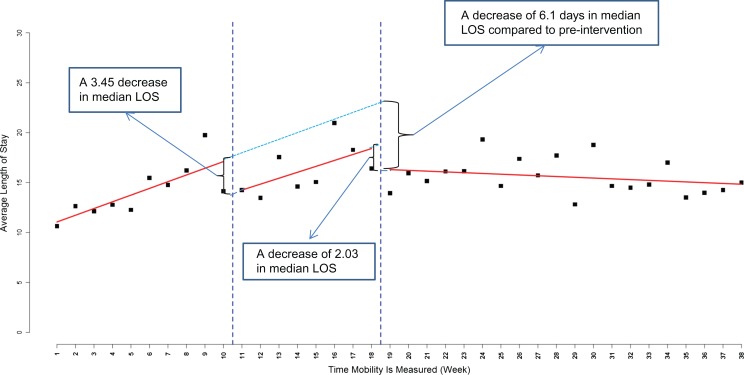
in total, 12,490 patients (mean age 80.0 years [standard deviation 8.36]) were included in the overall analysis. An increase in mobilisation was observed post-intervention, where significantly more patients were out of bed daily (intercept difference = 10.56%, 95% CI: [4.94, 16.18]; P < 0.001) post-intervention compared to pre-intervention. Hospital median LOS was significantly shorter during the intervention period (intercept difference = -3.45 days, 95% CI: [-6.67,-0.23], P = 0.0356) compared to pre-intervention. It continued to decrease post-intervention with significantly fewer days in hospital (intercept difference= -6.1, 95% CI: [-11,-1.2]; P = 0.015) in the post-intervention period compared to pre-intervention.
this is a large-scale study evaluating an implementation strategy for early mobilisation in older, general medical inpatients. The positive outcome of this simple intervention on an important functional goal of getting more patients out of bed is a striking success for improving care for hospitalised older patients.
入住医院的老年患者面临与活动受限相关的医院获得性发病率的风险。本研究的目的是实施和评估一项针对工作人员的循证干预措施,以促进在普通内科住院患者中进行早期活动。
针对工作人员的早期活动实施干预措施是多方面的,并根据加拿大安大略省 14 家学术医院的当地情况进行了调整。主要结果是患者的活动情况。次要结果包括住院时间(LOS)、出院目的地、跌倒和功能状态。目标患者年龄≥65 岁,入院时间为 2012 年 1 月至 2013 年 12 月。该干预措施在三个时间段进行评估:干预前、干预期间和干预后,采用中断时间序列设计。
共有 12490 名患者(平均年龄 80.0 岁[标准差 8.36])纳入了总体分析。观察到干预后活动量增加,每日下床的患者明显增多(截距差异=10.56%,95%CI:[4.94,16.18];P<0.001)。与干预前相比,干预期间医院中位 LOS 显著缩短(截距差异=-3.45 天,95%CI:[-6.67,-0.23];P=0.0356)。与干预前相比,干预后 LOS 持续缩短,出院天数明显减少(截距差异=-6.1,95%CI:[-11,-1.2];P=0.015)。
这是一项评估针对普通内科住院老年患者早期活动实施策略的大规模研究。该简单干预措施在使更多患者下床这一重要功能目标上取得的积极成果,是改善住院老年患者护理的显著成功。