Zhao Wenxue, Siegel David, Biton Anne, Tonqueze Olivier Le, Zaitlen Noah, Ahituv Nadav, Erle David J
Lung Biology Center, Department of Medicine, University of California San Francisco, 4th St, San Francisco, CA 94158, USA.
Centre de Bioinformatique, Biostatistique et Biologie Intégrative, C3BI, USR 3756 Institut Pasteur et CNRS, 25-28 Rue du Dr Roux, Paris 75015, France.
Nucleic Acids Res. 2017 Oct 13;45(18):10800-10810. doi: 10.1093/nar/gkx675.
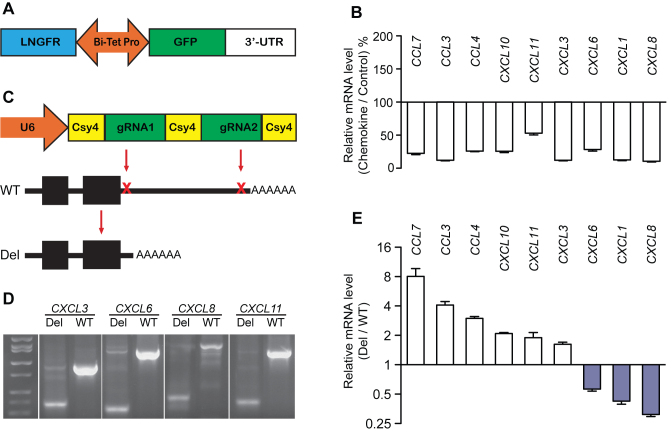
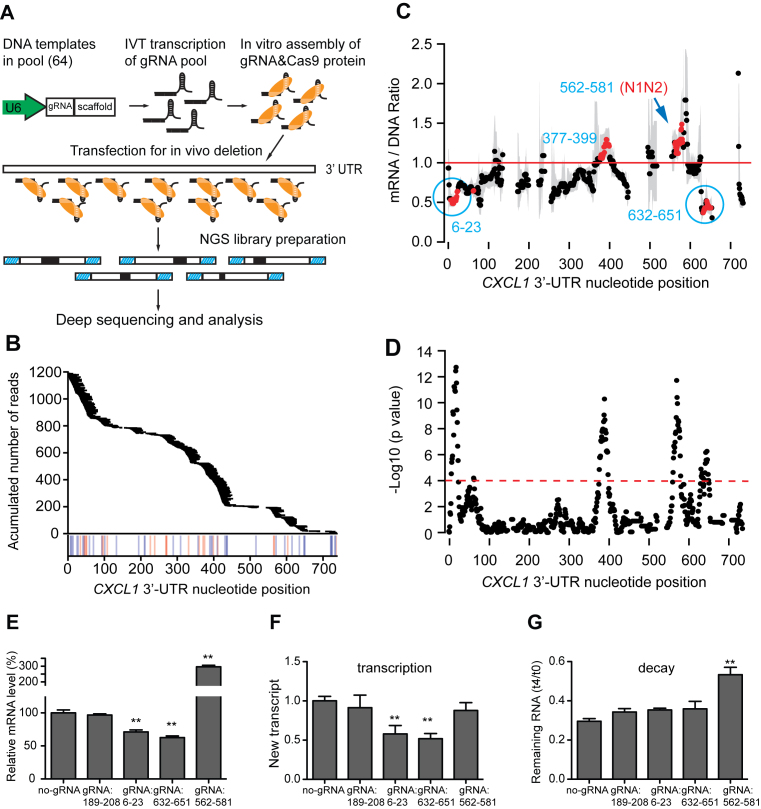
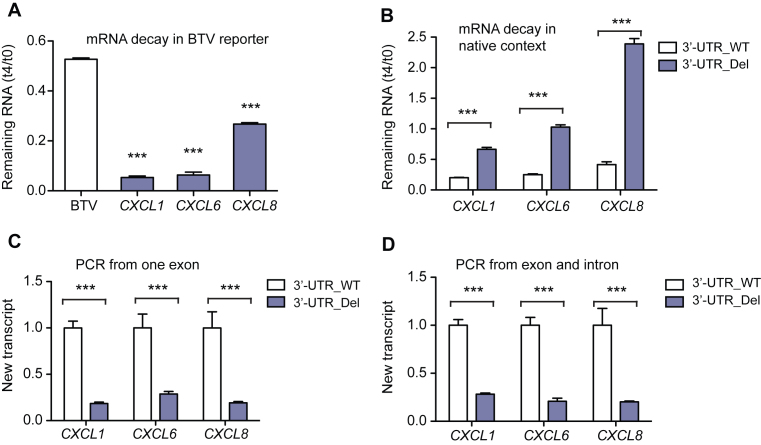
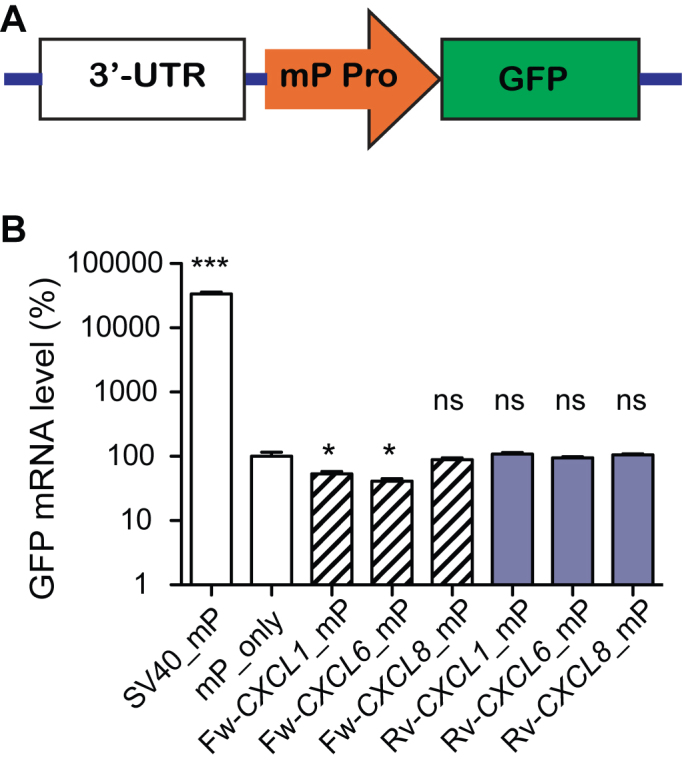
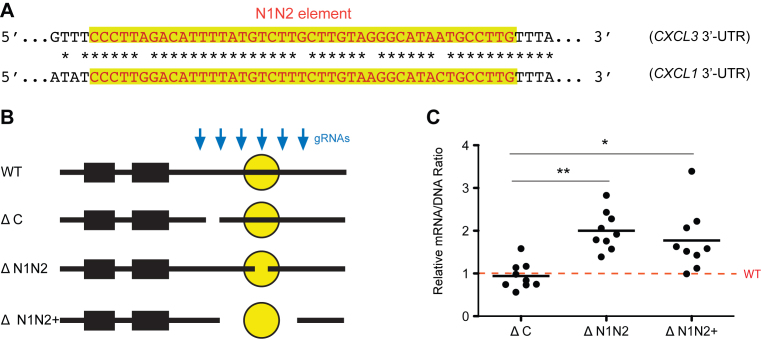
Many studies using reporter assays have demonstrated that 3' untranslated regions (3'-UTRs) regulate gene expression by controlling mRNA stability and translation. Due to intrinsic limitations of heterologous reporter assays, we sought to develop a gene editing approach to investigate the regulatory activity of 3'-UTRs in their native context. We initially used dual-CRISPR (clustered, regularly interspaced, short palindromic repeats)-Cas9 targeting to delete DNA regions corresponding to nine chemokine 3'-UTRs that destabilized mRNA in a reporter assay. Targeting six chemokine 3'-UTRs increased chemokine mRNA levels as expected. However, targeting CXCL1, CXCL6 and CXCL8 3'-UTRs unexpectedly led to substantial mRNA decreases. Metabolic labeling assays showed that targeting these three 3'-UTRs increased mRNA stability, as predicted by the reporter assay, while also markedly decreasing transcription, demonstrating an unexpected role for 3'-UTR sequences in transcriptional regulation. We further show that CRISPR-Cas9 targeting of specific 3'-UTR elements can be used for modulating gene expression and for highly parallel localization of active 3'-UTR elements in the native context. Our work demonstrates the duality and complexity of 3'-UTR sequences in regulation of gene expression and provides a useful approach for modulating gene expression and for functional annotation of 3'-UTRs in the native context.
许多使用报告基因检测的研究表明,3'非翻译区(3'-UTR)通过控制mRNA稳定性和翻译来调节基因表达。由于异源报告基因检测存在内在局限性,我们试图开发一种基因编辑方法来研究3'-UTR在其天然环境中的调控活性。我们最初使用双CRISPR(成簇规律间隔短回文重复序列)-Cas9靶向删除与九个趋化因子3'-UTR对应的DNA区域,这些区域在报告基因检测中会使mRNA不稳定。靶向六个趋化因子3'-UTR如预期那样增加了趋化因子mRNA水平。然而,靶向CXCL1、CXCL6和CXCL8的3'-UTR却意外地导致mRNA大幅下降。代谢标记分析表明,靶向这三个3'-UTR增加了mRNA稳定性,正如报告基因检测所预测的那样,同时也显著降低了转录,这表明3'-UTR序列在转录调控中具有意想不到的作用。我们进一步表明,CRISPR-Cas9靶向特定的3'-UTR元件可用于调节基因表达以及在天然环境中对活性3'-UTR元件进行高度平行定位。我们的工作证明了3'-UTR序列在基因表达调控中的双重性和复杂性,并为调节基因表达以及在天然环境中对3'-UTR进行功能注释提供了一种有用的方法。