Kang Byungjoon, Hong Soon Hyeok
Department of Chemistry , College of Natural Sciences , Seoul National University , 1 Gwanak-ro , Seoul 08826 , South Korea . Email:
Chem Sci. 2017 Sep 1;8(9):6613-6618. doi: 10.1039/c7sc02516e. Epub 2017 Jul 24.
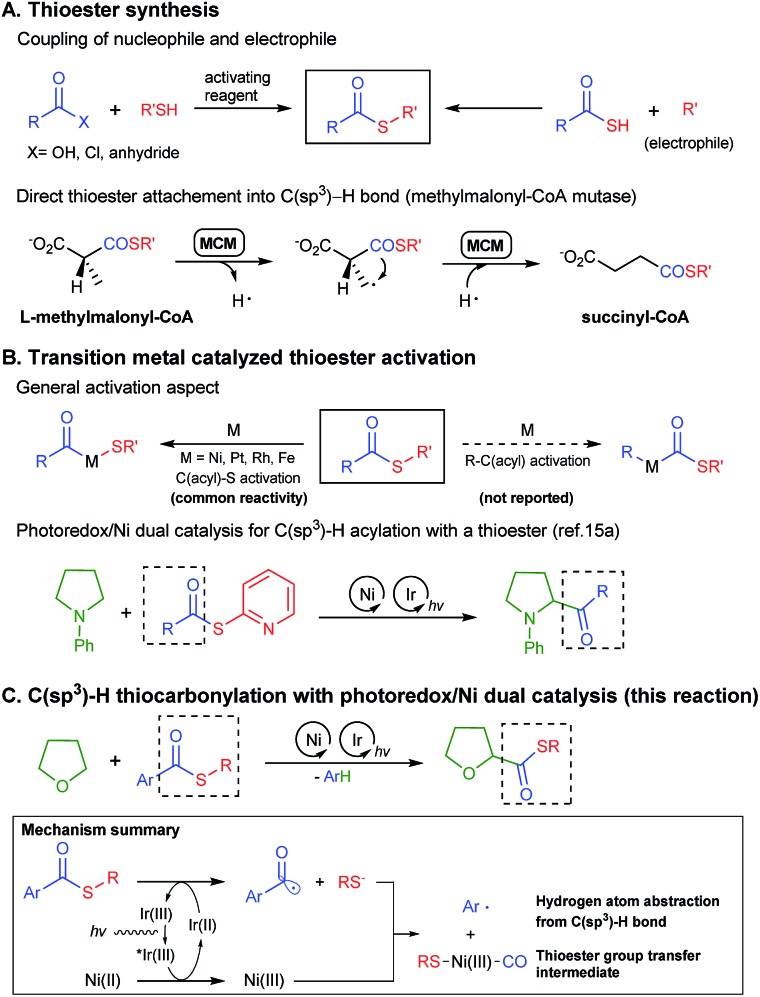
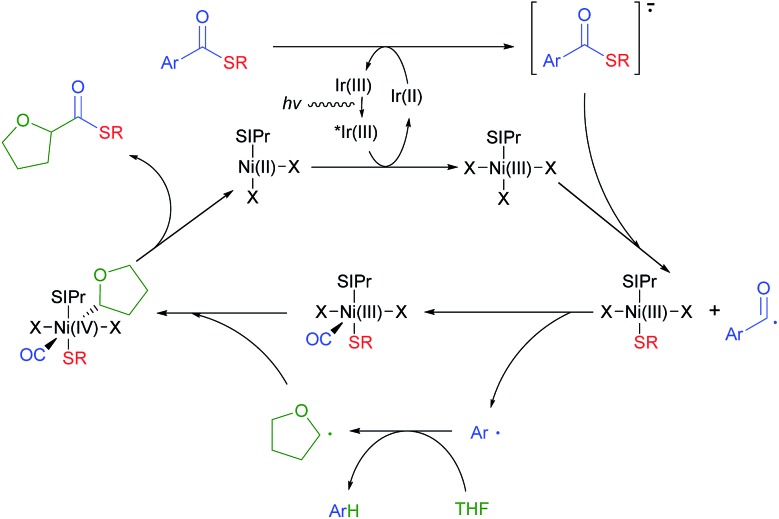
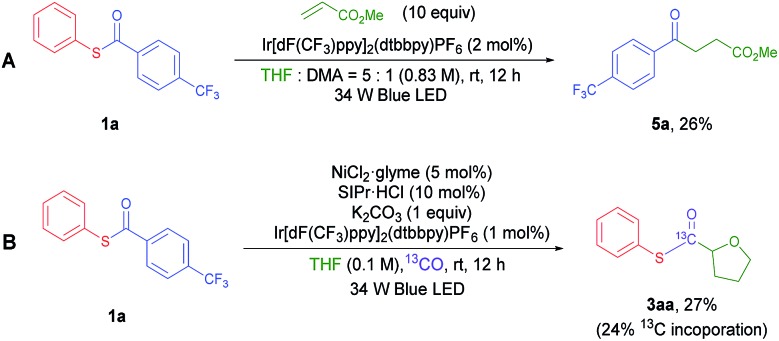
The first direct C(sp)-H thiocarbonylation reaction is achieved by visible light photoredox/Ni dual catalysis. The thioester group of thiobenzoate is transferred to the α-oxy carbon of various cyclic/acyclic ethers, which is the opposite to the commonly expected chemical reactivity involving acyl group transfer the weaker C(acyl)-S activation. Through mechanistic studies, we proposed that the reaction is initiated by photocatalytic reduction and fragmentation of the thioester into an acyl radical and a thiolate. A nickel complex binds to the thiolate and induces the decarbonylation of the acyl radical to form an aryl radical, which abstracts hydrogen from the α-oxy carbon of the ether. The resulting α-oxy C(sp) centered radical re-binds to the (RS)(CO)Ni complex, which undergoes CO migratory insertion and reductive elimination to give the desired thioester product.
通过可见光光氧化还原/Ni双催化实现了首例直接的C(sp)-H硫羰基化反应。硫代苯甲酸酯的硫酯基团转移至各种环状/非环状醚的α-氧碳上,这与通常预期的涉及酰基转移(较弱的C(酰基)-S活化)的化学反应性相反。通过机理研究,我们提出该反应由硫酯的光催化还原和碎片化引发,生成一个酰基自由基和一个硫醇盐。镍配合物与硫醇盐结合并诱导酰基自由基脱羰形成芳基自由基,该芳基自由基从醚的α-氧碳上夺取氢。生成的以α-氧C(sp)为中心的自由基重新与(RS)(CO)Ni配合物结合,该配合物经过CO迁移插入和还原消除得到所需的硫酯产物。