
ESRP1在卵巢癌中过表达,并促进卵巢癌细胞从间充质表型转变为上皮表型。
ESRP1 is overexpressed in ovarian cancer and promotes switching from mesenchymal to epithelial phenotype in ovarian cancer cells.
作者信息
Jeong H M, Han J, Lee S H, Park H-J, Lee H J, Choi J-S, Lee Y M, Choi Y-L, Shin Y K, Kwon M J
机构信息
Laboratory of Molecular Pathology and Cancer Genomics, College of Pharmacy, Seoul National University, Seoul, Korea.
Gencurix Inc., 242 Digital-ro, Seoul, Korea.
出版信息
Oncogenesis. 2017 Oct 9;6(10):e389. doi: 10.1038/oncsis.2017.87.
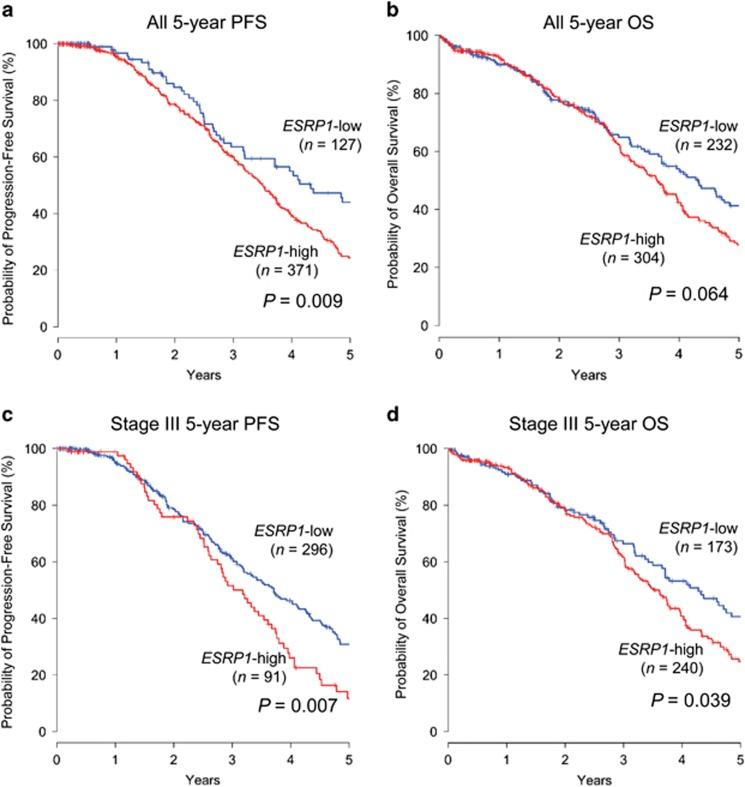
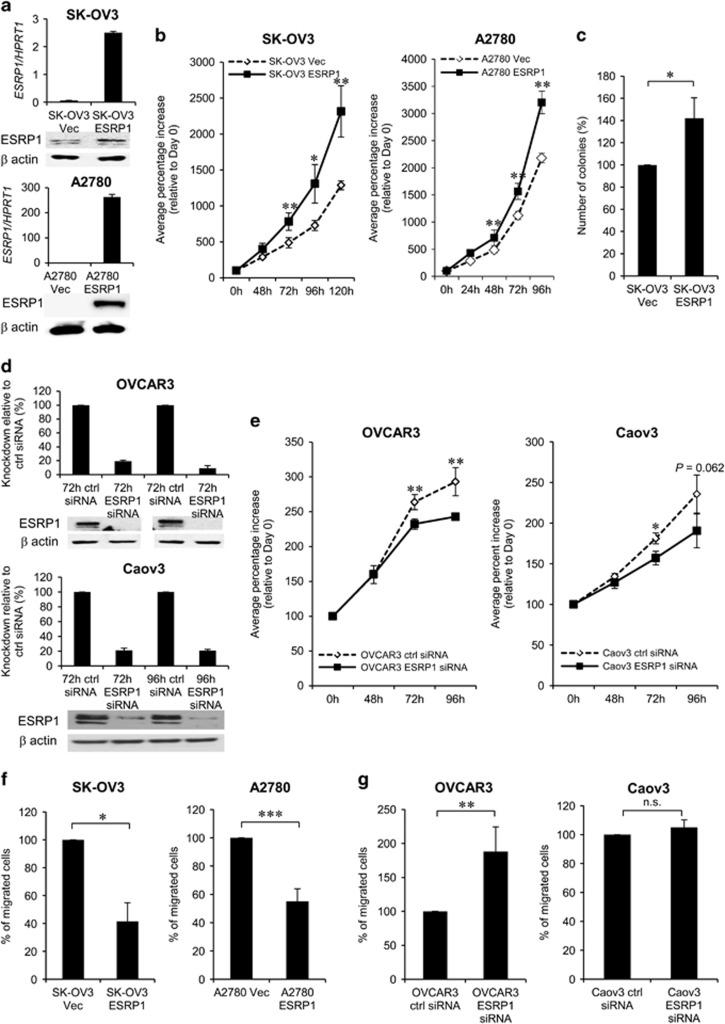
Epithelial splicing regulatory protein 1 (ESRP1) and 2 (ESRP2), epithelial cell-specific regulators of alternative splicing, are downregulated during the epithelial-mesenchymal transition (EMT). These factors have roles in tumor progression and metastasis in some cancers; however, their expression and function in ovarian cancer (OC) remain unclear. We found that ESRP1 and ESRP2 mRNAs were expressed at higher levels in OC cells than in immortalized ovarian surface epithelial (IOSE) cells, and confirmed their overexpression in OC tissues at the protein level. The Cancer Genome Atlas (TCGA) data analysis revealed frequent gene amplification of ESRP1 in OC tissues; however, we detected no significant correlation between ESRP1 gene copy number and gene expression in OC cells. Importantly, expression of ESRP1 and ESRP2 was inversely correlated with DNA methylation in OC cells, and ESRP2 overexpression in OC tissues was significantly associated with DNA hypomethylation. Notably, survival analysis using TCGA data from 541 OC tissues revealed that high ESRP1 expression was significantly associated with shorter 5-year survival of patients. Ectopic ESRP1 expression in mesenchymal OC cells promoted cell proliferation but suppressed cell migration. Furthermore, we found that ESRP1 drives a switch from mesenchymal to epithelial phenotype characterized by reduced cell migration in association with induction of epithelial cell-specific variant of CD44 and ENAH. Taken together, our findings suggest that an epigenetic mechanism is involved in ESRP1 overexpression, and that ESRP1 has a role in OC progression.
上皮剪接调节蛋白1(ESRP1)和2(ESRP2)是上皮细胞特异性的可变剪接调节因子,在上皮-间质转化(EMT)过程中表达下调。这些因子在某些癌症的肿瘤进展和转移中发挥作用;然而,它们在卵巢癌(OC)中的表达和功能仍不清楚。我们发现,ESRP1和ESRP2 mRNA在OC细胞中的表达水平高于永生化卵巢表面上皮(IOSE)细胞,并在蛋白质水平上证实了它们在OC组织中的过表达。癌症基因组图谱(TCGA)数据分析显示OC组织中ESRP1基因频繁扩增;然而,我们未检测到OC细胞中ESRP1基因拷贝数与基因表达之间存在显著相关性。重要的是,ESRP1和ESRP2的表达与OC细胞中的DNA甲基化呈负相关,OC组织中ESRP2的过表达与DNA低甲基化显著相关。值得注意的是,使用来自541个OC组织的TCGA数据进行的生存分析显示,ESRP1高表达与患者较短的5年生存率显著相关。间充质OC细胞中异位表达ESRP1可促进细胞增殖,但抑制细胞迁移。此外,我们发现ESRP1驱动了从间充质表型到上皮表型的转变,其特征是细胞迁移减少,同时诱导了CD44和ENAH的上皮细胞特异性变体。综上所述,我们的研究结果表明,一种表观遗传机制参与了ESRP1的过表达,并且ESRP1在OC进展中发挥作用。



 Zotero 插件