
tRNA 基因拷贝数和氨基酸使用的共同适应影响三个生命领域的翻译速率。
Co-adaption of tRNA gene copy number and amino acid usage influences translation rates in three life domains.
机构信息
School of Life Science and Technology.
Centre for Informational Biology.
出版信息
DNA Res. 2017 Dec 1;24(6):623-633. doi: 10.1093/dnares/dsx030.
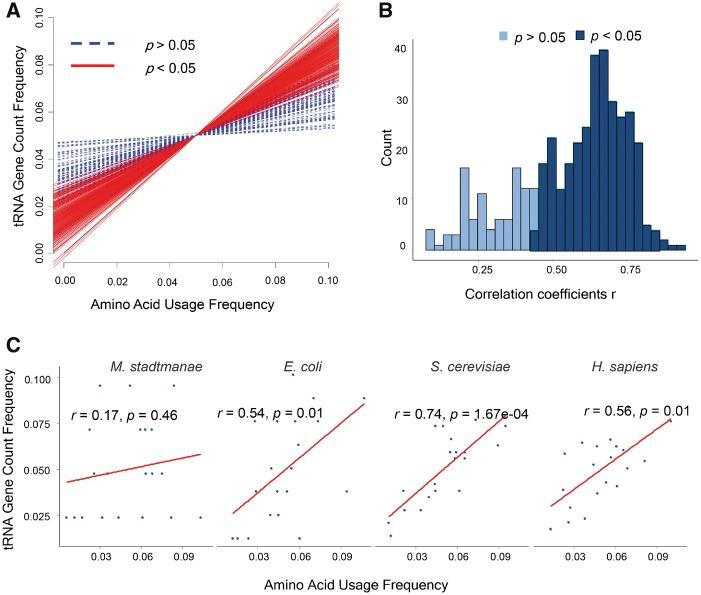
Although more and more entangled participants of translation process were realized, how they cooperate and co-determine the final translation efficiency still lacks details. Here, we reasoned that the basic translation components, tRNAs and amino acids should be consistent to maximize the efficiency and minimize the cost. We firstly revealed that 310 out of 410 investigated genomes of three domains had significant co-adaptions between the tRNA gene copy numbers and amino acid compositions, indicating that maximum efficiency constitutes ubiquitous selection pressure on protein translation. Furthermore, fast-growing and larger bacteria are found to have significantly better co-adaption and confirmed the effect of this pressure. Within organism, highly expressed proteins and those connected to acute responses have higher co-adaption intensity. Thus, the better co-adaption probably speeds up the growing of cells through accelerating the translation of special proteins. Experimentally, manipulating the tRNA gene copy number to optimize co-adaption between enhanced green fluorescent protein (EGFP) and tRNA gene set of Escherichia coli indeed lifted the translation rate (speed). Finally, as a newly confirmed translation rate regulating mechanism, the co-adaption reflecting translation rate not only deepens our understanding on translation process but also provides an easy and practicable method to improve protein translation rates and productivity.
尽管越来越多的翻译过程参与者被认识到,但它们如何合作以及共同决定最终的翻译效率仍缺乏细节。在这里,我们推断基本的翻译成分,tRNA 和氨基酸,应该保持一致,以最大限度地提高效率和最小化成本。我们首先揭示了在三个域的 410 个被调查基因组中,有 310 个具有 tRNA 基因拷贝数和氨基酸组成之间的显著协同适应,这表明最大效率构成了对蛋白质翻译的普遍选择压力。此外,快速生长和更大的细菌被发现具有更好的协同适应,并证实了这种压力的效果。在生物体内部,高表达的蛋白质和与急性反应有关的蛋白质具有更高的协同适应强度。因此,更好的协同适应可能通过加速特殊蛋白质的翻译来加速细胞的生长。在实验中,通过操纵 tRNA 基因拷贝数来优化增强型绿色荧光蛋白(EGFP)和大肠杆菌 tRNA 基因集之间的协同适应确实提高了翻译速度。最后,作为一种新确认的翻译速率调节机制,反映翻译速率的协同适应不仅加深了我们对翻译过程的理解,而且提供了一种简单可行的方法来提高蛋白质的翻译速率和生产力。



 Zotero 插件