Graham-Brown John, Hartley Catherine, Clough Helen, Kadioglu Aras, Baylis Matthew, Williams Diana J L
Department of Infection Biology, Institute of Infection and Global Health, University of Liverpool, Liverpool, United Kingdom.
Department of Epidemiology and Population Health, Institute of Infection and Global Health, University of Liverpool, Liverpool, United Kingdom.
Infect Immun. 2017 Dec 19;86(1). doi: 10.1128/IAI.00607-17. Print 2018 Jan.
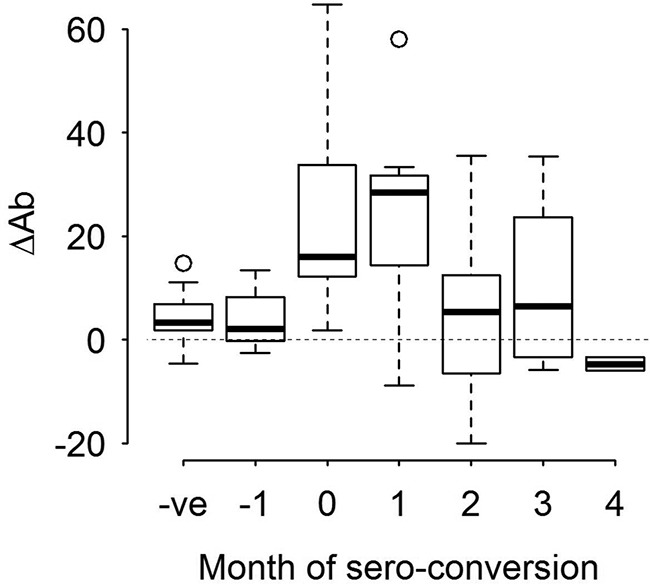
is a parasitic trematode of global importance in livestock. Control strategies reliant on anthelmintics are unsustainable due to the emergence of drug resistance. Vaccines are under development, but efficacies are variable. Evidence from experimental infection suggests that vaccine efficacy may be affected by parasite-induced immunomodulation. Little is known about the immune response to following natural exposure. Hence, we analyzed the immune responses over time in calves naturally exposed to infection. Cohorts of replacement dairy heifer calves ( = 42) with no prior exposure to , on three commercial dairy farms, were sampled over the course of a grazing season. Exposure was determined through an -specific serum antibody enzyme-linked immunosorbent assay (ELISA) and fluke egg counts. Concurrent changes in peripheral blood leukocyte subpopulations, lymphocyte proliferation, and cytokine responses were measured. Relationships between fluke infection and immune responses were analyzed by using multivariable linear mixed-effect models. All calves from one farm showed evidence of exposure, while cohorts from the remaining two farms remained negative over the grazing season. A type 2 immune response was associated with exposure, with increased interleukin-4 (IL-4) production, IL-5 transcription, and eosinophilia. Suppression of parasite-specific peripheral blood mononuclear cell (PBMC) proliferation was evident, while decreased mitogen-stimulated gamma interferon (IFN-γ) production suggested immunomodulation, which was not restricted to parasite-specific responses. Our findings show that the global immune response is modulated toward a nonproliferative type 2 state following natural challenge with This has implications in terms of the timing of the administration of vaccination programs and for host susceptibility to coinfecting pathogens.
是一种对全球家畜具有重要意义的寄生吸虫。由于耐药性的出现,依赖驱虫药的控制策略不可持续。疫苗正在研发中,但效果不一。实验性感染的证据表明,疫苗效果可能受寄生虫诱导的免疫调节影响。对于自然感染后的免疫反应知之甚少。因此,我们分析了自然感染吸虫的犊牛随时间的免疫反应。在三个商业奶牛场,对42头此前未接触过吸虫的后备奶牛犊牛群体在放牧季节进行了采样。通过吸虫特异性血清抗体酶联免疫吸附测定(ELISA)和吸虫卵计数确定感染情况。同时测量外周血白细胞亚群、淋巴细胞增殖和细胞因子反应的变化。使用多变量线性混合效应模型分析吸虫感染与免疫反应之间的关系。来自一个农场的所有犊牛都有感染迹象,而其余两个农场的群体在放牧季节仍为阴性。2型免疫反应与感染有关,白细胞介素-4(IL-4)产生增加、IL-5转录增加和嗜酸性粒细胞增多。寄生虫特异性外周血单个核细胞(PBMC)增殖受到明显抑制,而丝裂原刺激的γ干扰素(IFN-γ)产生减少表明存在免疫调节,且不限于寄生虫特异性反应。我们的研究结果表明,自然感染吸虫后,整体免疫反应向非增殖性2型状态调节。这对疫苗接种计划的给药时间以及宿主对共感染病原体的易感性具有影响。