Vwioko Emuejevoke, Adinkwu Onyekachukwu, El-Esawi Mohamed A
Department of Plant Biotechnology, Faculty of Life Sciences, University of BeninBenin, Nigeria.
Botany Department, Faculty of Science, Tanta UniversityTanta, Egypt.
Front Physiol. 2017 Sep 25;8:632. doi: 10.3389/fphys.2017.00632. eCollection 2017.
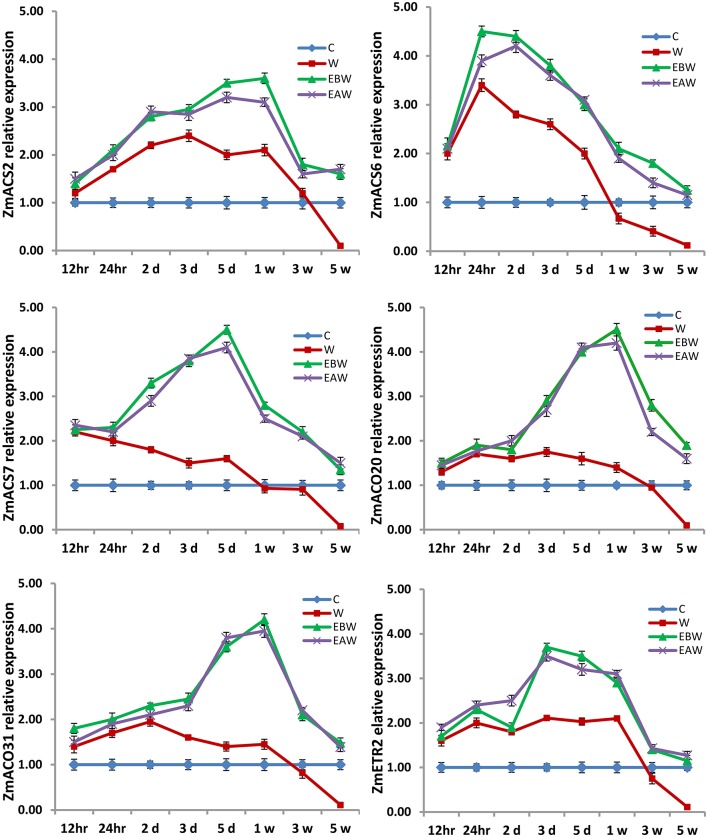
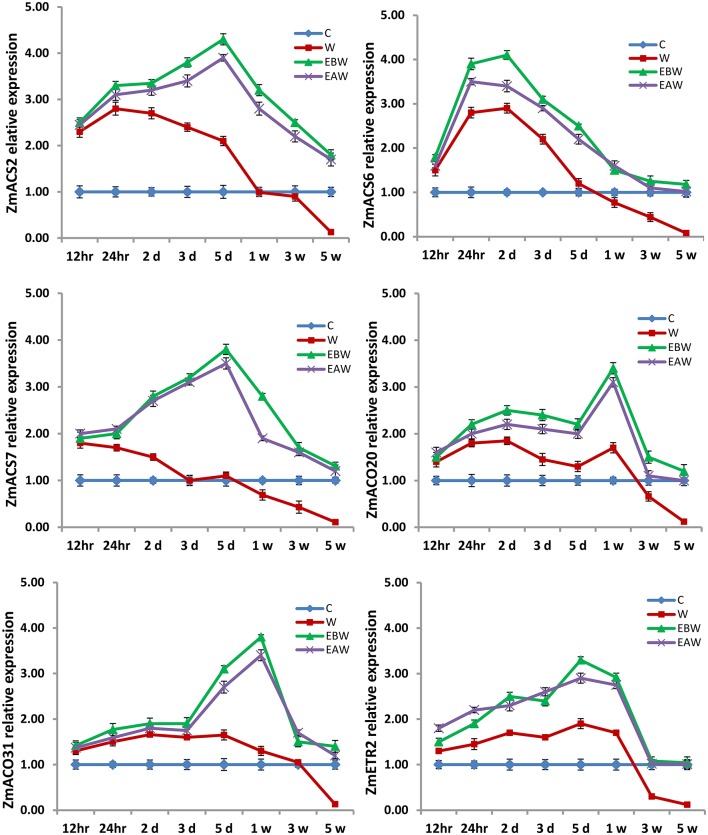
Waterlogging is an environmental challenge affecting crops worldwide. Ethylene induces the expression of genes linked to important agronomic traits under waterlogged conditions. The ability of okra ( L. Moench.) and maize ( L.) given exogenous ethylene priming to tolerate prolonged waterlogged conditions was investigated in this study. The investigation was carried out as field experiments using 3 week-old plants grouped into four treatments; control, waterlogged plants, ethylene priming of plants before waterlogging, and ethylene priming of plants after waterlogging. Different growth parameters were recorded. Soil chemical and bacterial analyses were performed. The activity and gene expression of antioxidant enzymes were studied. The ethylene biosynthetic genes expression analysis and root anatomy of surviving okra plants were also carried out. Results revealed that okra and maize plants showed increase in their height under waterlogged conditions. Ethylene priming and waterlogged conditions induced early production of adventitious roots in okra and maize. Maize survival lasted between 5 and 9 weeks under waterlogging without reaching the flowering stage. However, okra survived up to 15 weeks under waterlogging producing flower buds and fruits in all treatments. Variable changes were also recorded for total soluble phenolics of soil. Cross sections of waterlogged okra roots showed the formation of a dark peripheral layer and numerous large aerenchyma cells which may have assisted in trapping oxygen required for survival. The activity and gene expression levels of antioxidant enzymes were studied and showed higher increases in the root and leaf tissues of okra and maize subjected to both waterlogging and ethylene priming, as compared to control or waterlogged condition. Quantitative RT-PCR analysis also showed that the ethylene biosynthetic gene expression levels in all okra and maize tissues were up-regulated and showed much higher levels under ethylene-treated waterlogged conditions than those expressed under control or waterlogged conditions at all time points. These results indicate that okra and maize tissues respond to the conditions of waterlogging and exogenous ethylene priming by inducing their ethylene biosynthetic genes expression in order to enhance ethylene production and tolerate the prolonged waterlogging stress. In conclusion, this study revealed that exogenously generated ethylene gas as a priming treatment before or after waterlogging could enhance waterlogging tolerance in maize and okra crops.
涝害是影响全球农作物的一项环境挑战。乙烯可诱导与涝渍条件下重要农艺性状相关的基因表达。本研究调查了经外源乙烯引发处理的秋葵(L. Moench.)和玉米(L.)耐受长期涝渍条件的能力。该调查作为田间试验进行,使用3周龄的植株,分为四个处理组:对照组、涝渍植株组、涝渍前乙烯引发处理的植株组以及涝渍后乙烯引发处理的植株组。记录了不同的生长参数。进行了土壤化学和细菌分析。研究了抗氧化酶的活性和基因表达。还对存活的秋葵植株进行了乙烯生物合成基因表达分析和根部解剖。结果表明,秋葵和玉米植株在涝渍条件下高度增加。乙烯引发处理和涝渍条件促使秋葵和玉米提前产生不定根。玉米在涝渍条件下存活5至9周,未达到开花阶段。然而,秋葵在涝渍条件下存活长达15周,在所有处理中均产生花芽和果实。土壤总可溶性酚类物质也记录到了变化。涝渍秋葵根的横切面显示形成了深色的外周层和许多大型通气组织细胞,这可能有助于捕获生存所需的氧气。研究了抗氧化酶的活性和基因表达水平,结果表明,与对照组或仅涝渍条件相比,同时遭受涝渍和乙烯引发处理的秋葵和玉米根和叶组织中的抗氧化酶活性和基因表达水平升高幅度更大。定量逆转录聚合酶链反应(qRT-PCR)分析还表明,所有秋葵和玉米组织中的乙烯生物合成基因表达水平均上调,且在乙烯处理的涝渍条件下,所有时间点的表达水平均远高于对照组或涝渍条件下的表达水平。这些结果表明,秋葵和玉米组织通过诱导其乙烯生物合成基因表达来响应涝渍条件和外源乙烯引发处理,以提高乙烯产量并耐受长期涝渍胁迫。总之,本研究表明,在涝渍之前或之后作为引发处理的外源乙烯气体可增强玉米和秋葵作物的耐涝性。