Razpotnik Rok, Novak Neža, Čurin Šerbec Vladka, Rajcevic Uros
Department of Research and Development, Blood Transfusion Centre of Slovenia, Ljubljana, Slovenia.
Front Immunol. 2017 Sep 25;8:1181. doi: 10.3389/fimmu.2017.01181. eCollection 2017.
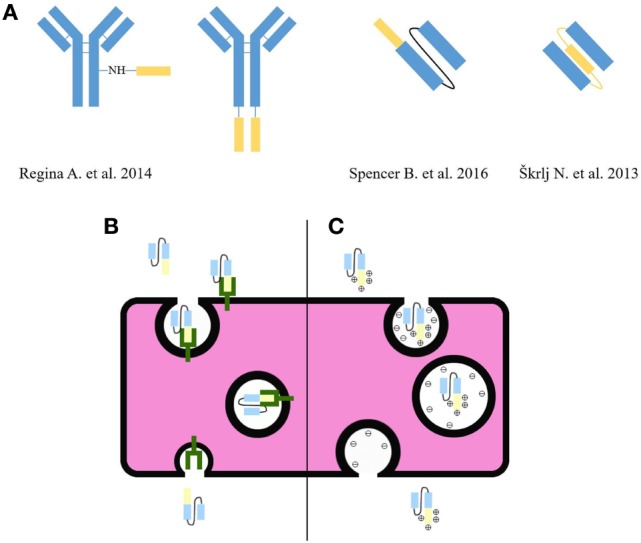
Antibodies have been shown to be a potent therapeutic tool. However, their use for targeting brain diseases, including neurodegenerative diseases and brain cancers, has been limited, particularly because the blood-brain barrier (BBB) makes brain tissue hard to access by conventional antibody-targeting strategies. In this review, we summarize new antibody therapeutic approaches to target brain tumors, especially malignant gliomas, as well as their potential drawbacks. Many different brain delivery platforms for antibodies have been studied such as liposomes, nanoparticle-based systems, cell-penetrating peptides (CPPs), and cell-based approaches. We have already shown the successful delivery of single-chain fragment variable (scFv) with CPP as a linker between two variable domains in the brain. Antibodies normally face poor penetration through the BBB, with some variants sufficiently passing the barrier on their own. A "Trojan horse" method allows passage of biomolecules, such as antibodies, through the BBB by receptor-mediated transcytosis (RMT). Such examples of therapeutic antibodies are the bispecific antibodies where one binding specificity recognizes and binds a BBB receptor, enabling RMT and where a second binding specificity recognizes an antigen as a therapeutic target. On the other hand, cell-based systems such as stem cells (SCs) are a promising delivery system because of their tumor tropism and ability to cross the BBB. Genetically engineered SCs can be used in gene therapy, where they express anti-tumor drugs, including antibodies. Different types and sources of SCs have been studied for the delivery of therapeutics to the brain; both mesenchymal stem cells (MSCs) and neural stem cells (NSCs) show great potential. Following the success in treatment of leukemias and lymphomas, the adoptive T-cell therapies, especially the chimeric antigen receptor-T cells (CAR-Ts), are making their way into glioma treatment as another type of cell-based therapy using the antibody to bind to the specific target(s). Finally, the current clinical trials are reviewed, showing the most recent progress of attractive approaches to deliver therapeutic antibodies across the BBB aiming at the specific antigen.
抗体已被证明是一种有效的治疗工具。然而,其在靶向脑部疾病(包括神经退行性疾病和脑癌)方面的应用一直受到限制,特别是因为血脑屏障(BBB)使得传统的抗体靶向策略难以进入脑组织。在本综述中,我们总结了靶向脑肿瘤(尤其是恶性胶质瘤)的新抗体治疗方法及其潜在缺点。已经研究了许多不同的抗体脑递送平台,如脂质体、基于纳米颗粒的系统、细胞穿透肽(CPPs)和基于细胞的方法。我们已经证明了以CPP作为两个可变域之间的连接体成功地将单链可变片段(scFv)递送至脑内。抗体通常难以穿透血脑屏障,有些变体自身能够充分通过该屏障。“特洛伊木马”方法允许生物分子(如抗体)通过受体介导的转胞吞作用(RMT)穿过血脑屏障。治疗性抗体的此类例子是双特异性抗体,其中一种结合特异性识别并结合血脑屏障受体,实现RMT,而另一种结合特异性识别作为治疗靶点的抗原。另一方面,基于细胞的系统(如干细胞(SCs))由于其肿瘤嗜性和穿过血脑屏障的能力,是一种有前途的递送系统。基因工程干细胞可用于基因治疗,在基因治疗中它们表达抗肿瘤药物,包括抗体。已经研究了不同类型和来源的干细胞用于将治疗剂递送至脑;间充质干细胞(MSCs)和神经干细胞(NSCs)都显示出巨大潜力。继白血病和淋巴瘤治疗取得成功之后,过继性T细胞疗法,尤其是嵌合抗原受体T细胞(CAR-Ts),正作为另一种使用抗体结合特定靶点的基于细胞的疗法进入胶质瘤治疗。最后,对当前的临床试验进行了综述,展示了旨在针对特定抗原穿过血脑屏障递送治疗性抗体的有吸引力方法的最新进展。