Kitzen Joep, Schotanus Martijn G M, Plasschaert Herbert S W, Hulsmans Frans-Jan H, Tilman Pieter B J
Department of Orthopaedic Surgery, Zuyderland Medical Centre, Postbus 5500, 6130 MB, Sittard-Geleen, the Netherlands.
Department of Pathology, Zuyderland Medical Centre, Sittard-Geleen, the Netherlands.
BMC Musculoskelet Disord. 2017 Oct 10;18(1):411. doi: 10.1186/s12891-017-1770-3.
Short-segment pedicle-screw instrumentation is frequently used to stabilize thoracolumbar burst fractures. A recognized disadvantage of this procedure is recurrent kyphosis from intervertebral disc creep into the fractured central endplate. Balloon Assisted Endplate Reduction (BAER) using Tricalcium Phosphate bone cement (TCP) enables elevation of the centrally depressed endplate. Our objective was to evaluate the bone-tissue response to TCP and to analyse whether BAER using TCP can prevent recurrent kyphosis after removal of the instrumentation.
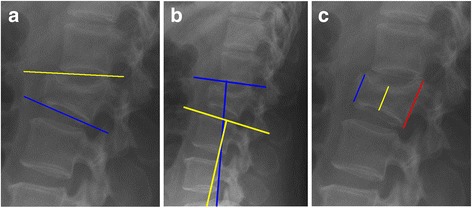
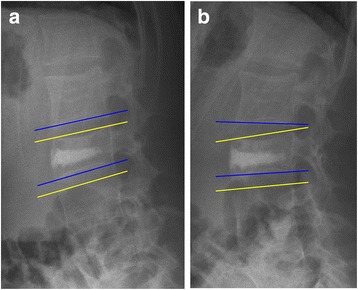
Fourteen patients with traumatic thoracolumbar burst fractures were operated with BAER using TCP in combination with short-segment instrumentation. Nine months after surgery, instrumentation was removed and transpedicular biopsies were taken for histological and histochemical analysis. Roentgenograms pre- and postoperatively and at latest follow-up after removal of the instrumentation were evaluated.
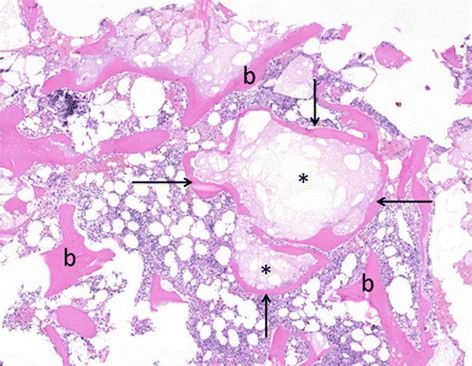
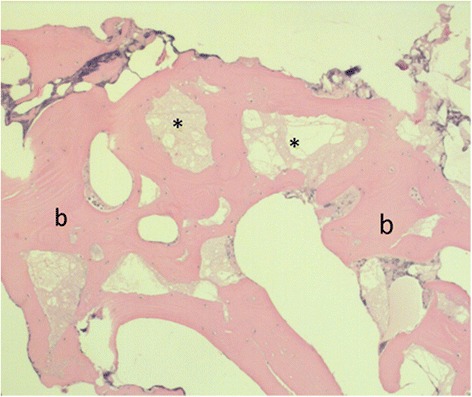
Average follow-up was 2.6 years. Analysis of the biopsies showed a variable degree of bone remodelling with incorporation of TCP into newly formed bone matrix. No extensive foreign body reactions, inflammation, granulomatous responses or tissue necrosis were observed. Wedge-angle, kyphosis-angle and both the anterior-posterior and central-posterior vertebral body height ratios improved significant postoperatively (p < 0.001). After removal of the instrumentation no significant differences in wedge-angle or height ratios were seen (p = 0.12). The kyphosis-angle increased four degrees (p = 0.01).
TCP showed good histological osseointegration with no adverse events. TCP can therefore be safely used and could be beneficial in treatment of thoracolumbar burst fractures. BAER with TCP in combination with short-segment instrumentation might reduce recurrence of deformity even after removal of the instrumentation in comparison to short-segment instrumentation alone.
This study is registered at the at the Dutch Trial Registry (NTR3498).
短节段椎弓根螺钉内固定术常用于稳定胸腰椎爆裂骨折。该手术一个公认的缺点是椎间盘向骨折的中央终板蠕变导致脊柱后凸复发。使用磷酸三钙骨水泥(TCP)的球囊辅助终板复位(BAER)可抬高中央凹陷的终板。我们的目的是评估骨组织对TCP的反应,并分析使用TCP的BAER能否预防内固定取出后脊柱后凸复发。
14例创伤性胸腰椎爆裂骨折患者接受了使用TCP的BAER联合短节段内固定术。术后9个月,取出内固定并进行经椎弓根活检,用于组织学和组织化学分析。评估术前、术后及内固定取出后最新随访时的X线片。
平均随访2.6年。活检分析显示骨重塑程度各异,TCP融入新形成的骨基质。未观察到广泛的异物反应、炎症、肉芽肿反应或组织坏死。术后楔角、后凸角以及椎体前后径和中央后径高度比均显著改善(p < 0.001)。内固定取出后,楔角或高度比未见显著差异(p = 0.12)。后凸角增加了4度(p = 0.01)。
TCP显示出良好的组织学骨整合,无不良事件。因此,TCP可安全使用,可能有益于胸腰椎爆裂骨折的治疗。与单纯短节段内固定相比,使用TCP的BAER联合短节段内固定可能减少内固定取出后畸形的复发。
本研究已在荷兰试验注册中心注册(NTR3498)。