Mäki Anita, Salmi Pauliina, Mikkonen Anu, Kremp Anke, Tiirola Marja
Department of Biological and Environmental Science, University of Jyväskylä, Jyväskylä, Finland.
Marine Research Centre, Finnish Environment Institute, Helsinki, Finland.
Front Microbiol. 2017 Sep 26;8:1848. doi: 10.3389/fmicb.2017.01848. eCollection 2017.
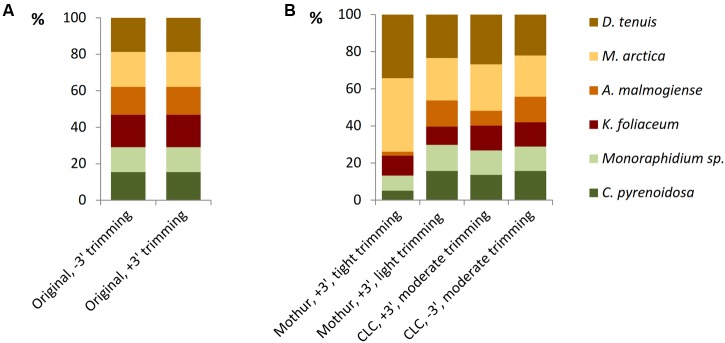
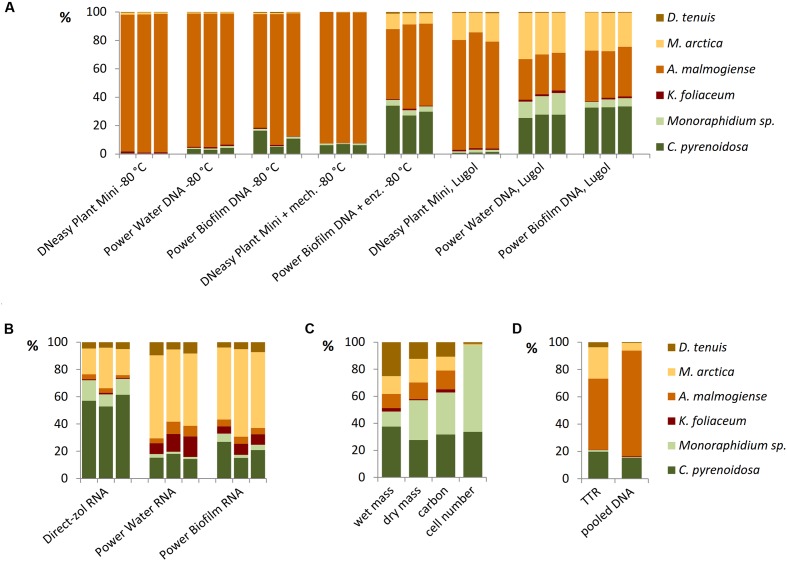
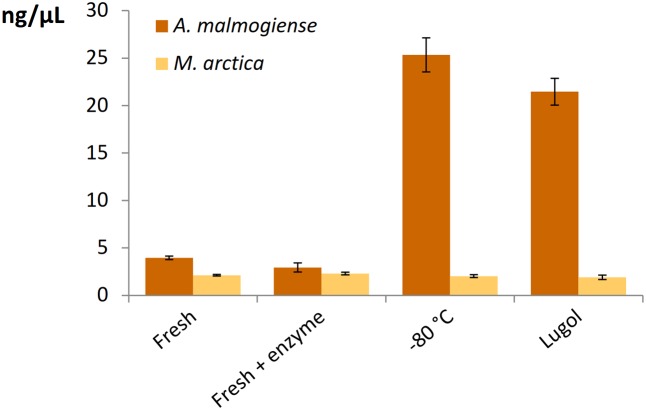
Phytoplankton is the basis for aquatic food webs and mirrors the water quality. Conventionally, phytoplankton analysis has been done using time consuming and partly subjective microscopic observations, but next generation sequencing (NGS) technologies provide promising potential for rapid automated examination of environmental samples. Because many phytoplankton species have tough cell walls, methods for cell lysis and DNA or RNA isolation need to be efficient to allow unbiased nucleic acid retrieval. Here, we analyzed how two phytoplankton preservation methods, three commercial DNA extraction kits and their improvements, three RNA extraction methods, and two data analysis procedures affected the results of the NGS analysis. A mock community was pooled from phytoplankton species with variation in nucleus size and cell wall hardness. Although the study showed potential for studying Lugol-preserved sample collections, it demonstrated critical challenges in the DNA-based phytoplankton analysis in overall. The 18S rRNA gene sequencing output was highly affected by the variation in the rRNA gene copy numbers per cell, while sample preservation and nucleic acid extraction methods formed another source of variation. At the top, sequence-specific variation in the data quality introduced unexpected bioinformatics bias when the sliding-window method was used for the quality trimming of the Ion Torrent data. While DNA-based analyses did not correlate with biomasses or cell numbers of the mock community, rRNA-based analyses were less affected by different RNA extraction procedures and had better match with the biomasses, dry weight and carbon contents, and are therefore recommended for quantitative phytoplankton analyses.
浮游植物是水生食物网的基础,反映了水质状况。传统上,浮游植物分析是通过耗时且部分主观的显微镜观察来进行的,但新一代测序(NGS)技术为快速自动检测环境样本提供了广阔潜力。由于许多浮游植物物种具有坚韧的细胞壁,细胞裂解以及DNA或RNA提取方法必须高效,以确保无偏差地获取核酸。在此,我们分析了两种浮游植物保存方法、三种商业DNA提取试剂盒及其改进方法、三种RNA提取方法以及两种数据分析程序如何影响NGS分析结果。从细胞核大小和细胞壁硬度各异的浮游植物物种中汇集了一个模拟群落。尽管该研究显示了对研究经鲁哥氏碘液保存的样本集的潜力,但总体而言,它揭示了基于DNA的浮游植物分析中的关键挑战。18S rRNA基因测序输出受每个细胞中rRNA基因拷贝数变化的影响很大,而样本保存和核酸提取方法构成了另一个变异来源。首先,当使用滑动窗口方法对Ion Torrent数据进行质量修剪时,数据质量中的序列特异性变异引入了意想不到的生物信息学偏差。虽然基于DNA的分析与模拟群落的生物量或细胞数量不相关,但基于rRNA的分析受不同RNA提取程序的影响较小,并且与生物量、干重和碳含量的匹配度更好,因此推荐用于浮游植物的定量分析。