Institute of Physiology, University of Würzburg, Röntgenring 9, 97070, Würzburg, Germany.
Drug Discovery, Bayer AG, Aprather Weg 18a, 42096, Wuppertal, Germany.
Naunyn Schmiedebergs Arch Pharmacol. 2017 Dec;390(12):1177-1188. doi: 10.1007/s00210-017-1429-5. Epub 2017 Oct 10.
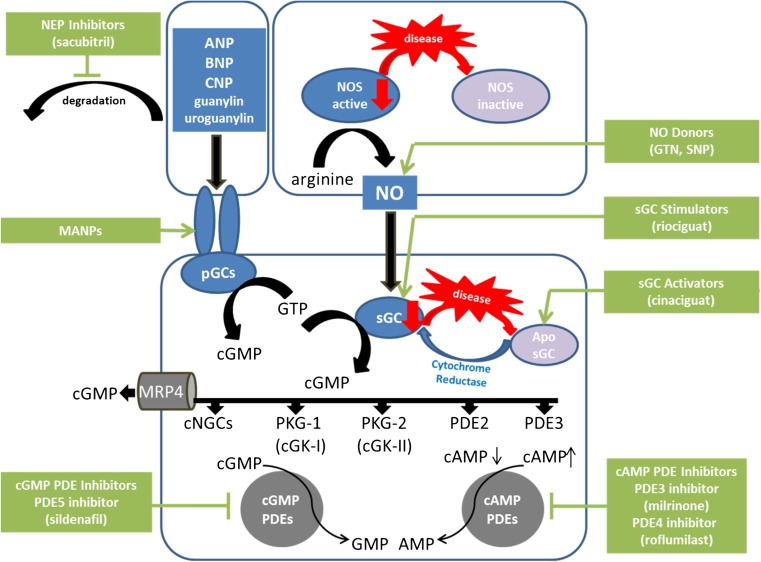
Although the Nobel Prize for the discovery of nitric oxide (NO) dates back almost 20 years now, the knowledge about cGMP signaling is still constantly increasing. It looks even so that our understanding of the role of the soluble guanylyl cyclase (sGC) and particulate guanylyl cyclase (pGC) in health and disease is in many aspects at the beginning and far from being understood. This holds even true for the therapeutic impact of innovative drugs acting on both the NO/sGC and the pGC pathways. Since cGMP, as second messenger, is involved in the pathogenesis of numerous diseases within the cardiovascular, pulmonary, renal, and endocrine systems and also plays a role in neuronal, sensory, and tumor processes, drug applications might be quite broad. On the 8th International Conference on cGMP, held in Bamberg, Germany, world leading experts came together to discuss these topics. All aspects of cGMP research from the basic understanding of cGMP signaling to clinical applicability were discussed in depth. In addition, present and future therapeutic applications of cGMP-modulating pharmacotherapy were presented ( http://www.cyclicgmp.net/index.html ).
尽管一氧化氮(NO)发现诺贝尔奖已经过去了近 20 年,但 cGMP 信号转导的知识仍在不断增加。看起来,我们对可溶性鸟苷酸环化酶(sGC)和颗粒状鸟苷酸环化酶(pGC)在健康和疾病中的作用的理解在许多方面才刚刚开始,远未被理解。这对于作用于 NO/sGC 和 pGC 途径的创新药物的治疗效果也是如此。由于 cGMP 作为第二信使,参与心血管、肺、肾和内分泌系统多种疾病的发病机制,并且在神经元、感觉和肿瘤过程中也发挥作用,因此药物应用可能非常广泛。在德国班贝格举行的第 8 届国际 cGMP 会议上,世界领先的专家齐聚一堂,讨论了这些主题。从 cGMP 信号转导的基本理解到临床应用,深入讨论了 cGMP 研究的所有方面。此外,还介绍了 cGMP 调节药物治疗的现有和未来治疗应用(http://www.cyclicgmp.net/index.html)。