Tao Xingguang, Chen Nong, Pan Fugen, Cheng Biao
Department of Orthopedics, Shanghai Tenth People's Hospital, Clinical College of Nanjing Medical University Department of Orthopedics, Qingpu Branch of Zhongshan Hospital, Fudan University, Shanghai, China.
Medicine (Baltimore). 2017 Oct;96(41):e8221. doi: 10.1097/MD.0000000000008221.
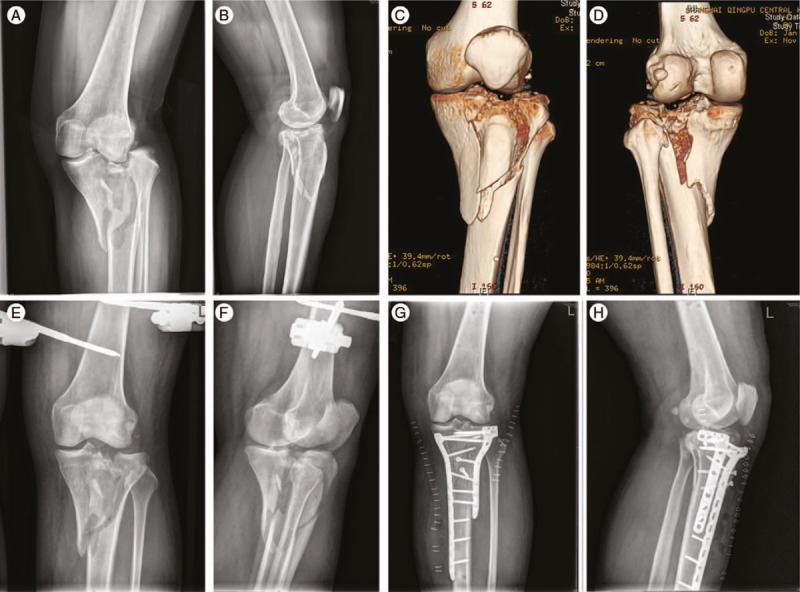
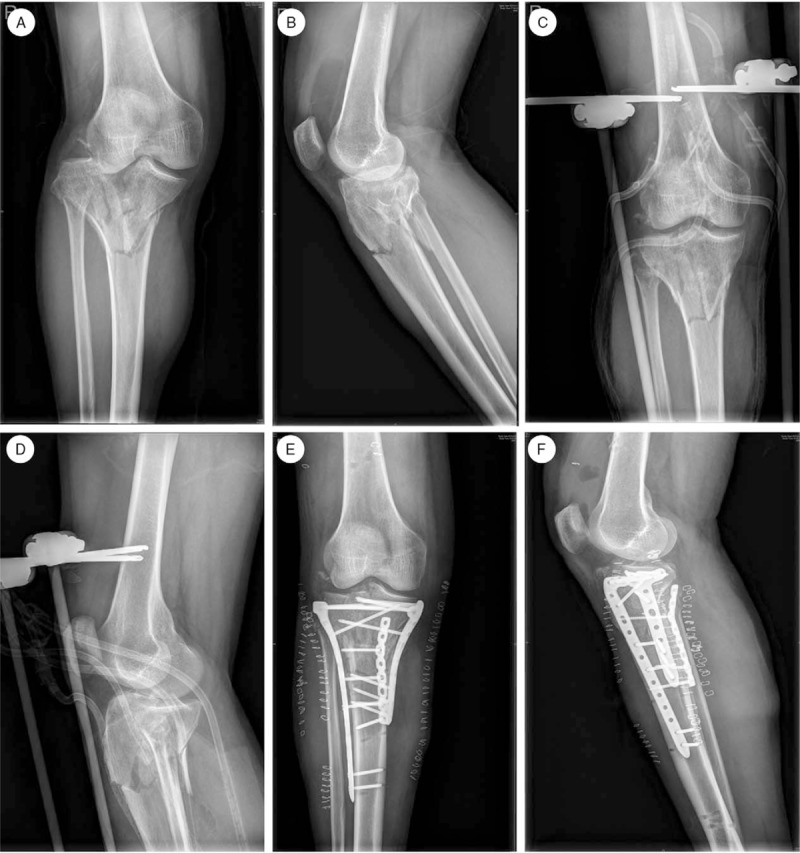
The aim of this study was to evaluate the clinical efficacy of external fixation, delayed open reduction, and internal fixation in treating tibial plateau fracture with dislocation.Clinical data of 34 patients diagnosed with tibial plateau fracture complicated with dislocation between January 2009 and May 2015 were retrospectively analyzed. Fifteen patients in group A underwent early calcaneus traction combined with open reduction and internal fixation and 19 in group B received early external fixation combined with delayed open reduction and internal fixation. Operation time, postoperative complication, bone healing time, knee joint range of motion, initial weight-bearing time, Rasmussen tibial plateau score, and knee function score (HSS) were statistically compared between 2 groups.The mean follow-up time was 18.6 months (range: 5-24 months). The mean operation time in group A was 96 minutes, significantly longer than 71 minutes in group B (P < .05). In group A, 5 cases had postoperative complications and 1 in group B (P < .05). The mean bone healing time in group A was 6.9 months (range: 5-9 months) and 6.0 months (range: 5-8 months) in group B (P > .05). In group A, initial weight-bearing time in group A was (14.0 ± 3.6) weeks, significantly differing from (12.9 ± 2.8) weeks in group B (P < 0.05). In group A, the mean knee joint range of motion was 122° (range: 95°-150°) and 135° (range: 100°-160°) in group B (P > 0.05). Rasmussen tibial plateau score in group A was slightly lower than that in group B (P > .05). The excellent rate of knee joint function in group A was 80% and 84.21% in group B (P > .05).External fixation combined with delayed open reduction and internal fixation is a safer and more efficacious therapy of tibial plateau fracture complicated with dislocation compared with early calcaneus traction and open reduction and internal fixation.
本研究旨在评估外固定、延期切开复位内固定治疗胫骨平台骨折伴脱位的临床疗效。回顾性分析2009年1月至2015年5月期间34例诊断为胫骨平台骨折合并脱位患者的临床资料。A组15例患者接受早期跟骨牵引联合切开复位内固定,B组19例患者接受早期外固定联合延期切开复位内固定。对两组患者的手术时间、术后并发症、骨折愈合时间、膝关节活动范围、初次负重时间、Rasmussen胫骨平台评分及膝关节功能评分(HSS)进行统计学比较。平均随访时间为18.6个月(范围:5 - 24个月)。A组平均手术时间为96分钟,显著长于B组的71分钟(P < 0.05)。A组5例出现术后并发症,B组1例(P < 0.05)。A组平均骨折愈合时间为6.9个月(范围:5 - 9个月),B组为6.0个月(范围:5 - 8个月)(P > 0.05)。A组初次负重时间为(14.0 ± 3.6)周,与B组的(12.9 ± 2.8)周有显著差异(P < 0.05)。A组膝关节平均活动范围为122°(范围:95° - 150°),B组为135°(范围:100° - 160°)(P > 0.05)。A组Rasmussen胫骨平台评分略低于B组(P > 0.05)。A组膝关节功能优良率为80%,B组为84.21%(P > 0.05)。与早期跟骨牵引联合切开复位内固定相比,外固定联合延期切开复位内固定是治疗胫骨平台骨折合并脱位更安全、有效的方法。