Woodward Steven H, Jamison Andrea L, Gala Sasha, Holmes Tyson H
National Center for PTSD, Dissemination and Training Division, VA Palo Alto Health Care System, Palo Alto, CA, United States of America.
Human Immune Monitoring Center (HIMC), Institute for Immunity, Transplantation and Infection, Stanford University School of Medicine, Stanford, CA, United States of America.
PLoS One. 2017 Oct 11;12(10):e0179912. doi: 10.1371/journal.pone.0179912. eCollection 2017.
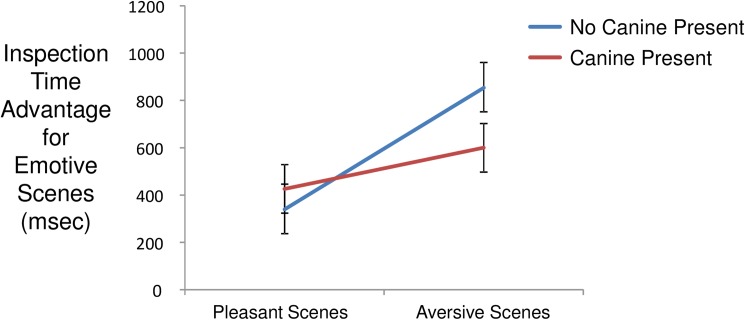
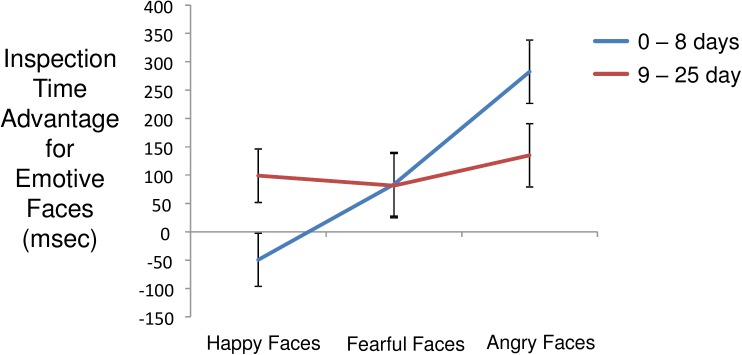
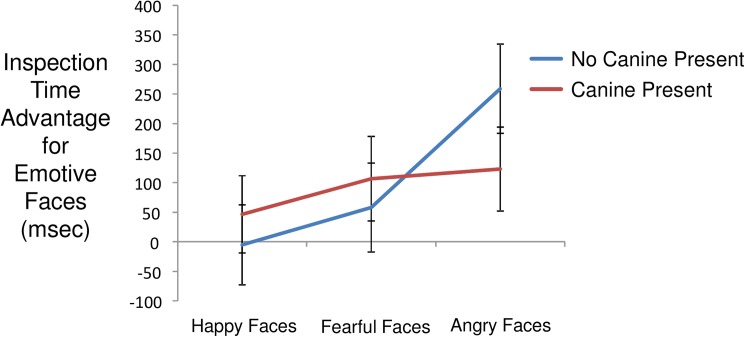
Attentional bias towards aversive stimuli has been demonstrated in the anxiety disorders and in posttraumatic stress disorder, and attentional bias modification has been proposed as a candidate treatment. This study rigorously assessed attentional bias towards aversive and pleasant visual imagery associated with the presence or absence of a familiar service canine in 23 veterans with chronic military-related posttraumatic stress disorder. Participants were repeatedly tested with and without their service canines present on two tasks designed to elicit spontaneous visual attention to facial and scenic image pairs, respectively. Each stimulus contrasted an emotive image with a neutral image. Via eye-tracking, the difference in visual attention directed to each image was analyzed as a function of the valence contrast and presence/absence of the canine. Across both tasks, the presence of a familiar service canine attenuated the normative attentional bias towards aversive image content. In the facial task, presence of the service canine specifically reduced attention toward angry faces. In that task, as well, accumulated days with the service canine similarly modulated attention toward facial emotion. The results suggest that the presence of a familiar service canine is associated with attenuation of attentional bias to aversive stimuli in chronic military-service-related posttraumatic stress disorder. Questions remain regarding the generalization of such effects to other populations, their dependence on the familiarity, breed, and training of the canine, and on social context.
对厌恶刺激的注意偏向已在焦虑症和创伤后应激障碍中得到证实,注意力偏向矫正已被提议作为一种候选治疗方法。本研究严格评估了23名患有慢性军事相关创伤后应激障碍的退伍军人对与熟悉的服务犬在场或不在场相关的厌恶和愉悦视觉意象的注意偏向。参与者在有和没有服务犬在场的情况下,分别在两项旨在引发对面部和风景图像对的自发视觉注意的任务上进行了反复测试。每个刺激都将一个情感图像与一个中性图像进行对比。通过眼动追踪,分析了针对每个图像的视觉注意差异,作为效价对比和犬只在场与否的函数。在两项任务中,熟悉的服务犬的存在减弱了对厌恶图像内容的正常注意偏向。在面部任务中,服务犬的存在特别减少了对愤怒面孔的关注。同样在该任务中,与服务犬在一起的累计天数也类似地调节了对面部情绪的关注。结果表明,在慢性军事服务相关创伤后应激障碍中,熟悉的服务犬的存在与对厌恶刺激的注意偏向减弱有关。关于这些效应能否推广到其他人群、它们对犬只的熟悉程度、品种和训练以及社会背景的依赖性,仍存在疑问。