Department of Neuroscience, University of Pennsylvania Perelman School of Medicine, Philadelphia, PA, 19104, USA.
Department of Molecular Biology, Princeton University, Princeton, NJ, 08540, USA.
Neural Dev. 2017 Oct 11;12(1):18. doi: 10.1186/s13064-017-0095-0.
The axons of Olfactory Sensory Neurons (OSNs) project to reproducible target locations within the Olfactory Bulb (OB), converting odorant experience into a spatial map of neural activity. We characterized the initial targeting of OSN axons in the zebrafish, a model system suitable for studying axonal targeting early in development. In this system the initial targets of OSN axons are a small number of distinct, individually identifiable neuropilar regions called protoglomeruli. Previously, Olfactory Marker Protein-expressing and TRPC2-expressing classes of OSNs were shown to project to specific, non-overlapping sets of protoglomeruli, indicating that particular subsets of OSNs project to specific protoglomerular targets. We set out to map the relationship between the classical Odorant Receptor (OR) an OSN chooses to express and the protoglomerulus its axon targets.
A panel of BACs were recombineered so that the axons of OSNs choosing to express modified ORs were fluorescently labeled. Axon projections were followed into the olfactory bulb to determine the protoglomeruli in which they terminated.
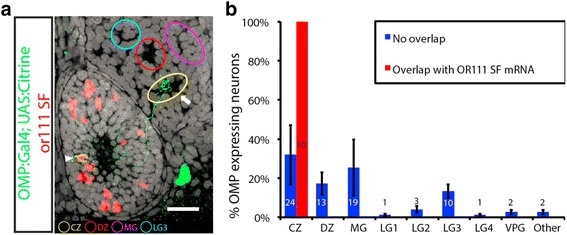
RNA-seq demonstrates that OSNs express a surprisingly wide variety of ORs and Trace Amine Associated Receptors (TAARs) very early when sensory axons are arriving in the bulb. Only a single OR is expressed in any given OSN even at these early developmental times. We used a BAC expression technique to map the trajectories of OSNs expressing specific odorant receptors. ORs can be divided into three clades based upon their sequence similarities. OSNs expressing ORs from two of these clades project to the CZ protoglomerulus, while OSNs expressing ORs from the third clade project to the DZ protoglomerulus. In contrast, OSNs expressing a particular TAAR project to multiple protoglomeruli. Neither OR choice nor axonal targeting are related to the position an OSN occupies within the olfactory pit.
Our results demonstrate that it is not the choice of a particular OR, but of one from a category of ORs, that is related to initial OSN target location within the olfactory bulb. These choices are not related to OSN position within the olfactory epithelium.
嗅感觉神经元(OSN)的轴突投射到嗅球(OB)内可重复的靶位,将气味体验转化为神经活动的空间图谱。我们描述了斑马鱼中 OSN 轴突的初始靶向,该模型系统适合在早期发育阶段研究轴突靶向。在这个系统中,OSN 轴突的初始靶标是一小部分独特的、可单独识别的神经丛区域,称为原嗅小球。以前,表达嗅觉标记蛋白和 TRPC2 的 OSN 类被证明投射到特定的、不重叠的原嗅小球集,表明特定的 OSN 亚群投射到特定的原嗅小球靶标。我们着手绘制 OSN 选择表达的经典气味受体(OR)与其轴突靶标原嗅小球之间的关系。
通过重组 BAC 面板,使选择表达修饰 OR 的 OSN 的轴突被荧光标记。追踪轴突投射到嗅球,以确定它们终止的原嗅小球。
RNA-seq 表明,当感觉轴突到达嗅球时,OSN 很早就表达了种类繁多的 OR 和 Trace Amine Associated Receptors (TAARs)。即使在这些早期发育阶段,任何一个 OSN 中也只表达一个 OR。我们使用 BAC 表达技术来绘制表达特定气味受体的 OSN 的轨迹。根据序列相似性,OR 可分为三个分支。来自这两个分支的 OR 表达的 OSN 投射到 CZ 原嗅小球,而来自第三个分支的 OR 表达的 OSN 投射到 DZ 原嗅小球。相比之下,表达特定 TAAR 的 OSN 投射到多个原嗅小球。OR 的选择和轴突靶向都与 OSN 在嗅囊内的位置无关。
我们的结果表明,与 OSN 在嗅球内的初始靶位相关的不是特定 OR 的选择,而是 OR 类别中的一个选择。这些选择与 OSN 在嗅上皮中的位置无关。