Department of Orthopaedics, The Second Hospital of Shandong University, Shandong University, Jinan, China.
Department of Orthopedics, Beijing Chaoyang Hospital, Capital Medical University, Beijing, China.
J Exp Clin Cancer Res. 2017 Oct 11;36(1):141. doi: 10.1186/s13046-017-0616-z.
Our previous studies reported that SHC SH2-domain binding protein 1 (SHCBP1) functions as an oncogene via promoting cell proliferations in synovial sarcoma (SS) cells. However, whether SHCBP1 has any effect on tumor metastasis remains unexplored.
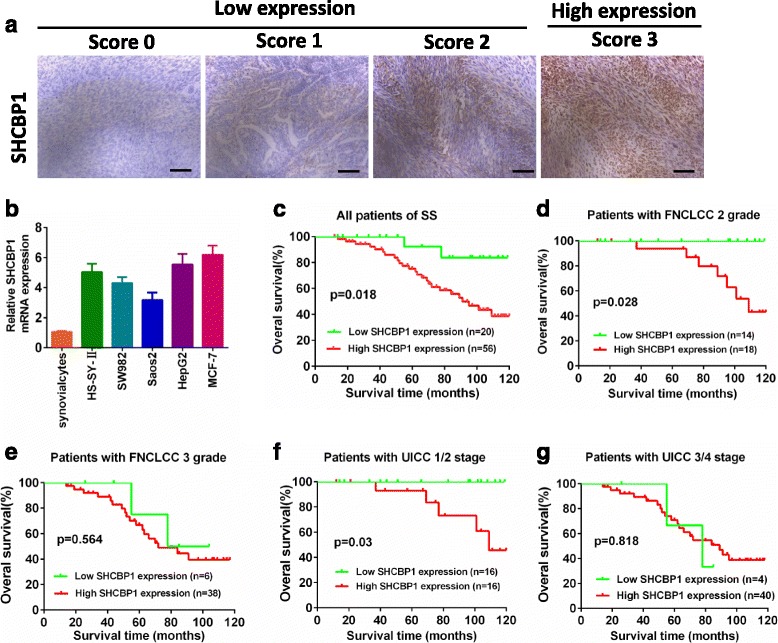
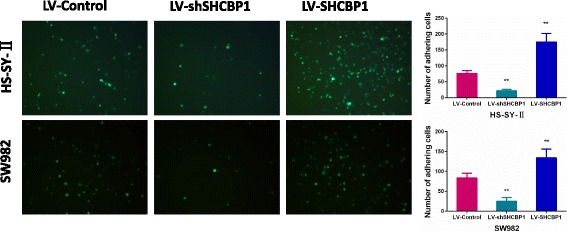
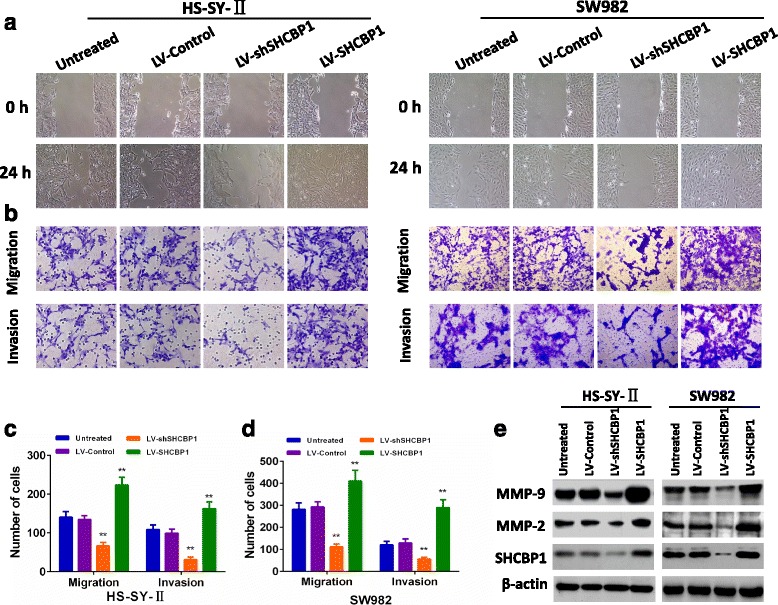
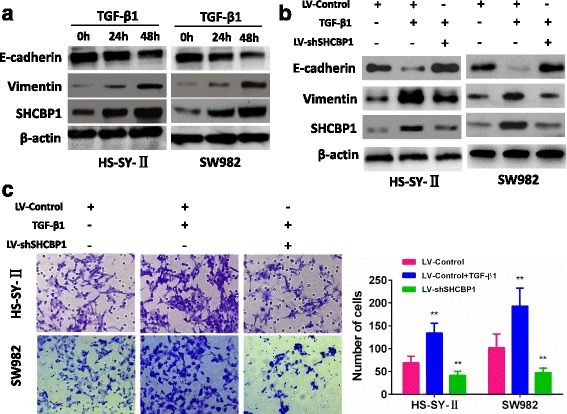
The expression of SHCBP1 was analyzed in 76 SS tissues and two SS cell lines by immunohistochemistry and real-time RT-PCR. The relationship between SHCBP1 expression and the clinicopathological features of SS was investigated. The role of SHCBP1 in SS cell adhesion, migration, invasion and angiogenesis was explored by adhesion, Wound healing, Transwell, and Matrigel tube formation assays. Western blotting was conducted to detect the protein expressions of TGF-β1/Smad signaling pathway and EMT-related markers. The key molecules associated with migration, invasion and EMT were evaluated by immunohistochemistry in tumor specimens.
In current study, we demonstrated that SHCBP1 overexpression significantly enhanced adhesion, migration, invasion and angiogenesis of SS cells. In contrast, SHCBP1 knockdown elicited the opposite effects on these phenotypes in vitro. SHCBP1 promoted tumor metastasis through inducing epithelial-mesenchymal transition (EMT) in SS cells. SHCBP1 knockdown could block the incidence of metastasis and EMT in SS cells. Furthermore, transforming growth factor-β1 (TGF-β1) induced SHCBP1 expression in a time-dependent pattern and SHCBP1 knockdown inhibited TGF-β1-induced EMT. The activation of the TGF-β1/Smad signaling pathway was involved in the oncogenic functions of SHCBP1 in SS. In addition, high expression of SHCBP1 in SS patients was associated with tumor progression and decreased survival as well as poor prognosis.
Taken together, our results indicate that SHCBP1 may promote the metastasis of SS by inducing EMT through targeting TGF-β1/Smad signaling pathway and can be a potential molecular target for SS therapy.
我们之前的研究表明,衔接蛋白 SH2 域结合蛋白 1(SHCBP1)通过促进滑膜肉瘤(SS)细胞的增殖而发挥癌基因作用。然而,SHCBP1 是否对肿瘤转移有任何影响仍未被探索。
通过免疫组织化学和实时 RT-PCR 分析 76 例 SS 组织和 2 种 SS 细胞系中 SHCBP1 的表达。研究了 SHCBP1 表达与 SS 临床病理特征的关系。通过粘附、划痕愈合、Transwell 和 Matrigel 管形成测定法探讨了 SHCBP1 在 SS 细胞粘附、迁移、侵袭和血管生成中的作用。Western blot 检测 TGF-β1/Smad 信号通路和 EMT 相关标志物的蛋白表达。通过免疫组织化学评估与迁移、侵袭和 EMT 相关的关键分子在肿瘤标本中的表达。
在本研究中,我们证明 SHCBP1 过表达显著增强了 SS 细胞的粘附、迁移、侵袭和血管生成。相反,SHCBP1 敲低在体外对这些表型产生了相反的影响。SHCBP1 通过诱导 SS 细胞上皮-间充质转化(EMT)促进肿瘤转移。SHCBP1 敲低可阻断 SS 细胞转移和 EMT 的发生。此外,转化生长因子-β1(TGF-β1)呈时间依赖性诱导 SHCBP1 表达,SHCBP1 敲低抑制 TGF-β1 诱导的 EMT。TGF-β1/Smad 信号通路的激活参与了 SHCBP1 在 SS 中的致癌作用。此外,SS 患者中 SHCBP1 的高表达与肿瘤进展、生存率降低以及预后不良相关。
综上所述,我们的研究结果表明,SHCBP1 可能通过靶向 TGF-β1/Smad 信号通路诱导 EMT 促进 SS 的转移,并且可以成为 SS 治疗的潜在分子靶点。