Hakim Shariful, Chowdhury Muhammad Abdul Baker, Uddin Md Jamal
Department of Statistics, Shahjalal University of Science & Technology, Sylhet 3114, Bangladesh.
Department of Emergency Medicine, University of Florida College of Medicine, Gainesville, 32610, FL, USA.
Prev Med Rep. 2017 Sep 6;8:122-128. doi: 10.1016/j.pmedr.2017.08.007. eCollection 2017 Dec.
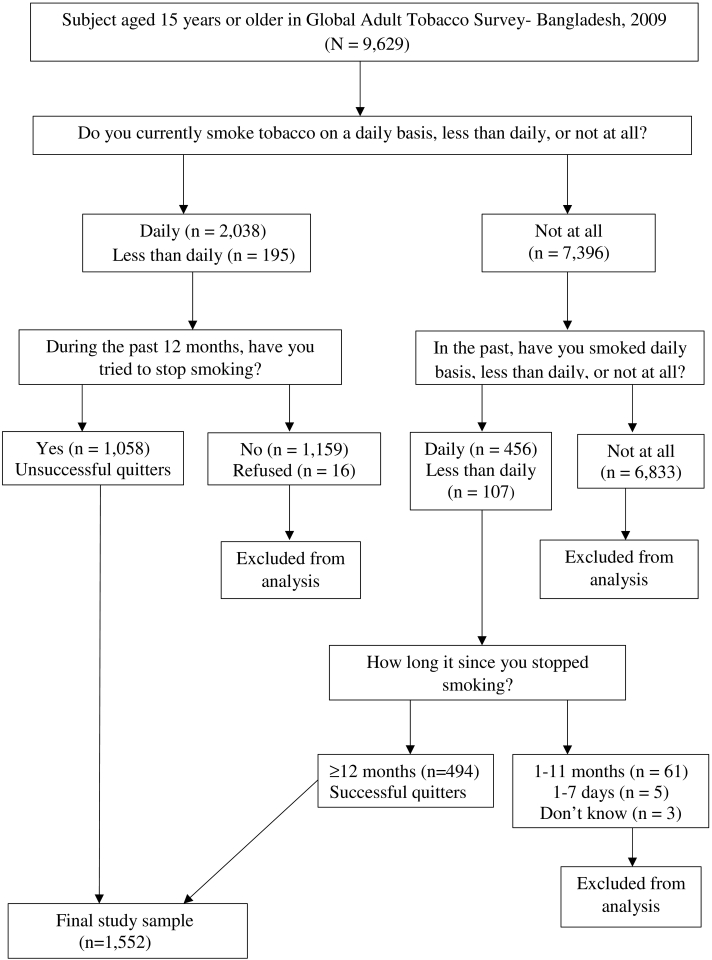
Having 21.9 million adult smokers, Bangladesh ranks among the top ten heaviest smoking countries in the world. Correlates of unsuccessful smoking cessation remain unknown. We aimed to identify the correlates of unsuccessful smoking cessation among adults in Bangladesh. We used data from the 2009 Global Adult Tobacco Survey (GATS) for Bangladesh. We compared socio-demographic, belief about health effect of smoking, and environmental characteristics of current smokers who had a recent failed quit attempt during the past 12 months of the survey (unsuccessful quitters) with those former smokers who had quit ≥ 12 months earlier of the survey and had not relapsed (successful quitters). Data were analyzed using logistic regression model and generalized estimating equations. A total of 1552 smokers (1058 unsuccessful quitters and 494 successful quitters) aged 15 years and older who participated in the survey was included in this study. Among the smokers, 1058 (68%) were unsuccessful quitters. Our analysis showed that older aged, female, and higher educated smokers were less likely to quit unsuccessfully. Moreover, who believed that smoking causes serious illness were also less likely to quit unsuccessfully. For the interaction between place of residence and smoking rules inside home, we found that among the smoker's, in those house smoking was allowed, and who lived in urban place were less likely to be unsuccessful in quitting than those who lived in rural place. Our findings suggest a cessation program that requires integrated approach with a view to considering these findings in setting up.
孟加拉国有2190万成年吸烟者,位列世界吸烟最严重的十个国家之一。戒烟未成功的相关因素尚不清楚。我们旨在确定孟加拉国成年人戒烟未成功的相关因素。我们使用了2009年孟加拉国全球成人烟草调查(GATS)的数据。我们将在调查过去12个月内近期戒烟尝试失败的当前吸烟者(戒烟未成功者)的社会人口统计学、对吸烟健康影响的信念以及环境特征与那些在调查前≥12个月戒烟且未复发的 former smokers(戒烟成功者)进行了比较。使用逻辑回归模型和广义估计方程对数据进行分析。本研究纳入了1552名年龄在15岁及以上参与调查的吸烟者(1058名戒烟未成功者和494名戒烟成功者)。在吸烟者中,1058人(68%)为戒烟未成功者。我们的分析表明,年龄较大、女性以及受教育程度较高的吸烟者戒烟未成功的可能性较小。此外,那些认为吸烟会导致严重疾病的人戒烟未成功的可能性也较小。对于居住地点和家中吸烟规定之间的相互作用,我们发现,在吸烟者中,家中允许吸烟且居住在城市的人比居住在农村的人戒烟未成功的可能性更小。我们的研究结果表明,戒烟计划需要一种综合方法,以便在制定过程中考虑这些结果。