Department of Molecular Medicine and Surgery, Section for Integrative Physiology, Karolinska Institutet, von Eulers väg 4a, IV, SE-171 65, Stockholm, Sweden.
Department of Physiology and Pharmacology, Integrative Physiology, Karolinska Institutet, Stockholm, Sweden.
Diabetologia. 2018 Feb;61(2):424-432. doi: 10.1007/s00125-017-4451-8. Epub 2017 Oct 11.
AIMS/HYPOTHESIS: Insulin-mediated signals and AMP-activated protein kinase (AMPK)-mediated signals are activated in response to physiological conditions that represent energy abundance and shortage, respectively. Focal adhesion kinase (FAK) is implicated in insulin signalling and cancer progression in various non-muscle cell types and plays a regulatory role during skeletal muscle differentiation. The role of FAK in skeletal muscle in relation to insulin stimulation or AMPK activation is unknown. We examined the effects of insulin or AMPK activation on FAK phosphorylation in human skeletal muscle and the direct role of FAK on glucose and lipid metabolism. We hypothesised that insulin treatment and AMPK activation would have opposing effects on FAK phosphorylation and that gene silencing of FAK would alter metabolism.
Human muscle was treated with insulin or the AMPK-activating compound 5-aminoimadazole-4-carboxamide ribonucleotide (AICAR) to determine FAK phosphorylation and glucose transport. Primary human skeletal muscle cells were used to study the effects of insulin or AICAR treatment on FAK signalling during serum starvation, as well as to determine the metabolic consequences of silencing the FAK gene, PTK2.
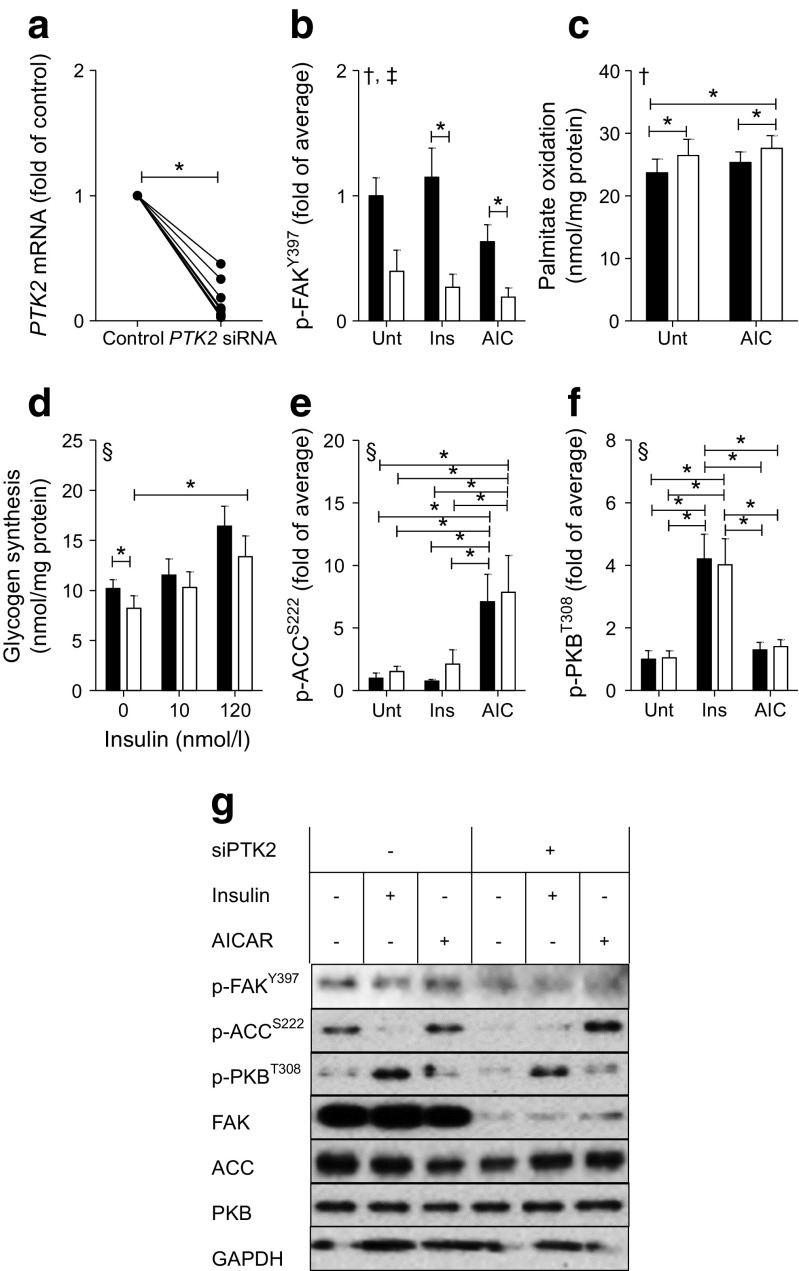
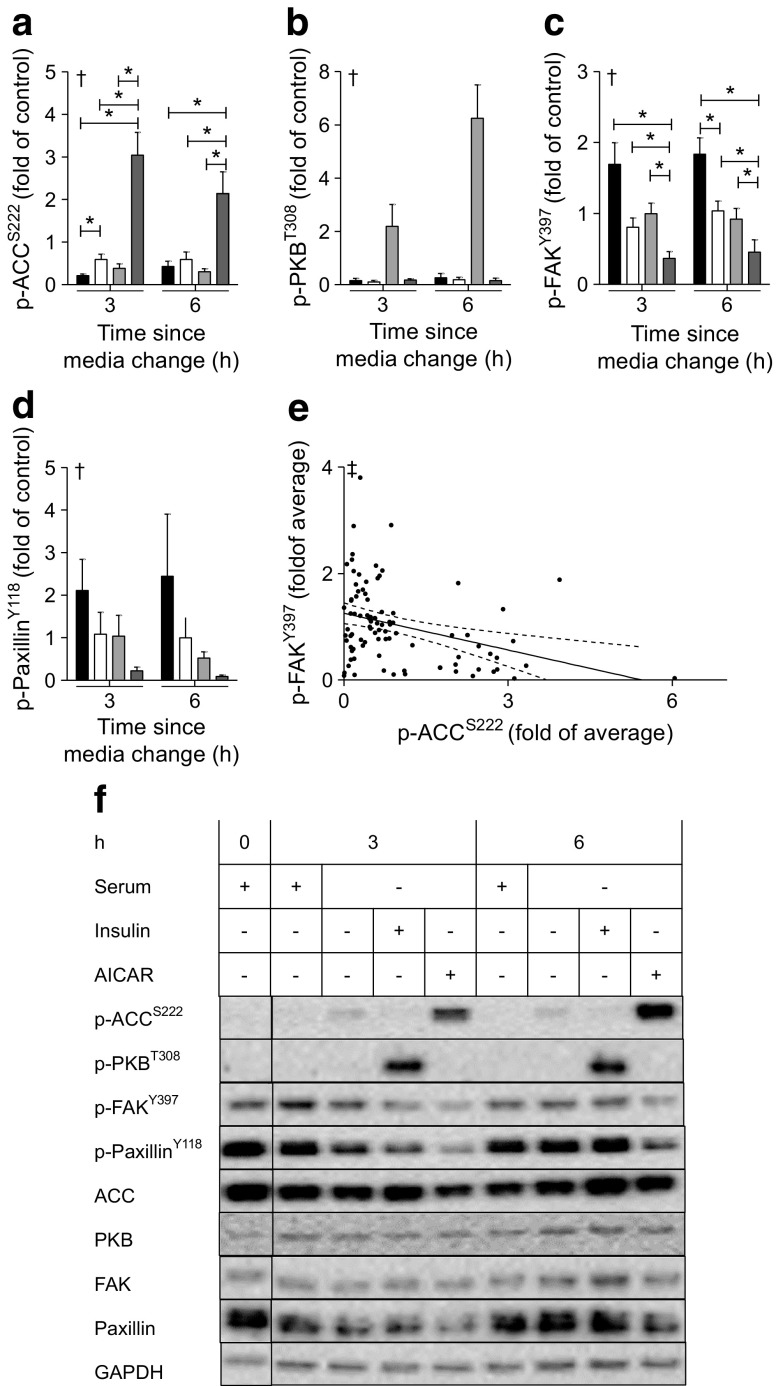
AMPK activation reduced tyrosine phosphorylation of FAK in skeletal muscle. AICAR reduced p-FAK in isolated human skeletal muscle and cultured myotubes. Insulin stimulation did not alter FAK phosphorylation. Serum starvation increased AMPK activation, as demonstrated by increased p-ACC, concomitant with reduced p-FAK. FAK signalling was reduced owing to serum starvation and AICAR treatment as demonstrated by reduced p-paxillin. Silencing PTK2 in primary human skeletal muscle cells increased palmitate oxidation and reduced glycogen synthesis.
CONCLUSIONS/INTERPRETATION: AMPK regulates FAK signalling in skeletal muscle. Moreover, siRNA-mediated FAK knockdown enhances lipid oxidation while impairing glycogen synthesis in skeletal muscle. Further exploration of the interaction between AMPK and FAK may lead to novel therapeutic strategies for diabetes and other chronic conditions associated with an altered metabolic homeostasis.
目的/假设:胰岛素介导的信号和 AMP 激活的蛋白激酶(AMPK)介导的信号分别对代表能量丰富和短缺的生理条件做出反应而被激活。粘着斑激酶(FAK)参与各种非肌肉细胞类型的胰岛素信号转导和癌症进展,并在骨骼肌分化过程中发挥调节作用。FAK 在与胰岛素刺激或 AMPK 激活相关的骨骼肌中的作用尚不清楚。我们检查了胰岛素或 AMPK 激活对人骨骼肌中 FAK 磷酸化的影响,以及 FAK 对葡萄糖和脂质代谢的直接作用。我们假设胰岛素处理和 AMPK 激活对 FAK 磷酸化有相反的影响,并且 FAK 基因沉默会改变代谢。
用人胰岛素或 AMPK 激活剂 5-氨基咪唑-4-甲酰胺核糖核苷酸(AICAR)处理人肌肉,以确定 FAK 磷酸化和葡萄糖转运。使用原代人骨骼肌细胞研究胰岛素或 AICAR 处理在血清饥饿期间对 FAK 信号的影响,以及沉默 FAK 基因 PTK2 的代谢后果。
AMPK 激活降低了骨骼肌中 FAK 的酪氨酸磷酸化。AICAR 降低了分离的人骨骼肌和培养的肌管中的 p-FAK。胰岛素刺激不会改变 FAK 磷酸化。血清饥饿增加了 AMPK 激活,表现为 p-ACC 增加,同时 p-FAK 减少。由于血清饥饿和 AICAR 处理,FAK 信号减少,表现为 p-paxillin 减少。在原代人骨骼肌细胞中沉默 PTK2 增加了棕榈酸氧化,减少了糖原合成。
结论/解释:AMPK 调节骨骼肌中的 FAK 信号。此外,siRNA 介导的 FAK 敲低增强了脂质氧化,同时损害了骨骼肌中的糖原合成。进一步探索 AMPK 和 FAK 之间的相互作用可能会为糖尿病和其他与代谢稳态改变相关的慢性疾病带来新的治疗策略。