Service of Intensive Care Medicine, Spanish Society of Intensive and Critical Care Medicine and Research Group in Critical Disorders (GREPAC), Institut Hospital del Mar d'Investigacions Mèdiques (IMIM), Coronary Units (SEMICYUC) Working Group on Infectious Diseases, Hospital del Mar, Parc de Salut Mar, Universitat Autònoma de Barcelona, Barcelona, Spain.
Service of Intensive Care Medicine, SEMICYUC Working Group on Infectious Diseases, Hospital Universitari Arnau de Vilanova, Lleida, Spain.
Crit Care Med. 2018 Feb;46(2):181-188. doi: 10.1097/CCM.0000000000002736.
The "Pneumonia Zero" project is a nationwide multimodal intervention based on the simultaneous implementation of a comprehensive evidence-based bundle measures to prevent ventilator-associated pneumonia in critically ill patients admitted to the ICU.
Prospective, interventional, and multicenter study.
A total of 181 ICUs throughout Spain.
All patients admitted for more than 24 hours to the participating ICUs between April 1, 2011, and December 31, 2012.
Ten ventilator-associated pneumonia prevention measures were implemented (seven were mandatory and three highly recommended). The database of the National ICU-Acquired Infections Surveillance Study (Estudio Nacional de Vigilancia de Infecciones Nosocomiales [ENVIN]) was used for data collection. Ventilator-associated pneumonia rate was expressed as incidence density per 1,000 ventilator days. Ventilator-associated pneumonia rates from the incorporation of the ICUs to the project, every 3 months, were compared with data of the ENVIN registry (April-June 2010) as the baseline period. Ventilator-associated pneumonia rates were adjusted by characteristics of the hospital, including size, type (public or private), and teaching (postgraduate) or university-affiliated (undergraduate) status.
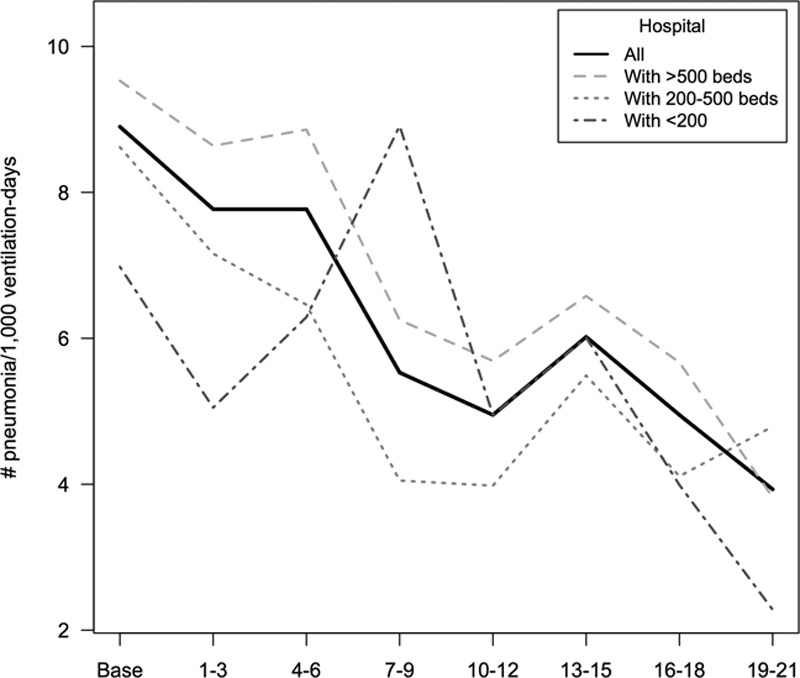
The 181 participating ICUs accounted for 75% of all ICUs in Spain. In a total of 171,237 ICU admissions, an artificial airway was present on 505,802 days (50.0% of days of stay in the ICU). A total of 3,474 ventilator-associated pneumonia episodes were diagnosed in 3,186 patients. The adjusted ventilator-associated pneumonia incidence density rate decreased from 9.83 (95% CI, 8.42-11.48) per 1,000 ventilator days in the baseline period to 4.34 (95% CI, 3.22-5.84) after 19-21 months of participation.
Implementation of the bundle measures included in the "Pneumonia Zero" project resulted in a significant reduction of more than 50% of the incidence of ventilator-associated pneumonia in Spanish ICUs. This reduction was sustained 21 months after implementation.
“肺炎零”项目是一项全国性的多模式干预措施,基于同时实施全面的循证捆绑措施,以预防入住 ICU 的危重症患者发生呼吸机相关性肺炎。
前瞻性、干预性和多中心研究。
西班牙共 181 个 ICU。
2011 年 4 月 1 日至 2012 年 12 月 31 日期间,在参与 ICU 住院超过 24 小时的所有患者。
实施了 10 项呼吸机相关性肺炎预防措施(其中 7 项为强制性措施,3 项为高度推荐措施)。采用国家 ICU 获得性感染监测研究(Estudio Nacional de Vigilancia de Infecciones Nosocomiales [ENVIN])数据库进行数据收集。呼吸机相关性肺炎发生率以每千个呼吸机日发病率表示。将纳入项目的 ICU 的每 3 个月的呼吸机相关性肺炎发生率与基线期(2010 年 4 月至 6 月)的 ENVIN 登记处的数据进行比较。根据医院的特征(大小、公立/私立、教学[研究生]或大学附属[本科生])对呼吸机相关性肺炎发生率进行调整。
参与的 181 个 ICU 占西班牙所有 ICU 的 75%。在 171237 例 ICU 入住患者中,有 505802 天(占 ICU 住院天数的 50.0%)存在人工气道。在 3186 名患者中,共诊断出 3474 例呼吸机相关性肺炎。调整后,基线期每千个呼吸机日的呼吸机相关性肺炎发病率密度为 9.83(95%CI,8.42-11.48),19-21 个月参与后降至 4.34(95%CI,3.22-5.84)。
“肺炎零”项目中包含的捆绑措施的实施,导致西班牙 ICU 中呼吸机相关性肺炎的发生率显著降低了 50%以上。实施 21 个月后,这种降低仍持续存在。