Department of Chemical Drugs, Faculty of Pharmacy, University of Veterinary and Pharmaceutical Sciences, Palackeho 1, Brno 61242, Czech Republic.
Department of Pharmaceutical Chemistry, Faculty of Pharmacy, Comenius University, Odbojarov 10, Bratislava 83232, Slovakia.
Molecules. 2017 Oct 12;22(10):1709. doi: 10.3390/molecules22101709.
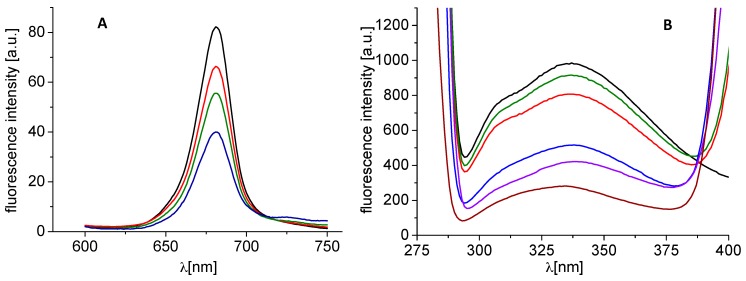
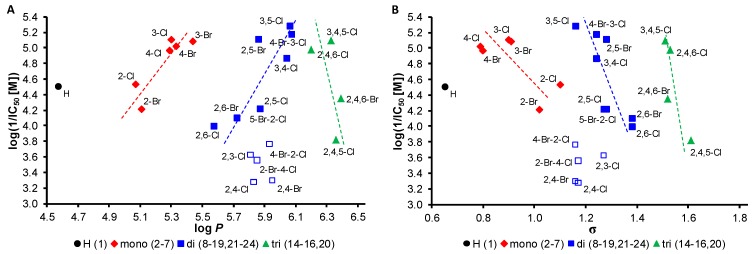
Series of seventeen new multihalogenated 1-hydroxynaphthalene-2-carboxanilides was prepared and characterized. All the compounds were tested for their activity related to the inhibition of photosynthetic electron transport (PET) in spinach ( L.) chloroplasts. 1-Hydroxy--phenylnaphthalene-2-carboxamides substituted in the anilide part by 3,5-dichloro-, 4-bromo-3-chloro-, 2,5-dibromo- and 3,4,5-trichloro atoms were the most potent PET inhibitors (IC = 5.2, 6.7, 7.6 and 8.0 µM, respectively). The inhibitory activity of these compounds depends on the position and the type of halogen substituents, i.e., on lipophilicity and electronic properties of individual substituents of the anilide part of the molecule. Interactions of the studied compounds with chlorophyll and aromatic amino acids present in pigment-protein complexes mainly in PS II were documented by fluorescence spectroscopy. The section between P and plastoquinone Q in the PET chain occurring on the acceptor side of PS II can be suggested as the site of action of the compounds. The structure-activity relationships are discussed.
合成了十七个新的多卤代 1-羟基萘-2-甲酰胺,并对其进行了表征。所有化合物均进行了活性测试,以评估其对菠菜( L.)叶绿体光合电子传递(PET)的抑制作用。在酰胺部分中,被 3,5-二氯、4-溴-3-氯、2,5-二溴和 3,4,5-三氯原子取代的 1-羟基--苯基萘-2-甲酰胺是最有效的 PET 抑制剂(IC 分别为 5.2、6.7、7.6 和 8.0 μM)。这些化合物的抑制活性取决于卤素取代基的位置和类型,即分子酰胺部分中各个取代基的亲脂性和电子性质。荧光光谱研究了这些化合物与叶绿素和色素蛋白复合物中存在的芳香族氨基酸的相互作用,主要在 PS II 中。可以推测,在 PS II 的受体侧发生的 PET 链中,在 P 和 plastoquinone Q 之间的部分是化合物作用的部位。讨论了结构-活性关系。