Sparagana Steven, Franz David N, Krueger Darcy A, Bissler John J, Berkowitz Noah, Burock Karin, Kingswood J Christopher
Texas Scottish Rite Hospital for Children and University of Texas Southwestern Medical Center, Dallas, TX, United States of America.
Cincinnati Children's Hospital Medical Center, Cincinnati, OH, United States of America.
PLoS One. 2017 Oct 12;12(10):e0186235. doi: 10.1371/journal.pone.0186235. eCollection 2017.
To determine the impact of everolimus on female fertility, including menstrual irregularities, secondary amenorrhea, and luteinizing and follicle stimulating hormone levels in female patients.
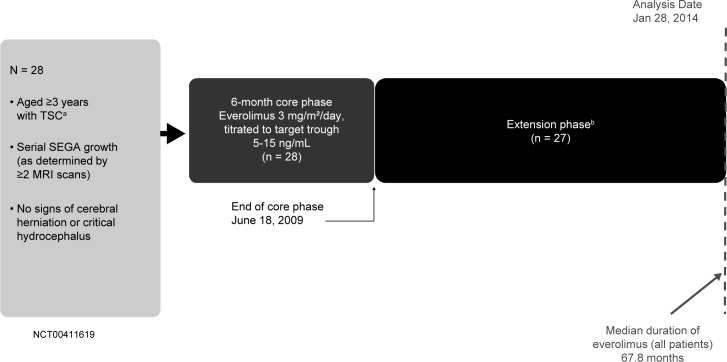
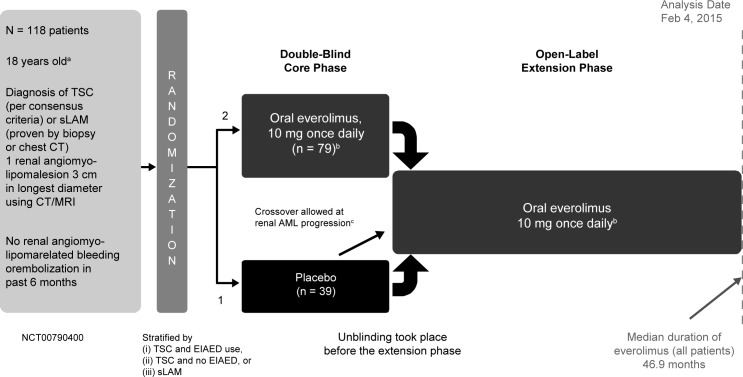
A pooled analysis from 3 prospective studies consisting of a core phase (≥6 months) and a long-term follow-up open-label extension.
One phase 2 single-center and two phase 3 multicenter studies.
Data were obtained from female participants, restricted to those between 10 and 55 years of age, during 1 of 3 of the described clinical trials of everolimus. Patients had received ≥ 1 dose of everolimus.
Incidence of fertility events.
A total of 43/112 patients (38.4%) experienced at least 1 menstrual irregularity. The most common events were amenorrhea (24.1%) and irregular menstruation (17.0%). Seven patients (6.3%) experienced grade 3/4 amenorrhea. When only the longest duration period of amenorrhea for each patient was considered, the median duration was 291 days. Fifteen patients attained menarche during the treatment period in any of the pooled studies. The mean age of menarche for this group was 12.4 years, similar to that of patients who were postmenarche at study entry (12.2 years). A total of 19/92 patients (20.7%) who were postmenarche at baseline or during the study experienced an irregular menstruation event. An increased luteinizing hormone level was reported as an adverse event in 3/112 patients (3%), and follicle-stimulating hormone levels were within normal limits for these patients.
No new safety concerns emerged regarding endocrine function and menstruation in female patients with tuberous sclerosis complex-associated subependymal giant cell astrocytoma or angiomyolipoma, who were receiving everolimus.
ClinicalTrials.gov NCT00411619, NCT00789828, NCT00790400.
确定依维莫司对女性生育能力的影响,包括月经不规律、继发性闭经以及女性患者的黄体生成素和卵泡刺激素水平。
对3项前瞻性研究进行汇总分析,包括一个核心阶段(≥6个月)和长期随访开放标签扩展阶段。
一项2期单中心研究和两项3期多中心研究。
数据来自女性参与者,限于10至55岁之间,在依维莫司上述3项临床试验中的1项期间。患者接受过≥1剂依维莫司。
生育事件的发生率。
总共43/112例患者(38.4%)经历了至少1次月经不规律。最常见的事件是闭经(24.1%)和月经不调(17.0%)。7例患者(6.3%)经历3/4级闭经。仅考虑每位患者闭经的最长持续时间时,中位持续时间为291天。在任何汇总研究中,15例患者在治疗期间月经初潮。该组月经初潮的平均年龄为12.4岁,与研究入组时已绝经的患者(12.2岁)相似。基线或研究期间已绝经的总共19/92例患者(20.7%)经历了月经不规律事件。3/112例患者(3%)报告黄体生成素水平升高为不良事件,这些患者的卵泡刺激素水平在正常范围内。
对于接受依维莫司治疗的结节性硬化症相关室管膜下巨细胞星形细胞瘤或肾血管平滑肌脂肪瘤女性患者,在内分泌功能和月经方面未出现新的安全问题。
ClinicalTrials.gov NCT00411619、NCT00789828、NCT00790400。