Mizoguchi Takanori, Ozaki Mineo, Ogino Nobuchika
Mizoguchi Eye Clinic, Ophthalmology, Sasebo, Japan.
Ozaki Eye Hospital, Ophthalmology, Miyazaki, Japan.
Clin Ophthalmol. 2017 Sep 27;11:1747-1753. doi: 10.2147/OPTH.S141279. eCollection 2017.
To evaluate the efficacy and safety of 0.05% epinastine and 0.1% olopatadine eye drop preparations as seasonal and preseasonal treatments in patients with seasonal allergic conjunctivitis (SAC).
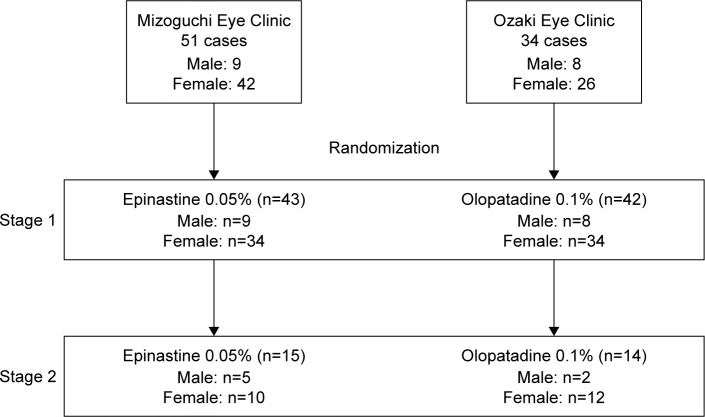
This was a prospective, randomized, case-control study involving two institutions. The subjects were patients diagnosed with SAC at two institutions between February and March in 2014. To examine the clinical effects of seasonal treatment, 0.05% epinastine and 0.1% olopatadine were administered, and their effects were investigated every 2 weeks (Stage 1). To evaluate the clinical effects of preseasonal therapy, in January 2015, the same eye drop preparations as adopted in Stage 1 were administered to patients who had participated in Stage 1 and provided consent to participate in this study, and their effects were investigated every month (Stage 2).
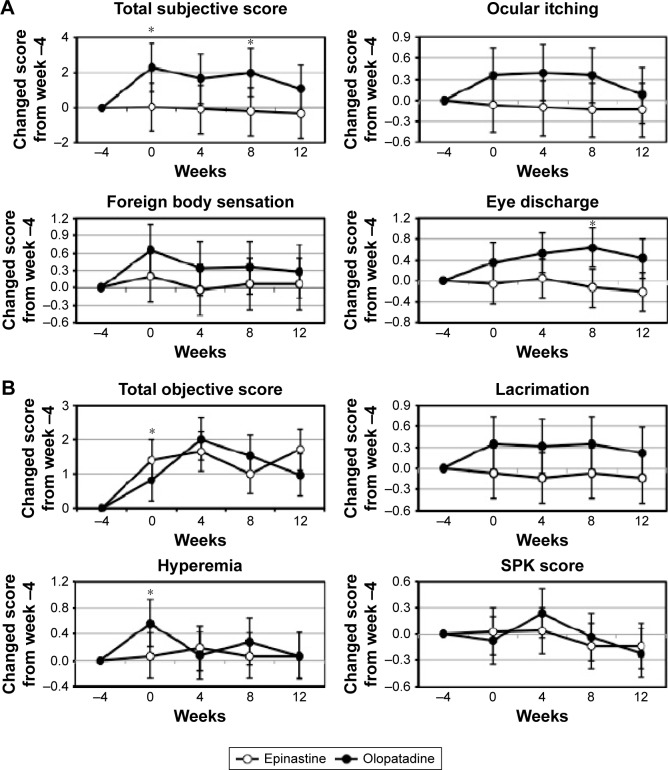
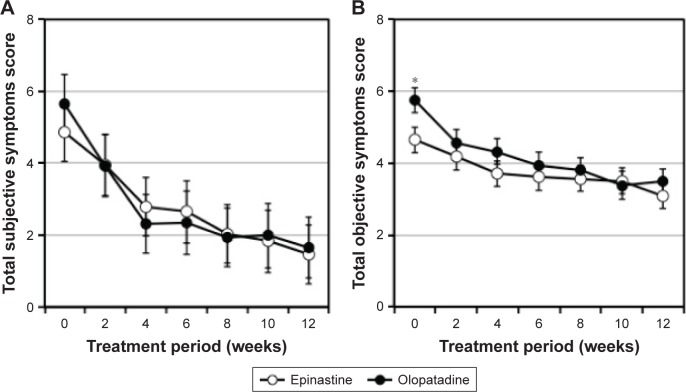
In Stage 1, the 0.05% epinastine group consisted of 43 patients, and the 0.1% olopatadine group consisted of 42 patients. There were significant improvements in the total symptom and objective finding scores at each time point after administration in comparison with those before its baseline, but there were no significant differences between the two groups. In Stage 2, the 0.05% epinastine group consisted of 15 patients, and the 0.1% olopatadine group consisted of 14 patients. The rate of change in the total symptom score in comparison with that at the baseline of preseasonal treatment was significantly higher in the 0.1% olopatadine group 1 month after the start of treatment, suggesting symptom deterioration (=0.025). There was no significant difference in the rate of change in the total objective finding score between the two groups.
Seasonal treatment with 0.05% epinastine or 0.1% olopatadine was equally effective for patients with allergic conjunctivitis. However, for preseasonal therapy, 0.05% epinastine was more effective than 0.1% olopatadine.
评估0.05%依匹斯汀和0.1%奥洛他定滴眼液制剂作为季节性和季节性前治疗方法对季节性变应性结膜炎(SAC)患者的疗效和安全性。
这是一项涉及两个机构的前瞻性、随机、病例对照研究。研究对象为2014年2月至3月期间在两个机构被诊断为SAC的患者。为了研究季节性治疗的临床效果,给予0.05%依匹斯汀和0.1%奥洛他定,并每2周调查一次其效果(第1阶段)。为了评估季节性前治疗的临床效果,2015年1月,将第1阶段采用的相同滴眼液制剂给予参与第1阶段并同意参与本研究的患者,并每月调查一次其效果(第2阶段)。
在第1阶段,0.05%依匹斯汀组有43例患者,0.1%奥洛他定组有42例患者。与基线前相比,给药后各时间点的总症状和客观体征评分均有显著改善,但两组之间无显著差异。在第2阶段,0.05%依匹斯汀组有15例患者,0.1%奥洛他定组有14例患者。治疗开始1个月后,0.1%奥洛他定组总症状评分相对于季节性前治疗基线的变化率显著更高,提示症状恶化(P=0.025)。两组总客观体征评分的变化率无显著差异。
0.05%依匹斯汀或0.1%奥洛他定的季节性治疗对变应性结膜炎患者同样有效。然而,对于季节性前治疗,0.05%依匹斯汀比0.1%奥洛他定更有效。