Lüpke Marvin, Leuchner Michael, Steinbrecher Rainer, Menzel Annette
Technische Universität München, Ecoclimatology, Hans-Carl-von-Carlowitz-Platz 2, 85354 Freising, Germany.
TUM Institute for Advanced Study, Lichtenbergstraße 2 a, 85748 Garching, Germany.
AoB Plants. 2017 Aug 30;9(5):plx045. doi: 10.1093/aobpla/plx045. eCollection 2017 Sep.
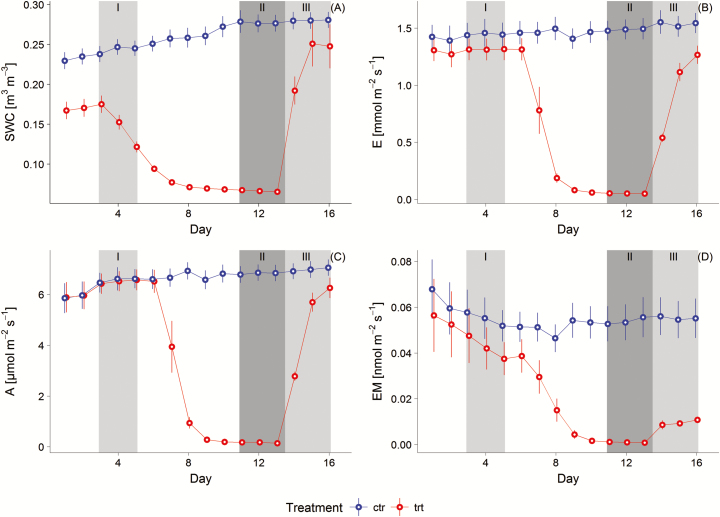
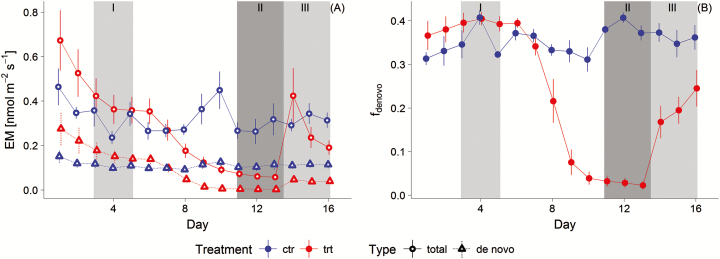
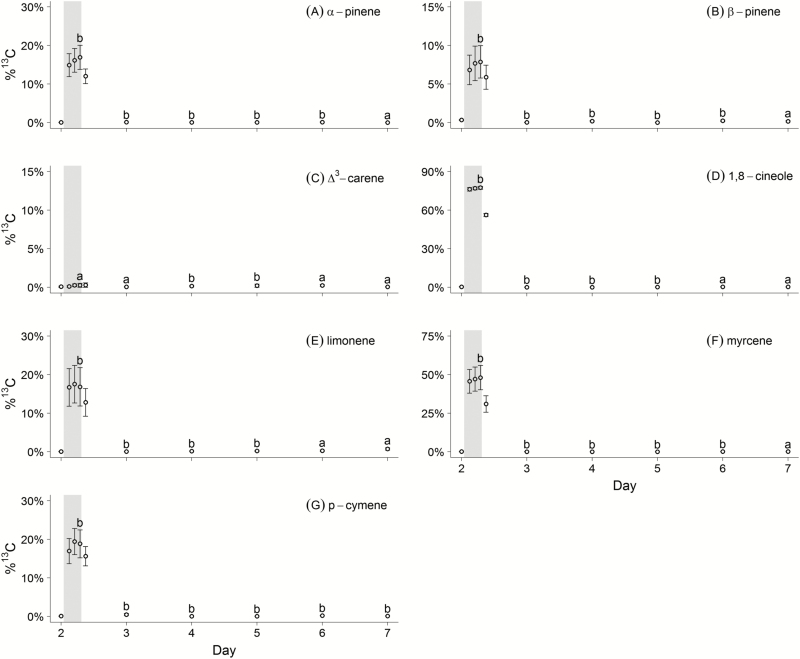
Monoterpene (MT) emissions of conifer tree species, emitted from synthesis and storage pools, play an important role in plant ecology and physiology. During drought stress both emission sources are affected differently and with conventional measuring techniques they are difficult to separate. We investigated C labelled MT emission of eight 3-year-old Scots pine seedlings in a drought stress experiment using a dynamic gas exchange chamber system (Tree DEMON). Monoterpene, water vapour and CO gas exchange were measured for a 2-day normal watering, a 11-day treatment and a 3-day re-watering period. In each period all trees were C labelled once for 5 h. Results showed the expected decrease of MT, water vapour and CO gas exchange with decreasing soil water content. However, during re-watering water vapour and CO gas exchange recovered fast to pre-drought levels, whereas MT increased to a lower level compared to the initial non-stressed phase. The C labelling showed highly variable %C values for different MTs, which ranged compound-specific from 0.5 to 95 % for unstressed trees. Overall, around 36 ± 5 % of the total emission rate originated from synthesized MTs during the 2-day prior to stress period. During full drought, the fraction was reduced to 3 %. For the re-watering phase emissions recovered only partly to 20 %, while pool emissions reached pre-drought conditions. Thus, emissions of synthesized MTs of Scots pine are down-regulated by soil drought rather than MT emissions from pools.
针叶树种的单萜(MT)排放来自合成和储存库,在植物生态和生理过程中发挥着重要作用。在干旱胁迫期间,这两个排放源受到的影响不同,使用传统测量技术很难将它们区分开来。我们在干旱胁迫实验中,使用动态气体交换室系统(Tree DEMON)研究了8株3年生苏格兰松幼苗的¹³C标记MT排放。在2天正常浇水、11天处理和3天重新浇水期间,测量了单萜、水蒸气和CO₂气体交换。在每个时期,所有树木都进行了一次¹³C标记,持续5小时。结果表明,随着土壤含水量的降低,MT、水蒸气和CO₂气体交换如预期那样减少。然而,在重新浇水期间,水蒸气和CO₂气体交换迅速恢复到干旱前水平,而MT与初始非胁迫阶段相比增加到较低水平。¹³C标记显示不同MT的¹³C百分比值变化很大,对于未受胁迫的树木,其范围因化合物而异,从0.5%到95%。总体而言,在胁迫期前的2天内,总排放率中约36±5%来自合成的MT。在完全干旱期间,这一比例降至3%。在重新浇水阶段,排放仅部分恢复到20%,而储存库排放达到干旱前条件。因此,苏格兰松合成MT的排放受到土壤干旱的下调,而不是储存库的MT排放。