Mortensen Joachim Høg, Manon-Jensen Tina, Jensen Michael Dam, Hägglund Per, Klinge Lone Gabriels, Kjeldsen Jens, Krag Aleksander, Karsdal Morten Asser, Bay-Jensen Anne-Christine
Nordic Bioscience, Biomarkers and Research, Herlev, Denmark.
Department of Internal Medicine, Lillebaelt Hospital Vejle, Vejle, Denmark.
PLoS One. 2017 Oct 13;12(10):e0185855. doi: 10.1371/journal.pone.0185855. eCollection 2017.
Increased protease activity is a key pathological feature of inflammatory bowel disease (IBD). However, the differences in extracellular matrix remodelling (ECM) in Crohn's disease (CD) and ulcerative colitis (UC) are not well described. An increased understanding of the inflammatory processes may provide optimized disease monitoring and diagnostics. We investigated the tissue remodelling in IBD and IBS patients by using novel blood-based biomarkers reflecting ECM remodelling.
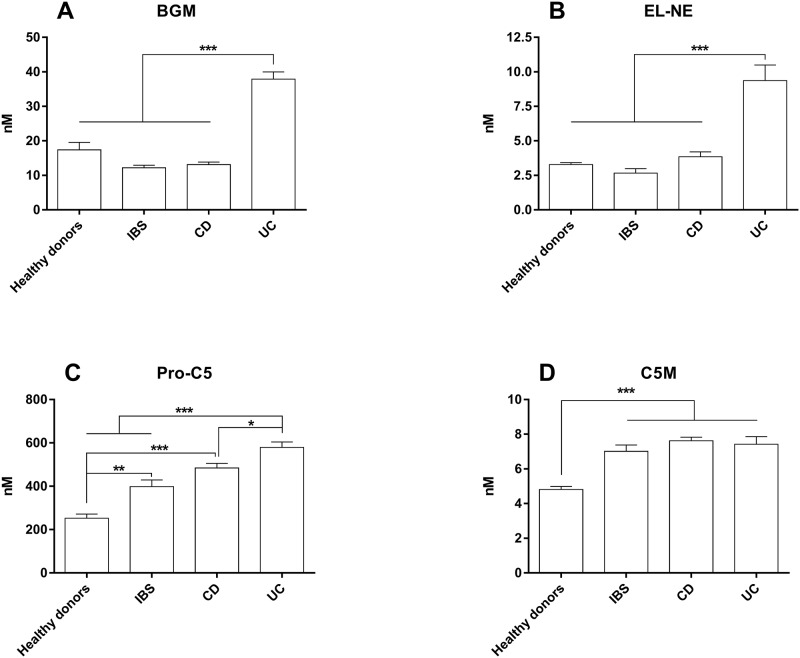
Five ECM biomarkers (VICM, BGM, EL-NE, C5M, Pro-C5) were measured by competitive ELISAs in serum from 72 CD patients, 60 UC patients, 22 patients with irritable bowel syndrome (IBS), and 24 healthy donors. One-way analysis of variance, Mann-Whitney U-test, logistic regression models, and receiver operator characteristics (ROC) curve analysis was carried out to evaluate the diagnostic accuracy of the biomarkers.
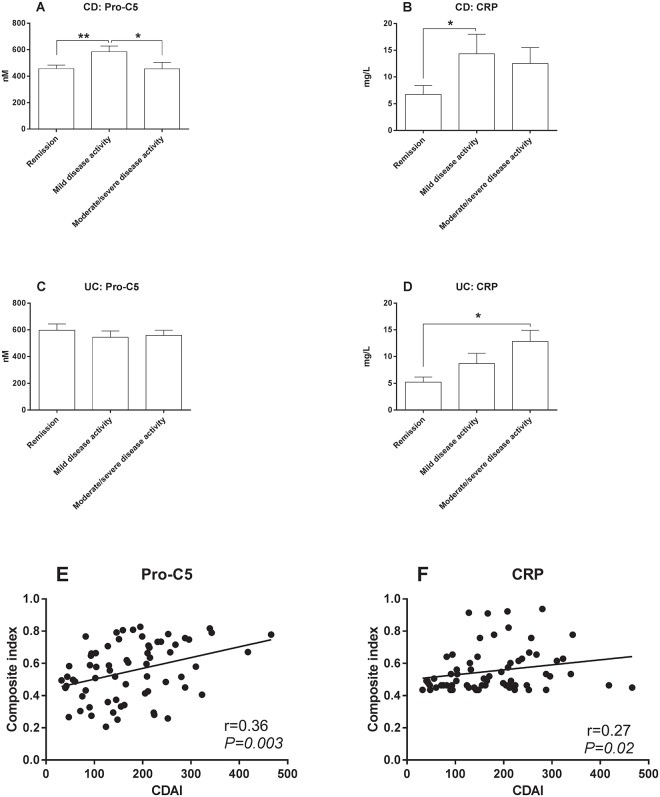
The ECM remodelling was significantly different in UC compared to CD. The best biomarker combination to differentiate UC from CD and colonic CD was BGM and VICM (AUC = 0.98, P<0.001; AUC = 0.97, P<0.001), and the best biomarker combination to differentiate IBD from IBS patients were BGM, EL-NE, and Pro-C5 (AUC = 0.8, P<0.001). When correcting for the use of immunosuppressant and elevated CRP levels (CRP>5mg/mL), correlation of Pro-C5 (r = 0.36) with CDAI was slightly improved compared to CRP (r = 0.27) corrected for the use of immunosuppressant. Furthermore, BGM and EL-NE biomarkers were highly associated with colon inflammation in CD patients.
ECM fragments of tissue remodelling in IBD affect UC and CD differently, and may aid in differentiating IBD from IBS (EL-NE, BGM, Pro-C5), and UC from CD patients (BGM, VICM). Formation of type V collagen is related to the level of inflammation in CD and may reflect disease activity in CD.
蛋白酶活性增加是炎症性肠病(IBD)的关键病理特征。然而,克罗恩病(CD)和溃疡性结肠炎(UC)细胞外基质重塑(ECM)的差异尚未得到充分描述。对炎症过程的深入了解可能有助于优化疾病监测和诊断。我们通过使用反映ECM重塑的新型血液生物标志物,研究了IBD和肠易激综合征(IBS)患者的组织重塑情况。
通过竞争性酶联免疫吸附测定法(ELISA),检测了72例CD患者、60例UC患者、22例肠易激综合征(IBS)患者和24名健康供体血清中的5种ECM生物标志物(VICM、BGM、EL-NE、C5M、Pro-C5)。采用单因素方差分析、曼-惠特尼U检验、逻辑回归模型和受试者工作特征(ROC)曲线分析,评估这些生物标志物的诊断准确性。
与CD相比,UC中的ECM重塑存在显著差异。区分UC与CD以及结肠CD的最佳生物标志物组合是BGM和VICM(曲线下面积[AUC]=0.98,P<0.001;AUC=0.97,P<0.001),区分IBD与IBS患者的最佳生物标志物组合是BGM、EL-NE和Pro-C5(AUC=0.8,P<0.001)。在校正免疫抑制剂的使用和升高的C反应蛋白(CRP)水平(CRP>5mg/mL)后,与校正免疫抑制剂使用后的CRP(r=0.27)相比,Pro-C5与CD活动指数(CDAI)的相关性(r=0.36)略有改善。此外,BGM和EL-NE生物标志物与CD患者的结肠炎症高度相关。
IBD中组织重塑的ECM片段对UC和CD的影响不同,可能有助于区分IBD与IBS(EL-NE、BGM、Pro-C5)以及UC与CD患者(BGM、VICM)。V型胶原的形成与CD中的炎症水平相关,可能反映CD的疾病活动。