McLean Alistair R D, Stanisic Danielle, McGready Rose, Chotivanich Kesinee, Clapham Caroline, Baiwog Francesca, Pimanpanarak Mupawjay, Siba Peter, Mueller Ivo, King Christopher L, Nosten François, Beeson James G, Rogerson Stephen, Simpson Julie A, Fowkes Freya J I
Burnet Institute, Melbourne, Victoria, Australia.
Centre for Epidemiology and Biostatistics, Melbourne School of Population and Global Health, The University of Melbourne, Melbourne, Australia.
PLoS One. 2017 Oct 13;12(10):e0186577. doi: 10.1371/journal.pone.0186577. eCollection 2017.
During pregnancy, immunoglobulin G (IgG) is transferred from the mother to the fetus, providing protection from disease in early infancy. Plasmodium falciparum infections may reduce maternofetal antibody transfer efficiency, but mechanisms remain unclear.
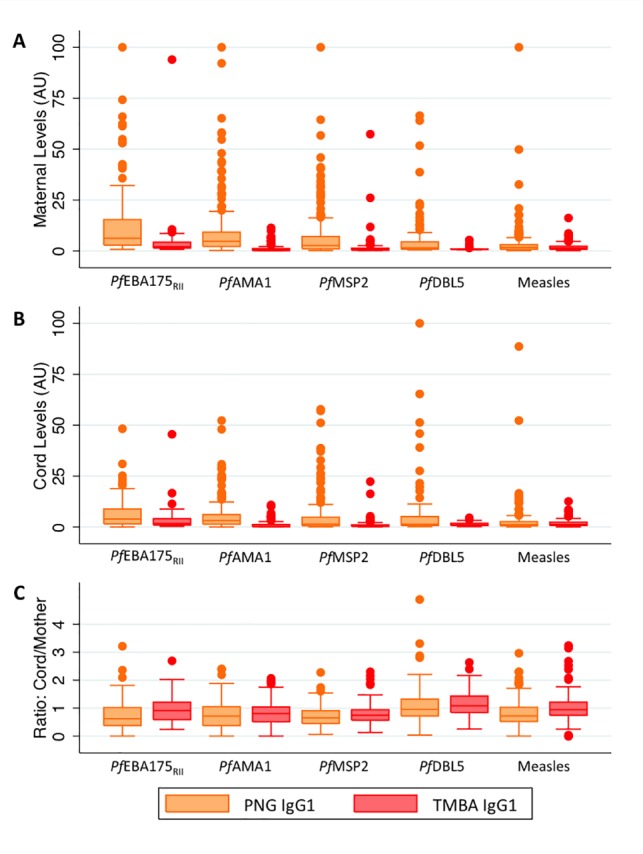
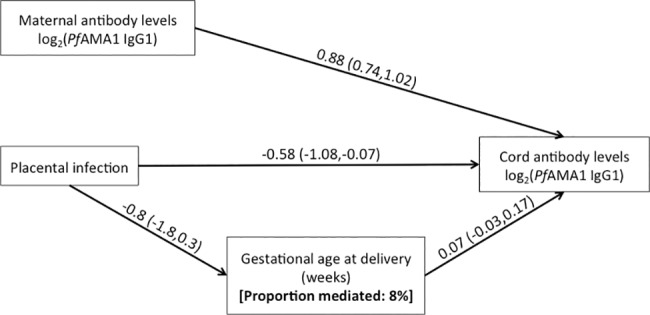
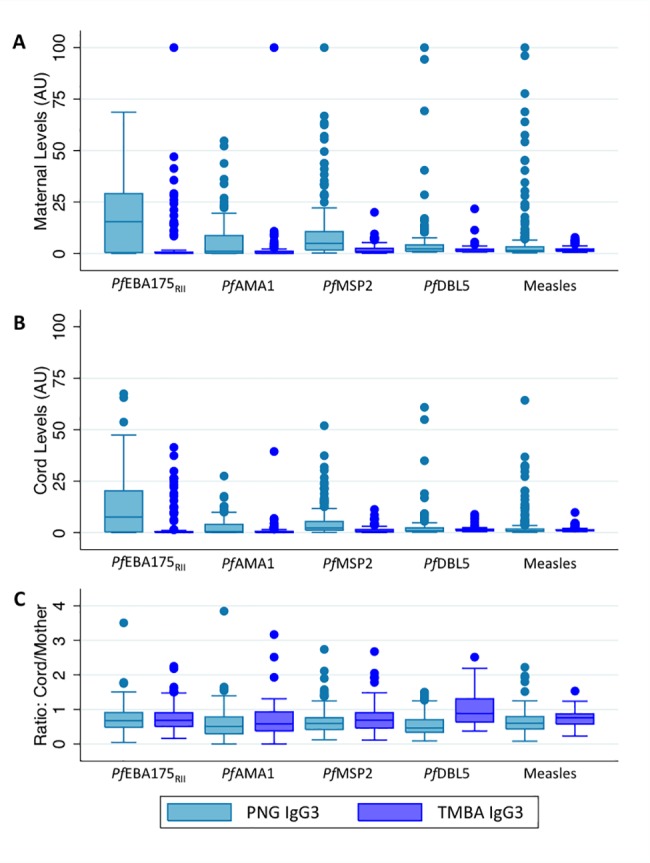
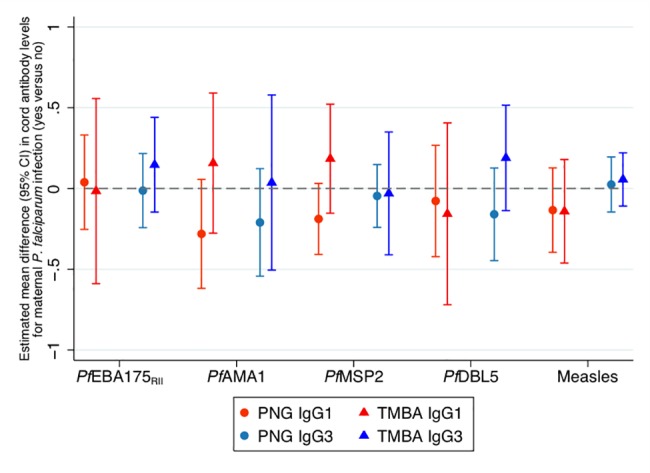
Mother-cord paired serum samples collected at delivery from Papua New Guinea (PNG) and the Thailand-Myanmar Border Area (TMBA) were tested for IgG1 and IgG3 to four P. falciparum antigens and measles antigen, as well as total serum IgG. Multivariable linear regression was conducted to assess the association of peripheral P. falciparum infection during pregnancy or placental P. falciparum infection assessed at delivery with maternofetal antibody transfer efficiency. Path analysis assessed the extent to which associations between P. falciparum infection and antibody transfer were mediated by gestational age at delivery or levels of maternal total serum IgG.
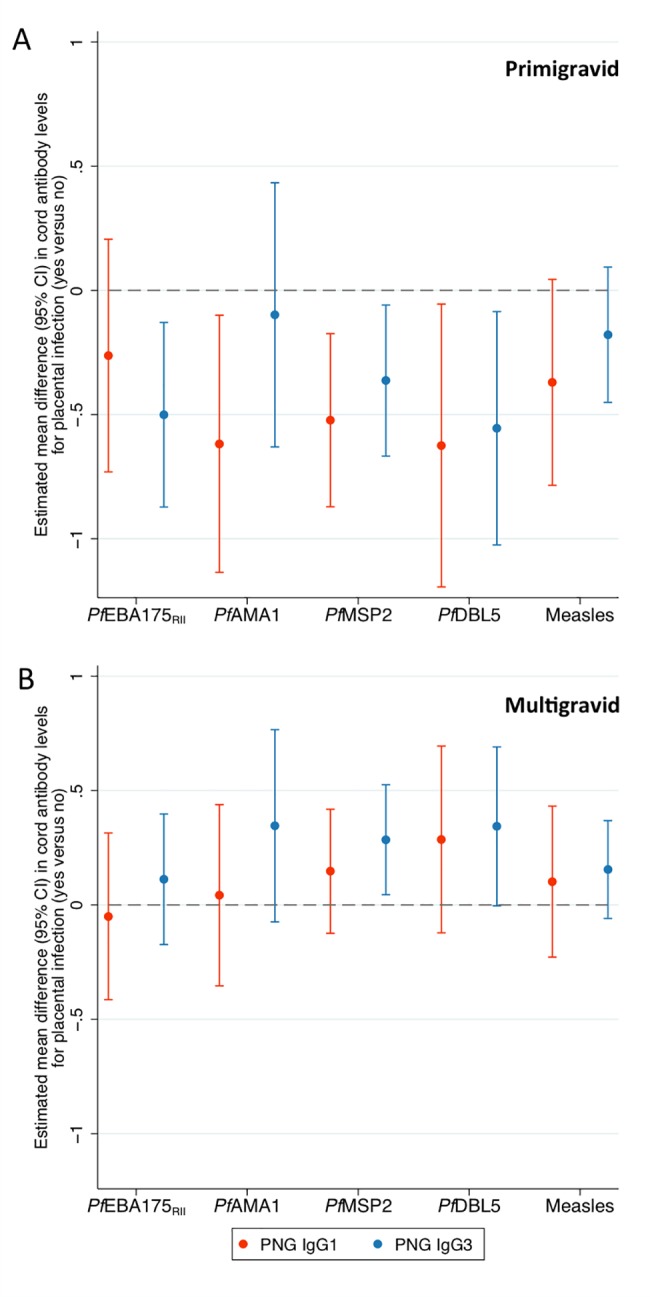
Maternofetal antibody transfer efficiency of IgG1 and IgG3 was lower in PNG compared to TMBA (mean difference in cord antibody levels (controlling for maternal antibody levels) ranged from -0.88 to 0.09, median of -0.20 log2 units). Placental P. falciparum infections were associated with substantially lower maternofetal antibody transfer efficiency in PNG primigravid women (mean difference in cord antibody levels (controlling for maternal antibody levels) ranged from -0.62 to -0.10, median of -0.36 log2 units), but not multigravid women. The lower antibody transfer efficiency amongst primigravid women with placental infection was only partially mediated by gestational age at delivery (proportion indirect effect ranged from 0% to 18%), whereas no mediation effects of maternal total serum IgG were observed.
Primigravid women may be at risk of impaired maternofetal antibody transport with placental P. falciparum infection. Direct effects of P. falciparum on the placenta, rather than earlier gestational age and elevated serum IgG, are likely responsible for the majority of the reduction in maternofetal antibody transfer efficiency with placental infection.
在孕期,免疫球蛋白G(IgG)从母亲传递给胎儿,为婴儿早期提供疾病防护。恶性疟原虫感染可能会降低母婴抗体传递效率,但其机制尚不清楚。
对在巴布亚新几内亚(PNG)以及泰国-缅甸边境地区(TMBA)分娩时采集的母婴配对血清样本进行检测,分析针对四种恶性疟原虫抗原、麻疹抗原的IgG1和IgG3,以及总血清IgG。采用多变量线性回归评估孕期外周血恶性疟原虫感染或分娩时评估的胎盘恶性疟原虫感染与母婴抗体传递效率之间的关联。路径分析评估了恶性疟原虫感染与抗体传递之间的关联在多大程度上由分娩时的孕周或母亲总血清IgG水平介导。
与TMBA相比,PNG中IgG1和IgG3的母婴抗体传递效率较低(脐血抗体水平的平均差异(校正母亲抗体水平后)范围为-0.88至0.09,中位数为-0.20 log2单位)。在PNG初产妇中,胎盘恶性疟原虫感染与母婴抗体传递效率显著降低相关(脐血抗体水平的平均差异(校正母亲抗体水平后)范围为-0.62至-0.10,中位数为-0.36 log2单位),但经产妇则不然。胎盘感染的初产妇中较低的抗体传递效率仅部分由分娩时的孕周介导(间接效应比例范围为0%至18%),而未观察到母亲总血清IgG的介导作用。
初产妇可能因胎盘恶性疟原虫感染而面临母婴抗体转运受损的风险。恶性疟原虫对胎盘的直接影响,而非更早的孕周和升高的血清IgG,可能是胎盘感染导致母婴抗体传递效率降低的主要原因。