School of Public Health, Brown University, Providence, RI, USA.
Global Health Initiative, Northeastern University, Boston, MA, USA.
Health Policy Plan. 2017 Dec 1;32(10):1407-1416. doi: 10.1093/heapol/czx121.
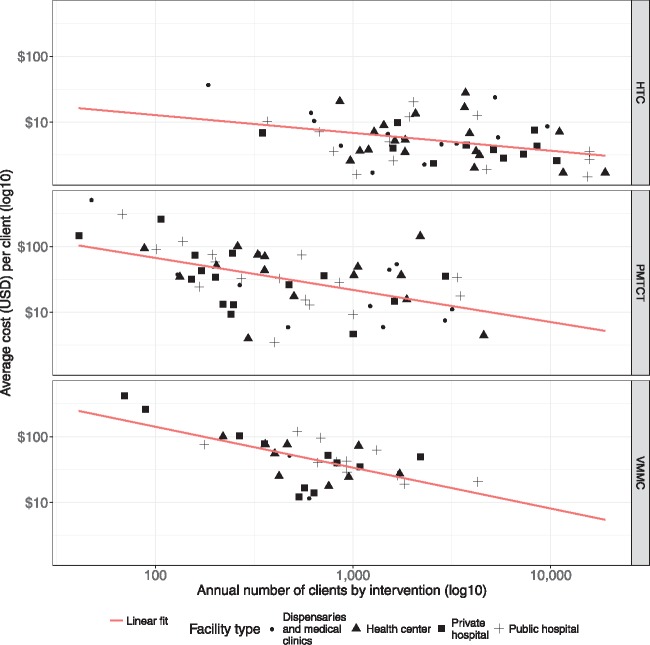
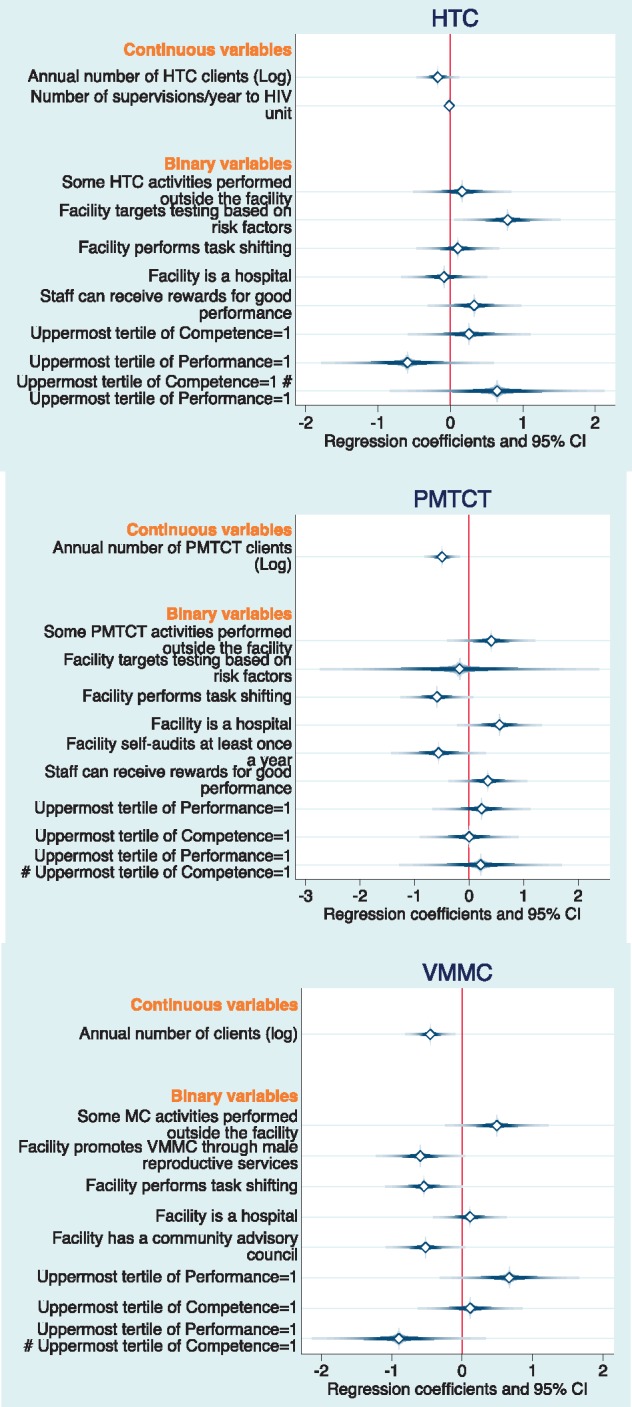
We estimate costs and their predictors for three HIV prevention interventions in Kenya: HIV testing and counselling (HTC), prevention of mother-to-child transmission (PMTCT) and voluntary medical male circumcision (VMMC). As part of the 'Optimizing the Response of Prevention: HIV Efficiency in Africa' (ORPHEA) project, we collected retrospective data from government and non-governmental health facilities for 2011-12. We used multi-stage sampling to determine a sample of health facilities by type, ownership, size and interventions offered totalling 144 sites in 78 health facilities in 33 districts across Kenya. Data sources included key informants, registers and time-motion observation methods. Total costs of production were computed using both quantity and unit price of each input. Average cost was estimated by dividing total cost per intervention by number of clients accessing the intervention. Multivariate regression methods were used to analyse predictors of log-transformed average costs. Average costs were $7 and $79 per HTC and PMTCT client tested, respectively; and $66 per VMMC procedure. Results show evidence of economies of scale for PMTCT and VMMC: increasing the number of clients per year by 100% was associated with cost reductions of 50% for PMTCT, and 45% for VMMC. Task shifting was associated with reduced costs for both PMTCT (59%) and VMMC (54%). Costs in hospitals were higher for PMTCT (56%) in comparison to non-hospitals. Facilities that performed testing based on risk factors as opposed to universal screening had higher HTC average costs (79%). Lower VMMC costs were associated with availability of male reproductive health services (59%) and presence of community advisory board (52%). Aside from increasing production scale, HIV prevention costs may be contained by using task shifting, non-hospital sites, service integration and community supervision.
艾滋病毒检测和咨询(HTC)、预防母婴传播(PMTCT)和自愿男性包皮环切术(VMMC)。作为“优化艾滋病毒预防应对措施:非洲艾滋病毒效率”(ORPHEA)项目的一部分,我们收集了 2011-12 年政府和非政府卫生机构的回溯性数据。我们采用多阶段抽样方法,通过类型、所有权、规模和提供的干预措施确定了卫生机构的样本,共包括肯尼亚 33 个县 78 个卫生机构的 144 个地点。数据来源包括主要知情人、登记册和时间动作观察方法。使用每种投入的数量和单价计算了生产总成本。通过将每种干预措施的总成本除以接受干预措施的客户数量,计算了平均成本。使用多元回归方法分析了对数转换后的平均成本的预测因素。每检测一个 HTC 和 PMTCT 客户的平均成本分别为 7 美元和 79 美元;每例 VMMC 手术的平均成本为 66 美元。结果表明 PMTCT 和 VMMC 存在规模经济:每年客户数量增加 100%,与 PMTCT 成本降低 50%和 VMMC 成本降低 45%相关。任务转移与 PMTCT(59%)和 VMMC(54%)成本降低相关。与非医院相比,医院的 PMTCT 成本更高(56%)。与普遍筛查相比,基于风险因素进行检测的设施 HTC 平均成本更高(79%)。VMMC 成本较低与男性生殖健康服务的提供(59%)和社区咨询委员会的存在(52%)相关。除了提高生产规模之外,还可以通过任务转移、非医院地点、服务整合和社区监督来控制艾滋病毒预防成本。