Liu Shihui, Ma Qian, Fattah Rasem, Bugge Thomas H, Leppla Stephen H
Proteases and Tissue Remodeling Section, National Institute of Dental and Craniofacial Research, National Institutes of Health, Bethesda, MD 20892, USA.
Microbial Pathogenesis Section, Laboratory of Parasitic Diseases, National Institute of Allergy and Infectious Diseases, National Institutes of Health, Bethesda, MD 20892, USA.
Oncotarget. 2017 May 9;8(39):65123-65131. doi: 10.18632/oncotarget.17729. eCollection 2017 Sep 12.
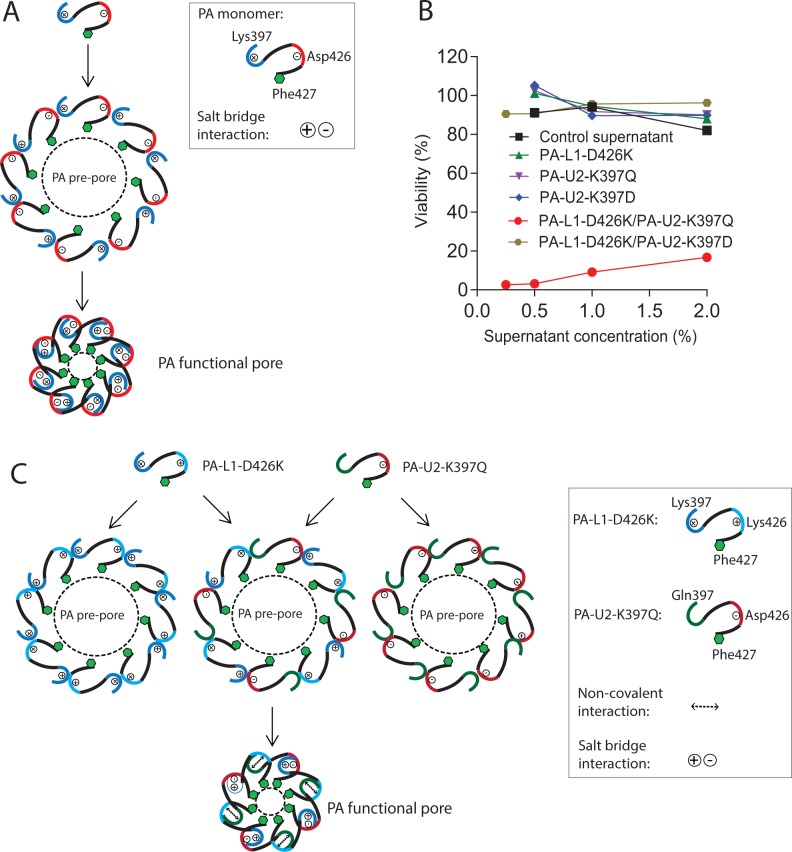
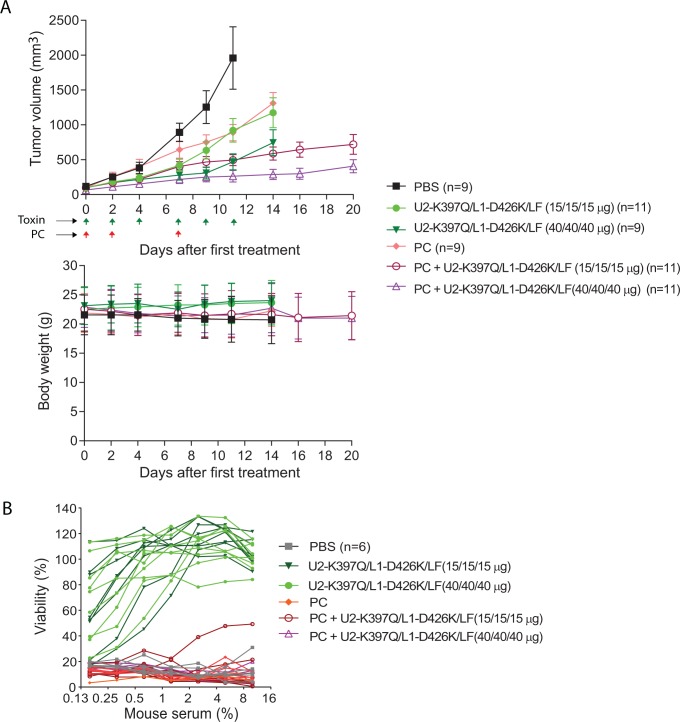
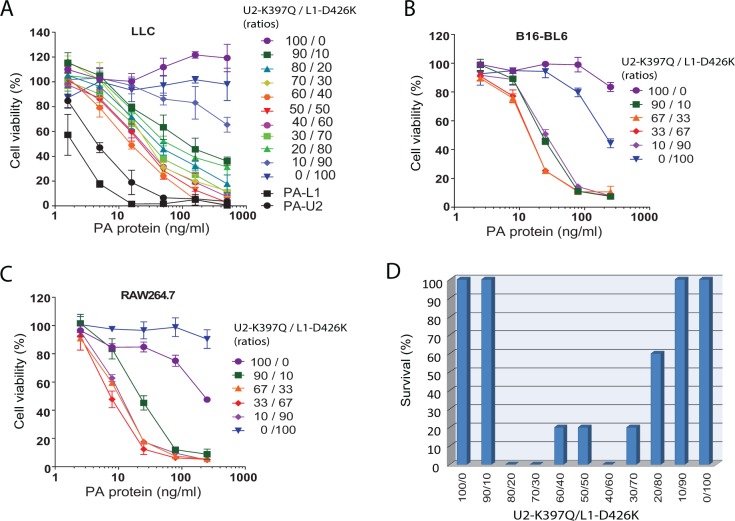
Anthrax lethal toxin is a typical A-B type protein toxin secreted by . Lethal factor (LF) is the catalytic A-subunit, a metalloprotease having MEKs as targets. LF relies on the cell-binding B-subunit, protective antigen (PA), to gain entry into the cytosol of target cells. PA binds to cell surface toxin receptors and is activated by furin protease to form an LF-binding-competent oligomer-PA pre-pore, which converts to a functional protein-conductive pore in the acidic endocytic vesicles, allowing translocation of LF into the cytosol. During PA pre-pore-to-pore conversion, the intermolecular salt bridge interactions between Lys397 and Asp426 on adjacent PA protomers play a critical role in positioning neighboring luminal Phe427 residues to form the Phe-clamp, an essential element of the PA functional pore. This essential intermolecular interaction affords the opportunity to create pairs of PA variants that depend on intermolecular complementation to form a functional pore. We have previously generated PA variants with furin-cleavage site replaced by substrate sequences of tumor-associated proteases, such as urokinase or MMPs. Here we show that PA-U2-K397Q, a urokinase-activated PA variant with Lys397 residue replaced by glutamine, and PA-L1-D426K, a MMP-activated PA variant with Asp426 changed to lysine, do not form functional pores both or unless they are used together. Further, the mixture of PA-U2-K397Q and PA-L1-D426K displayed potent anti-tumor activity in the presence of LF. Thus, PA-U2-K397Q and PA-L1-D426K form a novel intermolecular complementation system with toxin activation relying on the presence of two distinct tumor-associated proteases, i.e., urokinase and MMPs.
炭疽致死毒素是由……分泌的一种典型的A-B型蛋白质毒素。致死因子(LF)是催化性A亚基,是一种以MEKs为靶点的金属蛋白酶。LF依赖细胞结合性B亚基保护性抗原(PA)进入靶细胞的胞质溶胶。PA与细胞表面毒素受体结合,并被弗林蛋白酶激活形成具有LF结合能力的寡聚体——PA前孔,该前孔在酸性内吞小泡中转化为功能性蛋白质传导孔,使LF能够转运到胞质溶胶中。在PA前孔到孔的转化过程中,相邻PA原体上的Lys397和Asp426之间的分子间盐桥相互作用在定位相邻腔面Phe427残基以形成Phe钳(PA功能孔的关键元件)方面起着关键作用。这种关键的分子间相互作用提供了创造依赖分子间互补形成功能性孔的PA变体对的机会。我们之前已经生成了将弗林蛋白酶切割位点替换为肿瘤相关蛋白酶(如尿激酶或基质金属蛋白酶)底物序列的PA变体。在这里我们表明,PA-U2-K397Q(一种将Lys397残基替换为谷氨酰胺的尿激酶激活的PA变体)和PA-L1-D426K(一种将Asp426替换为赖氨酸的基质金属蛋白酶激活的PA变体),单独使用时都不能形成功能性孔,除非它们一起使用。此外,在存在LF的情况下,PA-U2-K397Q和PA-L1-D426K的混合物表现出强大的抗肿瘤活性。因此,PA-U2-K397Q和PA-L1-D426K形成了一种新型的分子间互补系统,毒素激活依赖于两种不同的肿瘤相关蛋白酶(即尿激酶和基质金属蛋白酶)的存在。