Koo Taeryool, Cho Bong Jun, Kim Dan Hyo, Park Ji Min, Choi Eun Jung, Kim Hans H, Lee David J, Kim In Ah
Department of Radiation Oncology, Graduate School of Medicine, Seoul National University, Seoul, Republic of Korea.
Medical Science Research Institute, Seoul National University Bundang Hospital, Seongnam, Republic of Korea.
Oncotarget. 2017 Jul 3;8(39):65457-65468. doi: 10.18632/oncotarget.18924. eCollection 2017 Sep 12.
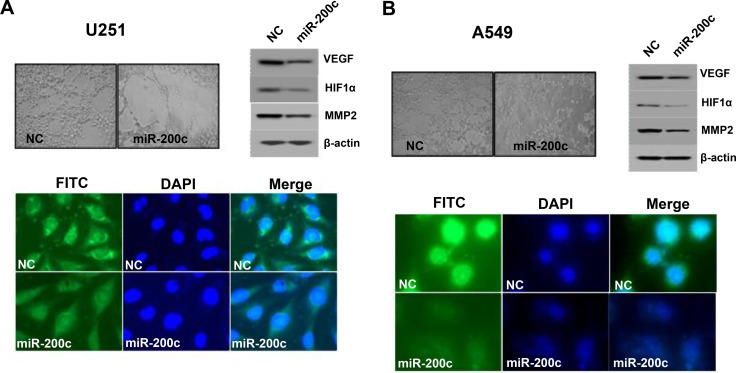
MicroRNA-200c (miR-200c) recently was found to have tumor-suppressive properties by inhibiting the epithelial-mesenchymal transition (EMT) in several cancers. miR-200c also interacts with various cellular signaling molecules and regulates many important signaling pathways. In this study, we investigated the radiosensitizing effect of miR-200c and its mechanism in a panel of human cancer cell lines. Malignant glioma (U251, T98G), breast cancer (MDA-MB-468), and lung carcinoma (A549) cells were transfected with control pre-microRNA, pre-miR-200c, or anti-miR-200c. Then, RT-PCR, clonogenic assays, immunoblotting, and immunocytochemisty were performed. To predict the potential targets of miR-200c, microRNA databases were used for bioinformatics analysis. Ectopic overexpression of miR-200c downregulated p-EGFR and p-AKT and increased the radiosensitivity of U251, T98G, A549, and MDA-MB-468 cells. In contrast, miR-200c inhibition upregulated p-EGFR and p-AKT, and decreased radiation-induced cell killing. miR-200c led to persistent γH2AX focus formation and downregulated pDNA-PKc expression. Autophagy and apoptosis were major modes of cell death. Bioinformatics analysis predicted that miR-200c may be associated with , and . We also confirmed that miR-200c downregulated the expression of VEGF, HIF-1α, and MMP2 in U251 and A549 cells. In these cells, overexpressing miR-200c inhibited invasion, migration, and vascular tube formation. These phenotypic changes were associated with E-cadherin and EphA2 downregulation and N-cadherin upregulation. miR-200c showed no observable cytotoxic effect on normal human fibroblasts and astrocytes. Taken together, our data suggest that miR-200c is an attractive target for improving the efficacy of radiotherapy via a unique modulation of the complex regulatory network controlling cancer pro-survival signaling and EMT.
微小RNA-200c(miR-200c)最近被发现通过抑制多种癌症中的上皮-间质转化(EMT)具有肿瘤抑制特性。miR-200c还与多种细胞信号分子相互作用并调节许多重要的信号通路。在本研究中,我们研究了miR-200c在一组人类癌细胞系中的放射增敏作用及其机制。用对照前体微小RNA、前体miR-200c或抗miR-200c转染恶性胶质瘤(U251、T98G)、乳腺癌(MDA-MB-468)和肺癌(A549)细胞。然后,进行逆转录-聚合酶链反应(RT-PCR)、克隆形成试验、免疫印迹和免疫细胞化学分析。为了预测miR-200c的潜在靶点,使用微小RNA数据库进行生物信息学分析。miR-200c的异位过表达下调了磷酸化表皮生长因子受体(p-EGFR)和磷酸化蛋白激酶B(p-AKT),并增加了U251、T98G、A549和MDA-MB-468细胞的放射敏感性。相反,抑制miR-200c上调了p-EGFR和p-AKT,并减少了辐射诱导的细胞杀伤。miR-200c导致持续的γH2AX焦点形成并下调磷酸化DNA依赖蛋白激酶催化亚基(pDNA-PKc)的表达。自噬和凋亡是细胞死亡的主要方式。生物信息学分析预测miR-200c可能与 和 相关。我们还证实miR-200c下调了U251和A549细胞中血管内皮生长因子(VEGF)、缺氧诱导因子-1α(HIF-1α)和基质金属蛋白酶2(MMP2)的表达。在这些细胞中,过表达miR-200c抑制侵袭、迁移和血管管形成。这些表型变化与E-钙黏蛋白和EphA2下调以及N-钙黏蛋白上调有关。miR-200c对正常人成纤维细胞和星形胶质细胞未显示出明显的细胞毒性作用。综上所述,我们的数据表明,miR-200c通过独特地调节控制癌症生存信号和EMT的复杂调控网络,是提高放射治疗疗效的一个有吸引力的靶点。