Wu Di, Duan Chongyang, Wu Fenfang, Chen Liyong, Chen Size
Central Laboratory, The First Affiliated Hospital of Guangdong Pharmaceutical University, Guangzhou, China.
Department of Biostatistics, School of Public Health, Southern Medical University, Guangzhou, China.
Oncotarget. 2017 Aug 16;8(39):66491-66503. doi: 10.18632/oncotarget.20281. eCollection 2017 Sep 12.
The recommendations regarding the optimum treatment for advanced non-small-cell lung cancer (NSCLC) patients with wild-type (WT) epidermal growth factor receptor (EGFR) tumors remain unclear. This meta-analysis was conducted to assess the efficacy among programmed death-ligand 1 (PD-L1)/programmed death-1 (PD-1) antibody, EGFR-tyrosine kinase inhibitors (TKI) and chemotherapy in second-and third-line therapy.
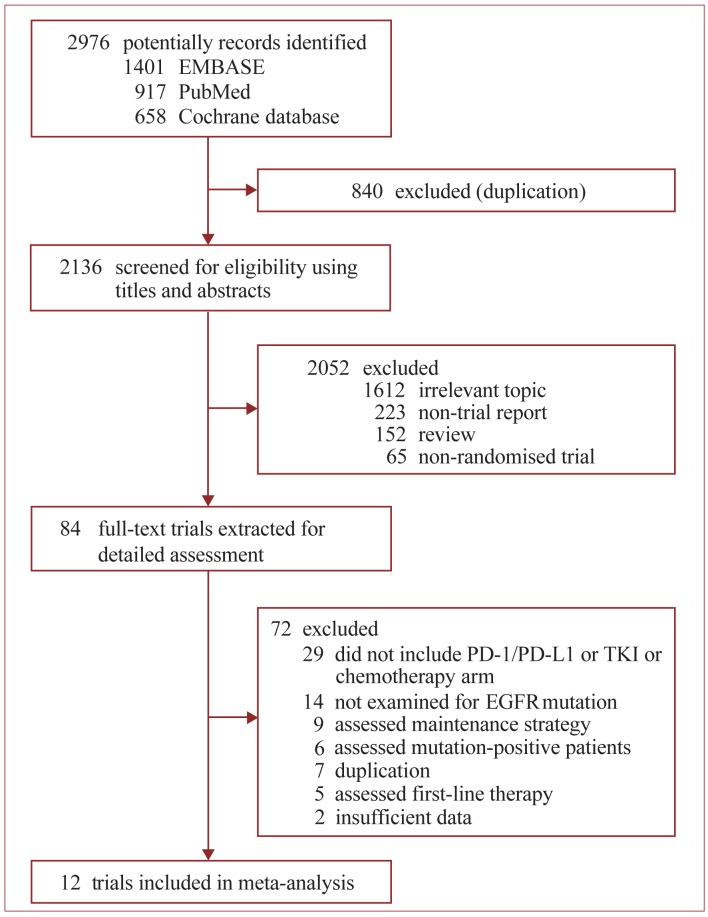
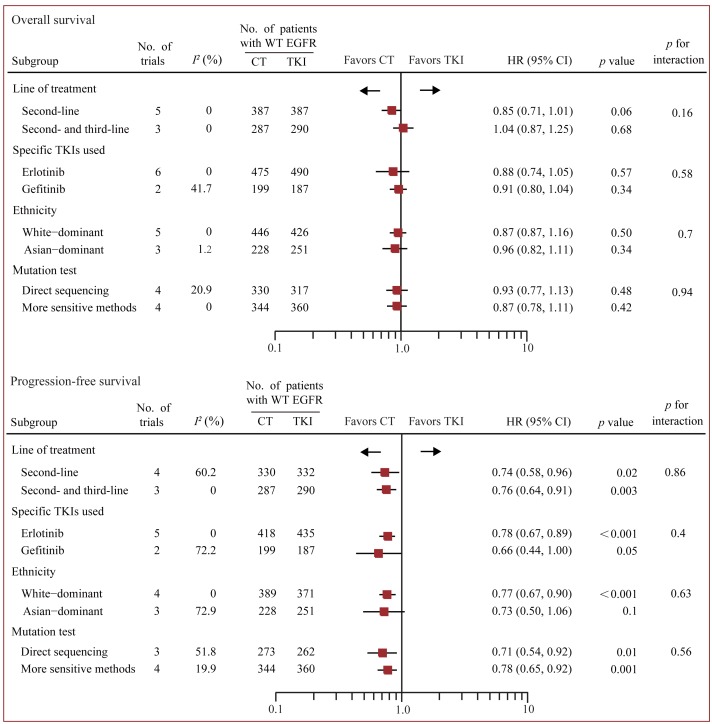
Randomized trials investigating two of the three treatments were searched and included. Multiple treatments comparison and pairwise comparison were performed to assess overall survival (OS) and progression-free survival (PFS), expressed as hazard ratios (HRs). The effect of prespecified study-level characteristics was assessed by subgroup analysis and meta-regression.
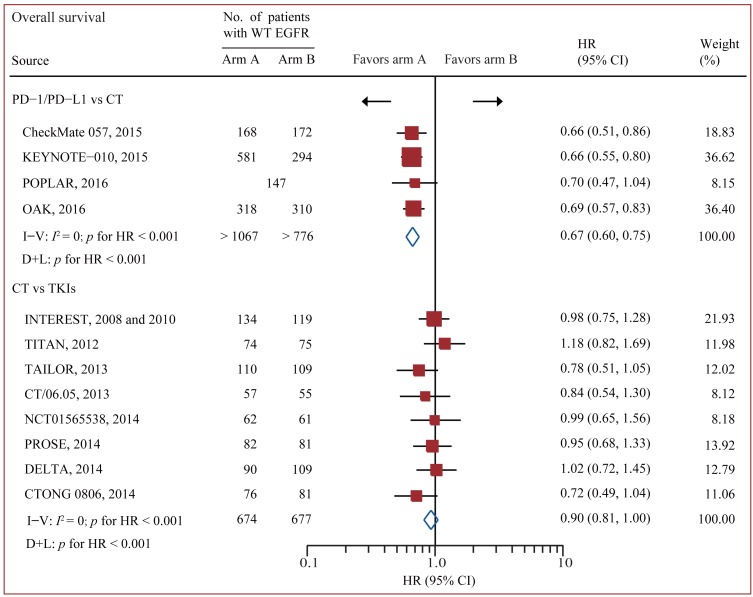
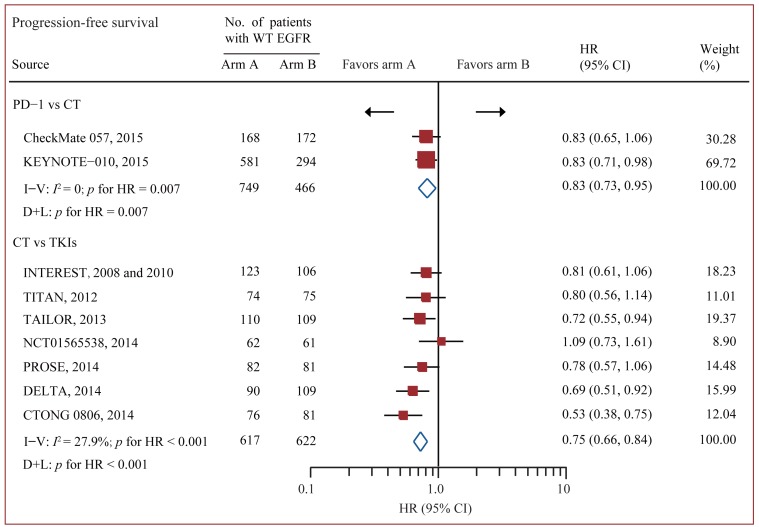
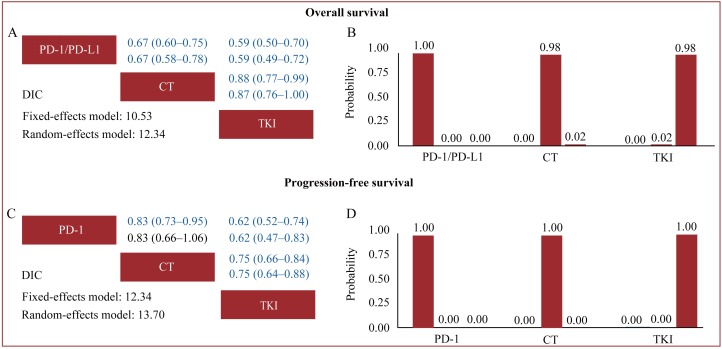
12 randomized trials accruing 3341 advanced patients with WT EGFR tumors were analyzed. PD-1/PD-L1 antibody was associated with significantly longer OS and PFS than chemotherapy (OS: HR 0.67, 95% CrI 0.60-0.75; PFS: HR 0.83, 95% CrI 0.73-0.95) and TKI (OS: HR 0.59, 95% CrI 0.50-0.70; PFS: HR 0.75, 95% CrI 0.66-0.84) , while chemotherapy was associated with significantly longer OS (HR 0.88, 95% CrI 0.77-0.99) and PFS (HR 0.75, 95% CrI 0.66-0.84) than TKI.
For advanced NSCLC patients with WT-EGFR tumors in second- or third-line therapy, PD-1/PD-L1 antibody appeared to be the most efficacious treatment, which was followed by chemotherapy. EGFR-TKI was worse than chemotherapy.
对于野生型(WT)表皮生长因子受体(EGFR)肿瘤的晚期非小细胞肺癌(NSCLC)患者,最佳治疗方案的建议仍不明确。本荟萃分析旨在评估程序性死亡配体1(PD-L1)/程序性死亡1(PD-1)抗体、EGFR酪氨酸激酶抑制剂(TKI)和化疗在二线及三线治疗中的疗效。
检索并纳入了对三种治疗中的两种进行研究的随机试验。进行了多种治疗的比较和两两比较,以评估总生存期(OS)和无进展生存期(PFS),以风险比(HRs)表示。通过亚组分析和荟萃回归评估预先设定的研究水平特征的影响。
分析了12项随机试验,共纳入3341例晚期WT EGFR肿瘤患者。PD-1/PD-L1抗体与化疗相比,OS和PFS显著更长(OS:HR 0.67,95%可信区间0.60 - 0.75;PFS:HR 0.83,95%可信区间0.73 - 0.95),与TKI相比也是如此(OS:HR 0.59,95%可信区间0.50 - 0.70;PFS:HR 0.75,95%可信区间0.66 - 0.84),而化疗与TKI相比,OS(HR 0.88,95%可信区间0.77 - 0.99)和PFS(HR 0.75,95%可信区间0.66 - 0.84)显著更长。
对于二线或三线治疗的晚期WT-EGFR肿瘤NSCLC患者,PD-1/PD-L1抗体似乎是最有效的治疗方法,其次是化疗。EGFR-TKI比化疗效果差。