Abdel-Salam Omar M E, Morsy Safaa M Youssef, Sleem Amany A
Department of Toxicology and Narcotics, National Research Centre, Cairo.
Department of Medical Biochemistry, National Research Centre, Cairo.
EXCLI J. 2011 Dec 8;10:290-302. eCollection 2011.
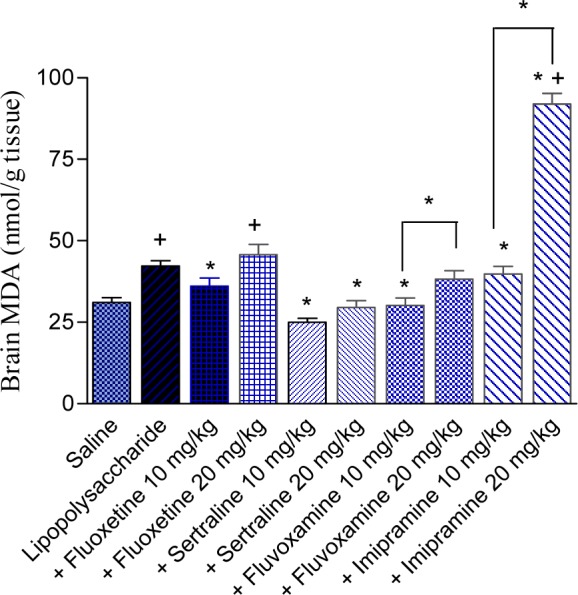
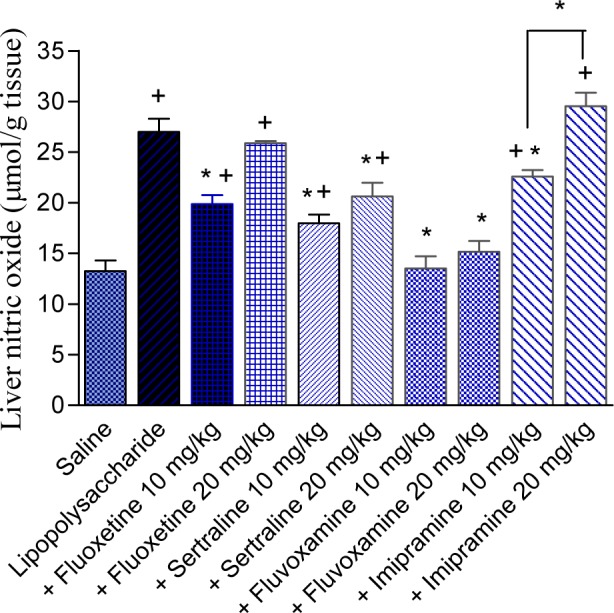
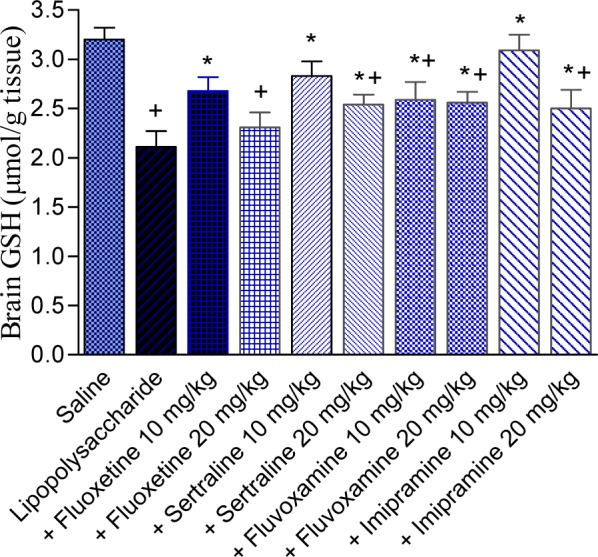
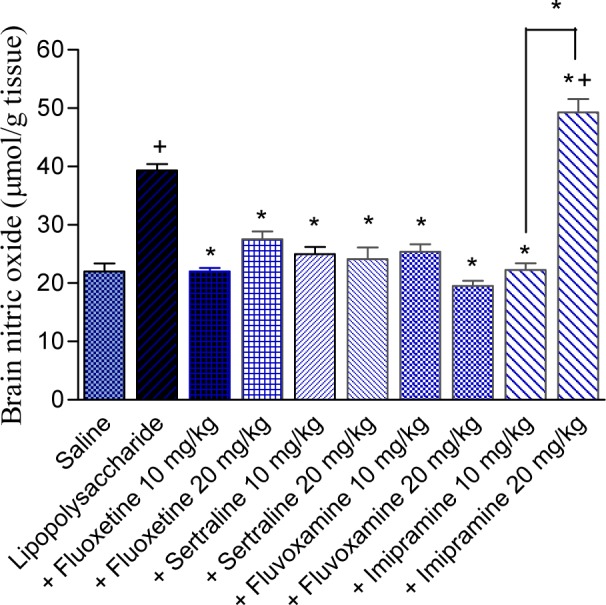
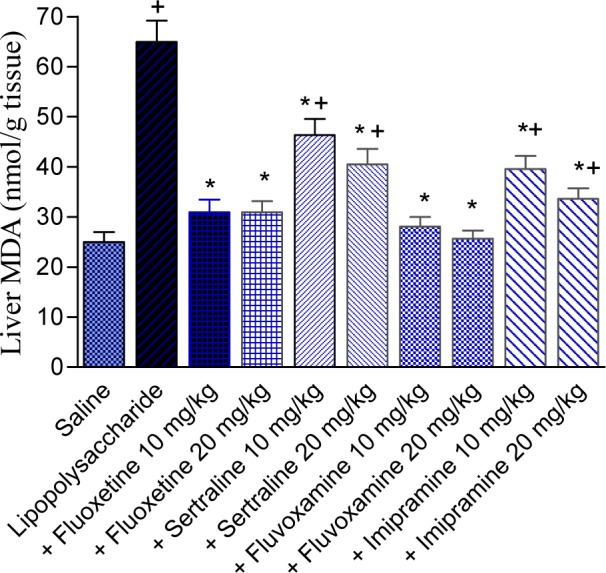
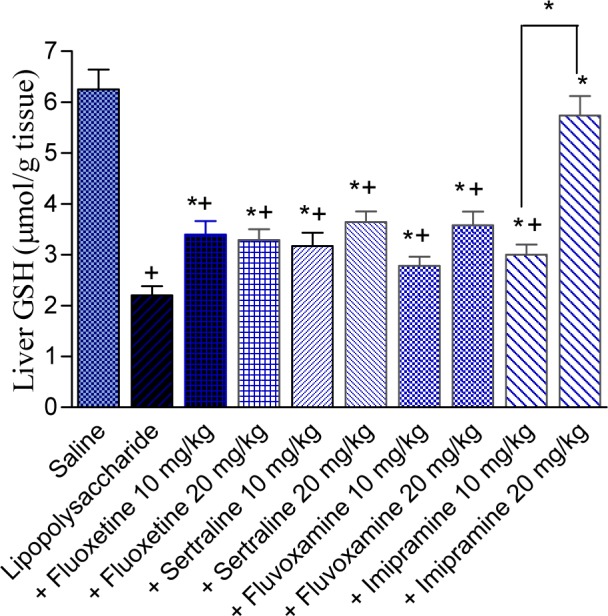
This study investigated the effect of the serotonin selective reuptake inhibitors (SSRIs) fluoxetine, sertraline, fluvoxamine and the tricyclic antidepressant (TCA) impiramine on oxidative stress in brain and liver induced by lipopolysaccharide administration in mice. Each drug was administered subcutaneously at doses of 10 or 20 mg/kg, for two days prior to intraperitoneal (i.p.) administration of lipopolysaccharide E (LPS: 200 µg/kg). Mice were euthanized 4 h after administration of the lipopolysaccharide. Lipid peroxidation (malondialdehyde; MDA), reduced glutathione (GSH) and nitric oxide (nitrite/nitrate) concentrations were measured in brain and liver. The administration of lipopolysaccharide increased oxidative stress in brain and liver; it increased brain MDA by 36.1 and liver MDA by 159.8 %. GSH decreased by 34.1 % and 64.8 % and nitric oxide increased by 78.7 % and 103.8 % in brain and liver, respectively. In brain, MDA decreased after the administration of sertraline and by the lower dose of fluoxetine or fluvoxamine, but increased after the higher dose of imipramine. Reduced glutathione increased after sertraline, fluvoxamine and the lower dose of fluoxetine or imipramine. Nitric oxide decreased by sertraline, fluoxetine, fluvoxamine and by the lower dose of imipramine. In the liver, all drugs decreased MDA and increased GSH level. Nitric oxide is decreased by sertraline, fluvoxamine and by the lower dose of fluoxetine or imipramine. It is concluded that, during mild systemic inflammatory illness induced by peripheral bacterial endotoxin injection, the SSRIs fluoxetine, sertraline and fluvoxamine reduced, while the TCA impiramine increased oxidative stress induced in the brain. The SSRIs as well as imipramine reduced oxidative stress due to lipopolysaccharide in liver tissue.
本研究调查了5-羟色胺选择性再摄取抑制剂(SSRIs)氟西汀、舍曲林、氟伏沙明以及三环类抗抑郁药(TCA)丙咪嗪对小鼠腹腔注射脂多糖所诱导的脑和肝脏氧化应激的影响。在腹腔注射脂多糖E(LPS:200μg/kg)前两天,每种药物均以10或20mg/kg的剂量皮下给药。脂多糖给药4小时后对小鼠实施安乐死。测量脑和肝脏中的脂质过氧化(丙二醛;MDA)、还原型谷胱甘肽(GSH)和一氧化氮(亚硝酸盐/硝酸盐)浓度。脂多糖给药增加了脑和肝脏中的氧化应激;它使脑MDA增加了36.1%,肝脏MDA增加了159.8%。脑和肝脏中的GSH分别降低了34.1%和64.8%,一氧化氮分别增加了78.7%和103.8%。在脑中,舍曲林给药后以及低剂量氟西汀或氟伏沙明给药后MDA降低,但高剂量丙咪嗪给药后MDA增加。舍曲林、氟伏沙明以及低剂量氟西汀或丙咪嗪给药后还原型谷胱甘肽增加。舍曲林、氟西汀、氟伏沙明以及低剂量丙咪嗪给药后一氧化氮降低。在肝脏中,所有药物均降低了MDA并提高了GSH水平。舍曲林、氟伏沙明以及低剂量氟西汀或丙咪嗪给药后一氧化氮降低。得出的结论是,在由外周细菌内毒素注射所诱导的轻度全身性炎症疾病期间,SSRIs氟西汀、舍曲林和氟伏沙明降低了氧化应激,而TCA丙咪嗪增加了脑中所诱导的氧化应激。SSRIs以及丙咪嗪降低了肝脏组织中由脂多糖所致的氧化应激。