Zhou Menglan, Yang Qiwen, Kudinha Timothy, Sun Liying, Zhang Rui, Liu Chang, Yu Shuying, Xiao Meng, Kong Fanrong, Zhao Yupei, Xu Ying-Chun
Department of Clinical Laboratory, Peking Union Medical College Hospital, Peking Union Medical College, Chinese Academy of Medical Sciences, Beijing, China.
Graduate School, Peking Union Medical College, Chinese Academy of Medical Sciences, Beijing, China.
Front Microbiol. 2017 Sep 28;8:1824. doi: 10.3389/fmicb.2017.01824. eCollection 2017.
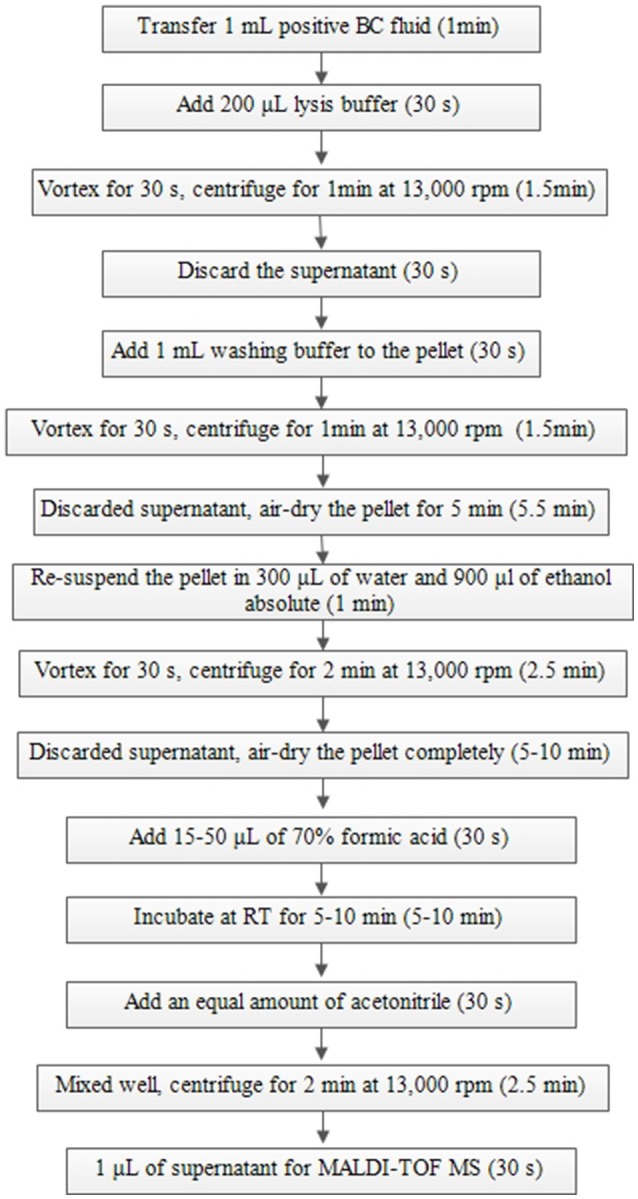
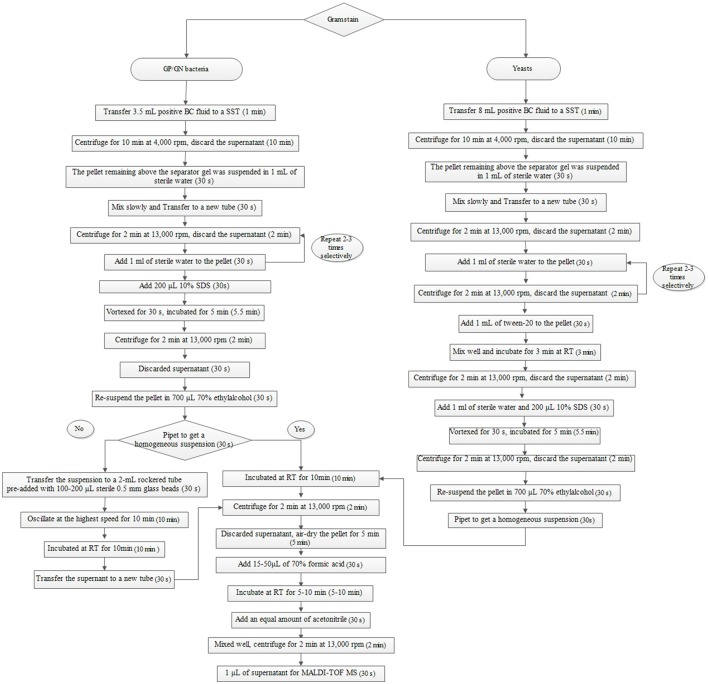
Bloodstream infection is a major cause of morbidity and mortality in hospitalized patients worldwide. Delays in the identification of microorganisms often leads to a poor prognosis. The application of matrix-assisted laser desorption/ionization time-of-flight mass spectrometry (MALDI-TOF MS) directly to blood culture (BC) broth can potentially identify bloodstream infections earlier, and facilitate timely management. We developed an "in-house" (IH) protocol for direct MALDI-TOF MS based identification of organisms in positive BCs. The IH protocol was initially evaluated and improved with spiked BC samples, and its performance was compared with the commercial Sepsityper™ kit using both traditional and modified cut-off values. We then studied in parallel the performance of the IH protocol and the colony MS identifications in positive clinical BC samples using only modified cut-off values. All discrepancies were investigated by "gold standard" of gene sequencing. In 54 spiked BC samples, the IH method showed comparable results with Sepsityper™ after applying modified cut-off values. Specifically, accurate species and genus level identification was achieved in 88.7 and 3.9% of all the clinical monomicrobial BCs (284/301, 94.4%), respectively. The IH protocol exhibited superior performance for Gram negative bacteria than for Gram positive bacteria (92.8 vs. 82.4%). For anaerobes and yeasts, accurate species identification was achieved in 80.0 and 90.0% of the cases, respectively. For polymicrobial cultures (17/301, 5.6%), MALDI-TOF MS correctly identified a single species present in all the polymicrobial BCs under the Standard mode, while using the MIXED method, two species were correctly identified in 52.9% of the samples. Comparisons based on BC bottle type, showed that the BACTEC™ Lytic/10 Anaerobic/F culture vials performed the best. Our study provides a novel and effective sample preparation method for MALDI-TOF MS direct identification of pathogens from positive BC vials, with a lower cost ($1.5 vs. $ 7) albeit a slightly more laborious extracting process (an extra 15 min) compared with Sepsityper™ kit.
血流感染是全球住院患者发病和死亡的主要原因。微生物鉴定的延迟往往导致预后不良。将基质辅助激光解吸/电离飞行时间质谱(MALDI-TOF MS)直接应用于血培养(BC)肉汤有可能更早地识别血流感染,并促进及时治疗。我们开发了一种“内部”(IH)方案,用于基于MALDI-TOF MS直接鉴定阳性血培养中的微生物。该IH方案最初使用加标血培养样本进行评估和改进,并使用传统和修改后的临界值将其性能与商业Sepsityper™试剂盒进行比较。然后,我们仅使用修改后的临界值,并行研究了IH方案和阳性临床血培养样本中菌落MS鉴定的性能。所有差异均通过基因测序的“金标准”进行调查。在54个加标血培养样本中,应用修改后的临界值后,IH方法与Sepsityper™显示出可比的结果。具体而言,在所有临床单一微生物血培养(284/301,94.4%)中,分别有88.7%和3.9%实现了准确的种属水平鉴定。IH方案对革兰氏阴性菌的性能优于革兰氏阳性菌(92.8%对82.4%)。对于厌氧菌和酵母菌,分别在80.0%和90.0%的病例中实现了准确的种属鉴定。对于混合微生物培养(17/301,5.6%),MALDI-TOF MS在标准模式下正确鉴定了所有混合微生物血培养中存在的单一物种,而使用混合方法时,在52.9%的样本中正确鉴定了两个物种。基于血培养瓶类型的比较表明,BACTEC™ Lytic/10厌氧/F培养瓶表现最佳。我们的研究为MALDI-TOF MS直接从阳性血培养瓶中鉴定病原体提供了一种新颖有效的样本制备方法,成本较低(1.5美元对7美元),尽管与Sepsityper™试剂盒相比提取过程略显繁琐(额外15分钟)。