Schmidt Katrin G, Herrero San Juan Martina, Trautmann Sandra, Berninger Lucija, Schwiebs Anja, Ottenlinger Florian M, Thomas Dominique, Zaucke Frank, Pfeilschifter Josef M, Radeke Heinfried H
pharmazentrum frankfurt/ZAFES, Institute of Pharmacology and Toxicology, Hospital of the Goethe University, Frankfurt, Germany.
pharmazentrum frankfurt/ZAFES, Institute for Clinical Pharmacology, Hospital of the Goethe University, Frankfurt, Germany.
Front Immunol. 2017 Sep 29;8:1242. doi: 10.3389/fimmu.2017.01242. eCollection 2017.
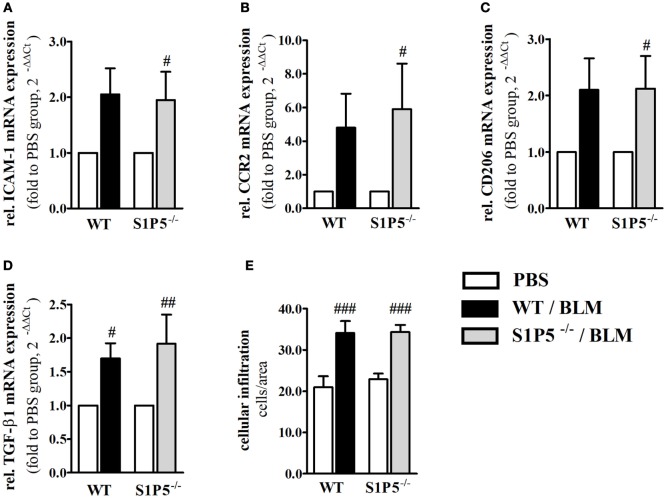
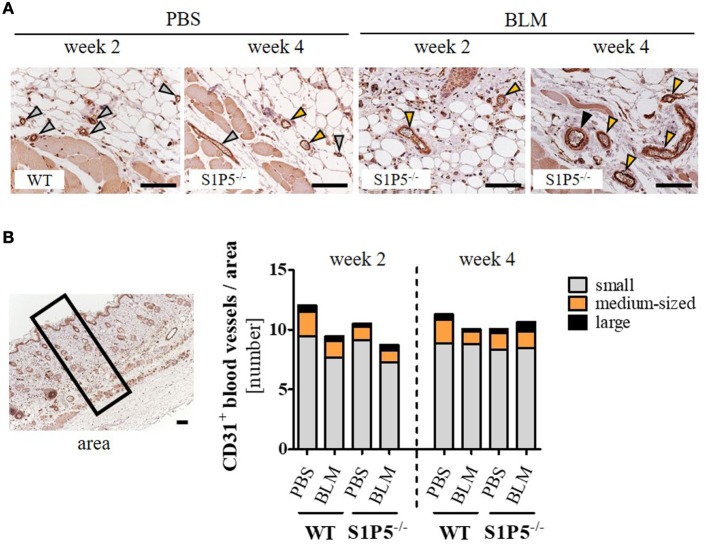
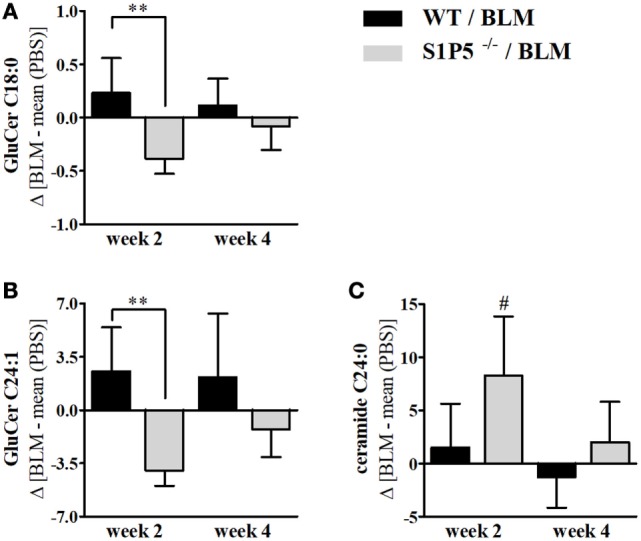
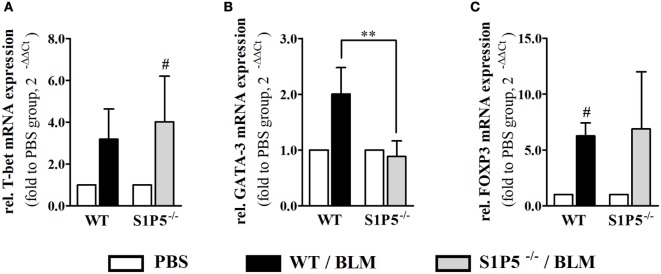
Systemic sclerosis (SSc) is a rare multi-organ autoimmune disease characterized by progressive skin fibrosis. Inflammation, type 2 immunity, and fibrogenic processes are involved in disease development and may be affected by sphingolipids. However, details about early-stage pathophysiological mechanisms and implicated mediators remain elusive. The sphingolipid sphingosine-1-phosphate (S1P) is elevated in the sera of SSc patients, and its receptor S1P5 is expressed in skin tissue. Nevertheless, almost nothing is known about the dermatological contribution of S1P5 to inflammatory and pro-fibrotic processes leading to the pathological changes seen in SSc. In this study, we observed a novel effect of S1P5 on the inflammatory processes during low-dose bleomycin (BLM)-induced fibrogenesis in murine skin. By comparing 2-week-treated skin areas of wild-type (WT) and S1P5-deficient mice, we found that S1P5 is important for the transcriptional upregulation of the Th2 characteristic transcription factor under treatment-induced inflammatory conditions, while (Th1) and (Treg) mRNA expression was regulated independently of S1P5. Additionally, treatment caused a regulation of and mRNA as well as a regulation of long-chain ceramide profiles, which both differ significantly between the genotypes. Despite S1P5-dependent differences regarding inflammatory processes, similar macroscopic evidence of fibrosis was detected in the skin histology of WT and S1P5-deficient mice after 4 weeks of subcutaneous BLM treatment. However, at the earlier 2-week point in time, the mRNA data of and indicate a pro-fibrotic S1P5 contribution in the applied SSc mouse model. In conclusion, we propose that S1P5 plays a role as a novel modulator during the early phase of BLM-caused fibrogenesis in murine skin. An immediate relationship between dermal S1P5 expression and fibrotic processes leading to skin alterations, such as formative for SSc pathogenesis, is indicated but should be studied more profound in further investigations. Therefore, this study is an initial step in understanding the role of S1P5-mediated effects during early stages of fibrogenesis, which may encourage the ongoing search for new therapeutic options for SSc patients.
系统性硬化症(SSc)是一种罕见的多器官自身免疫性疾病,其特征为进行性皮肤纤维化。炎症、2型免疫和纤维化过程参与疾病发展,且可能受鞘脂影响。然而,关于早期病理生理机制及相关介质的细节仍不清楚。鞘脂类的1-磷酸鞘氨醇(S1P)在SSc患者血清中升高,其受体S1P5在皮肤组织中表达。然而,关于S1P5对导致SSc病理变化的炎症和促纤维化过程的皮肤学贡献几乎一无所知。在本研究中,我们观察到S1P5在低剂量博来霉素(BLM)诱导的小鼠皮肤纤维化过程中对炎症过程具有新作用。通过比较野生型(WT)和S1P5缺陷型小鼠经2周处理的皮肤区域,我们发现S1P5在治疗诱导的炎症条件下对Th2特征性转录因子的转录上调很重要,而Th1和Treg mRNA表达的调节独立于S1P5。此外,治疗导致了和mRNA的调节以及长链神经酰胺谱的调节,这两者在不同基因型之间存在显著差异。尽管在炎症过程方面存在S1P5依赖性差异,但在皮下注射BLM 4周后,WT和S1P5缺陷型小鼠的皮肤组织学检查中检测到了类似的宏观纤维化证据。然而,在较早的2周时间点, 和的mRNA数据表明在应用的SSc小鼠模型中S1P5具有促纤维化作用。总之,我们提出S1P5在BLM引起的小鼠皮肤纤维化早期阶段作为一种新型调节因子发挥作用。表明真皮S1P5表达与导致皮肤改变(如SSc发病机制形成)的纤维化过程之间存在直接关系,但应在进一步研究中更深入地进行研究。因此,本研究是理解S1P5介导的效应在纤维化早期阶段作用的第一步,这可能会促进正在进行的针对SSc患者新治疗选择的探索。