• 文献检索
  • 文档翻译
  • 深度研究
  • 学术资讯
  • Suppr Zotero 插件Zotero 插件
  • 邀请有礼
  • 套餐&价格
  • 历史记录
应用&插件
Suppr Zotero 插件Zotero 插件浏览器插件Mac 客户端Windows 客户端微信小程序
定价
高级版会员购买积分包购买API积分包
服务
文献检索文档翻译深度研究API 文档MCP 服务
关于我们
关于 Suppr公司介绍联系我们用户协议隐私条款
关注我们

Suppr 超能文献

核心技术专利:CN118964589B侵权必究
粤ICP备2023148730 号-1Suppr @ 2026

文献检索

告别复杂PubMed语法,用中文像聊天一样搜索,搜遍4000万医学文献。AI智能推荐,让科研检索更轻松。

立即免费搜索

文件翻译

保留排版,准确专业,支持PDF/Word/PPT等文件格式,支持 12+语言互译。

免费翻译文档

深度研究

AI帮你快速写综述,25分钟生成高质量综述,智能提取关键信息,辅助科研写作。

立即免费体验

噻苯达唑对Hn5头颈部鳞状细胞癌细胞系的细胞毒性作用。

Cytotoxic Effect of Thiabendazole on Hn5 Head and Neck Squamous Cell Carcinoma Cell Line.

作者信息

Abassi Amir Jalal, Mohamadnia Abdolreza, Parhiz Seyed Alireza, Azizi Moghadam Nahid, Bahrami Naghmeh

机构信息

Craniomaxillofacial Research Center, Tehran University of Medical Sciences, Tehran, Iran.

Virology Research Center, National Research Institute of Tuberculosis and Lung Diseases (NRITLD), Shahid Beheshti University of Medical Sciences, Tehran, Iran.

出版信息

J Dent (Shiraz). 2017 Sep;18(3):219-226.

PMID:29034278
原文链接:https://pmc.ncbi.nlm.nih.gov/articles/PMC5634363/
Abstract

STATEMENT OF THE PROBLEM

Evidence shows thiabendazole has the potential to inhibit angiogenesis in melanoma and fibrosarcoma; however, its effect on oral squamous cell carcinoma has not been previously studied.

PURPOSE

This study sought to assess the cytotoxic effects of thiabendazole on HN5 head and neck squamous carcinoma cell line.

MATERIALS AND METHOD

HN5 cell lines were exposed to different concentrations of thiabendazole (prepared from 99% pure powder) for 24, 48 and 72 hours. Cell viability was assessed by the methyl thiazol tetrazolium assay, and IC50 of thiabendazole was calculated. Cells were also exposed to different concentrations of thiabendazole for 48 hours to determine its effect on expression and transcription of vascular endothelial growth factor gene. Expression of vascular endothelial growth factor mRNA was assessed by real-time polymerase chain reaction. The vascular endothelial growth factor release was assessed by the enzyme-linked immunosorbent assay test.

RESULTS

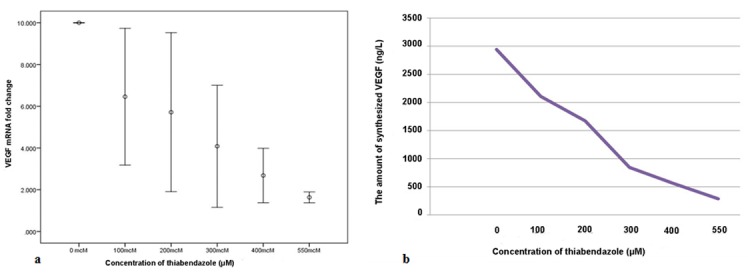
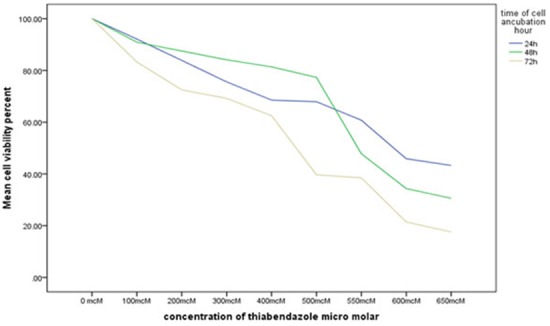
In all concentrations of thiabendazole except for 200 and 550μM, cell viability was significantly different at different time points (< 0.05). At 48 and 72 hours, cell viability at all concentrations of thiabendazole (100-650μM) significantly decreased compared to the control group (zero concentration). In addition, cell viability significantly decreased with an increase in thiabendazole concentration. At 48 hours, expression of vascular endothelial growth factor mRNA was significantly lower in presence of 500μM thiabendazole compared to the control group (< 0.001) and release of vascular endothelial growth factor was inhibited in a dose-dependent manner.

CONCLUSION

Thiabendazole inhibited the proliferation of HN5 cells in a dose-dependent and time-dependent manner. It also inhibited the expression of vascular endothelial growth factor gene.

摘要

问题陈述

有证据表明噻苯达唑有可能抑制黑色素瘤和纤维肉瘤中的血管生成;然而,其对口腔鳞状细胞癌的影响此前尚未得到研究。

目的

本研究旨在评估噻苯达唑对HN5头颈部鳞状癌细胞系的细胞毒性作用。

材料与方法

将HN5细胞系暴露于不同浓度的噻苯达唑(由99%的纯粉末制备)中24、48和72小时。通过甲基噻唑四氮唑法评估细胞活力,并计算噻苯达唑的半数抑制浓度(IC50)。细胞还被暴露于不同浓度的噻苯达唑中48小时,以确定其对血管内皮生长因子基因表达和转录的影响。通过实时聚合酶链反应评估血管内皮生长因子mRNA的表达。通过酶联免疫吸附测定试验评估血管内皮生长因子的释放。

结果

除200和550μM外,在所有浓度的噻苯达唑中,不同时间点的细胞活力均有显著差异(<0.05)。在48和72小时时,与对照组(零浓度)相比,所有浓度(100 - 650μM)的噻苯达唑处理下细胞活力均显著降低。此外,细胞活力随噻苯达唑浓度的增加而显著降低。在48小时时,与对照组相比,500μM噻苯达唑存在时血管内皮生长因子mRNA的表达显著降低(<0.001),且血管内皮生长因子的释放受到剂量依赖性抑制。

结论

噻苯达唑以剂量和时间依赖性方式抑制HN5细胞的增殖。它还抑制血管内皮生长因子基因的表达。
https://cdn.ncbi.nlm.nih.gov/pmc/blobs/2a89/5634363/249b191dae46/JDS-18-219-g003.jpg
https://cdn.ncbi.nlm.nih.gov/pmc/blobs/2a89/5634363/b2e815ffadc3/JDS-18-219-g001.jpg
https://cdn.ncbi.nlm.nih.gov/pmc/blobs/2a89/5634363/27ba88e1dd62/JDS-18-219-g002.jpg
https://cdn.ncbi.nlm.nih.gov/pmc/blobs/2a89/5634363/249b191dae46/JDS-18-219-g003.jpg
https://cdn.ncbi.nlm.nih.gov/pmc/blobs/2a89/5634363/b2e815ffadc3/JDS-18-219-g001.jpg
https://cdn.ncbi.nlm.nih.gov/pmc/blobs/2a89/5634363/27ba88e1dd62/JDS-18-219-g002.jpg
https://cdn.ncbi.nlm.nih.gov/pmc/blobs/2a89/5634363/249b191dae46/JDS-18-219-g003.jpg

相似文献

1
Cytotoxic Effect of Thiabendazole on Hn5 Head and Neck Squamous Cell Carcinoma Cell Line.噻苯达唑对Hn5头颈部鳞状细胞癌细胞系的细胞毒性作用。
J Dent (Shiraz). 2017 Sep;18(3):219-226.
2
Specific Targeting of HER2-Positive Head and Neck Squamous Cell Carcinoma Line HN5 by Idarubicin-ZHER2 Affibody Conjugate.达柔比星-ZHER2 亲和素缀合物特异性靶向 HER2 阳性头颈部鳞状细胞癌 HN5 细胞系。
Curr Cancer Drug Targets. 2019;19(1):65-73. doi: 10.2174/1568009617666170427105417.
3
Thiabendazole, a well-known antifungal drug, exhibits anti-metastatic melanoma B16F10 activity via inhibiting VEGF expression and inducing apoptosis.噻苯达唑是一种知名的抗真菌药物,通过抑制血管内皮生长因子(VEGF)表达和诱导细胞凋亡,展现出抗转移性黑色素瘤B16F10活性。
Pharmazie. 2013 Dec;68(12):962-8.
4
EGFR blockade by tyrosine kinase inhibitor or monoclonal antibody inhibits growth, directs terminal differentiation and induces apoptosis in the human squamous cell carcinoma HN5.酪氨酸激酶抑制剂或单克隆抗体对表皮生长因子受体(EGFR)的阻断可抑制人鳞状细胞癌HN5的生长、引导终末分化并诱导其凋亡。
Int J Oncol. 1998 Aug;13(2):335-42. doi: 10.3892/ijo.13.2.335.
5
IL-6 antisense-mediated growth inhibition in a head and neck squamous cell carcinoma cell line.白细胞介素-6 反义介导的头颈部鳞状细胞癌细胞系生长抑制。
In Vivo. 2011 Jul-Aug;25(4):579-84.
6
2-methoxyestradiol inhibits hypoxia-inducible factor 1alpha, tumor growth, and angiogenesis and augments paclitaxel efficacy in head and neck squamous cell carcinoma.2-甲氧基雌二醇抑制缺氧诱导因子1α、肿瘤生长和血管生成,并增强紫杉醇在头颈部鳞状细胞癌中的疗效。
Clin Cancer Res. 2004 Dec 15;10(24):8665-73. doi: 10.1158/1078-0432.CCR-04-1393.
7
Hepatocyte growth factor/scatter factor-induced activation of MEK and PI3K signal pathways contributes to expression of proangiogenic cytokines interleukin-8 and vascular endothelial growth factor in head and neck squamous cell carcinoma.肝细胞生长因子/分散因子诱导的MEK和PI3K信号通路激活有助于头颈部鳞状细胞癌中促血管生成细胞因子白细胞介素-8和血管内皮生长因子的表达。
Cancer Res. 2001 Aug 1;61(15):5911-8.
8
Bevacizumab Inhibits Angiogenic Cytokines in Head and Neck Squamous Cell Carcinoma: From Gene to the Protein.贝伐单抗抑制头颈部鳞状细胞癌中的血管生成细胞因子:从基因到蛋白质
Int J Hematol Oncol Stem Cell Res. 2018 Apr 1;12(2):136-141.
9
Expression of vascular endothelial growth factor family members in head and neck squamous cell carcinoma correlates with lymph node metastasis.血管内皮生长因子家族成员在头颈部鳞状细胞癌中的表达与淋巴结转移相关。
Cancer. 2001 Aug 1;92(3):556-68. doi: 10.1002/1097-0142(20010801)92:3<556::aid-cncr1355>3.0.co;2-q.
10
Evaluation of epigenetic inactivation of vascular endothelial growth factor receptors in head and neck squamous cell carcinoma.头颈部鳞状细胞癌中血管内皮生长因子受体表观遗传失活的评估
Tumour Biol. 2017 Jul;39(7):1010428317711657. doi: 10.1177/1010428317711657.

引用本文的文献

1
Effect of Curcumin-Loaded Mesoporous Silica Nanoparticles on the Head and Neck Cancer Cell Line, HN5.载姜黄素介孔二氧化硅纳米颗粒对头颈部癌细胞系HN5的影响
Curr Issues Mol Biol. 2022 Oct 27;44(11):5247-5259. doi: 10.3390/cimb44110357.

本文引用的文献

1
Synthesis and biological evaluation of thiabendazole derivatives as anti-angiogenesis and vascular disrupting agents.噻苯达唑衍生物作为抗血管生成和血管破坏剂的合成及生物学评价
Bioorg Med Chem. 2015 Jul 1;23(13):3774-80. doi: 10.1016/j.bmc.2015.03.085. Epub 2015 Apr 8.
2
Tumor microenvironment in head and neck squamous cell carcinoma.头颈部鳞状细胞癌的肿瘤微环境。
Semin Oncol. 2014 Apr;41(2):217-34. doi: 10.1053/j.seminoncol.2014.03.003. Epub 2014 Mar 5.
3
VEGF and CD 34: A correlation between tumor angiogenesis and microvessel density-an immunohistochemical study.
血管内皮生长因子与CD34:肿瘤血管生成与微血管密度的相关性——一项免疫组织化学研究
J Oral Maxillofac Pathol. 2013 Sep;17(3):367-73. doi: 10.4103/0973-029X.125200.
4
Thiabendazole, a well-known antifungal drug, exhibits anti-metastatic melanoma B16F10 activity via inhibiting VEGF expression and inducing apoptosis.噻苯达唑是一种知名的抗真菌药物,通过抑制血管内皮生长因子(VEGF)表达和诱导细胞凋亡,展现出抗转移性黑色素瘤B16F10活性。
Pharmazie. 2013 Dec;68(12):962-8.
5
Evolutionarily repurposed networks reveal the well-known antifungal drug thiabendazole to be a novel vascular disrupting agent.进化再利用网络表明,广为人知的抗真菌药物噻苯达唑是一种新型的血管破坏剂。
PLoS Biol. 2012;10(8):e1001379. doi: 10.1371/journal.pbio.1001379. Epub 2012 Aug 21.
6
The Growth of Malignant Disease in Man and the Lower Animals, with special reference to the Vascular System.人类和低等动物恶性疾病的生长,特别涉及血管系统。
Proc R Soc Med. 1908;1(Surg Sect):1-13.
7
Vascular endothelial growth factor (VEGF) signaling in tumor progression.血管内皮生长因子(VEGF)信号传导在肿瘤进展中的作用
Crit Rev Oncol Hematol. 2007 Jun;62(3):179-213. doi: 10.1016/j.critrevonc.2007.01.006. Epub 2007 Feb 26.
8
Head and neck squamous cell carcinoma cell lines: established models and rationale for selection.头颈部鳞状细胞癌细胞系:已建立的模型及选择依据。
Head Neck. 2007 Feb;29(2):163-88. doi: 10.1002/hed.20478.
9
Role of angiogenic and non-angiogenic mechanisms in oral squamous cell carcinoma: correlation with histologic differentiation and tumor progression.血管生成和非血管生成机制在口腔鳞状细胞癌中的作用:与组织学分化和肿瘤进展的相关性
J Oral Pathol Med. 2004 Nov;33(10):601-6. doi: 10.1111/j.1600-0714.2004.00252.x.
10
Vascular endothelial growth factor: basic science and clinical progress.血管内皮生长因子:基础科学与临床进展
Endocr Rev. 2004 Aug;25(4):581-611. doi: 10.1210/er.2003-0027.