Termrungruanglert Wichai, Khemapech Nipon, Tantitamit Tanitra, Sangrajrang Suleeporn, Havanond Piyalamporn, Laowahutanont Piyawat
Department of Obstetrics and Gynecology, Faculty of Medicine, Chulalongkorn University, Bangkok, Thailand.
Department of Obstetrics and Gynecology, Faculty of Medicine, Srinakharinwirot University, Nakhonnayok, Thailand.
Gynecol Oncol Rep. 2017 Sep 28;22:58-63. doi: 10.1016/j.gore.2017.09.007. eCollection 2017 Nov.
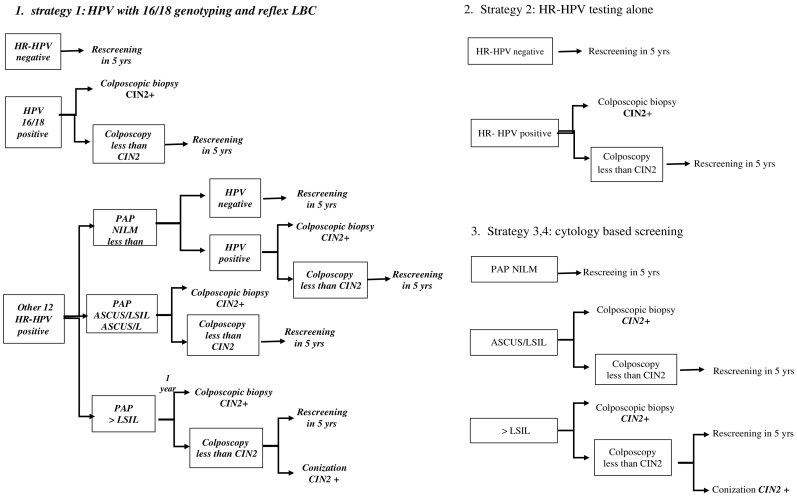
The aim of this study is to compare the cost and benefit of four different cervical cancer screening strategies involving primary HPV 16/18 genotyping, hrHPV testing alone and cytology for detecting CIN2 +.
Economical analysis using Markov modeling approach to combine the epidemiological data from current population-based study of The National Cancer Institute of Thailand. A cohort of 100,000 hypothetical female population age 30-65 years was simulated in each strategy. The compared strategies are HPV 16/18 genotyping with reflexed cytology, hrHPV testing alone followed by colposcopy, Papanicolaou standard cytology and liquid based cytology followed by colposcopy. The interval of screening was 5 years' interval. The main outcomes were defined as a number of CIN2 + cases and cost per 100,000 women screening over 35 years.
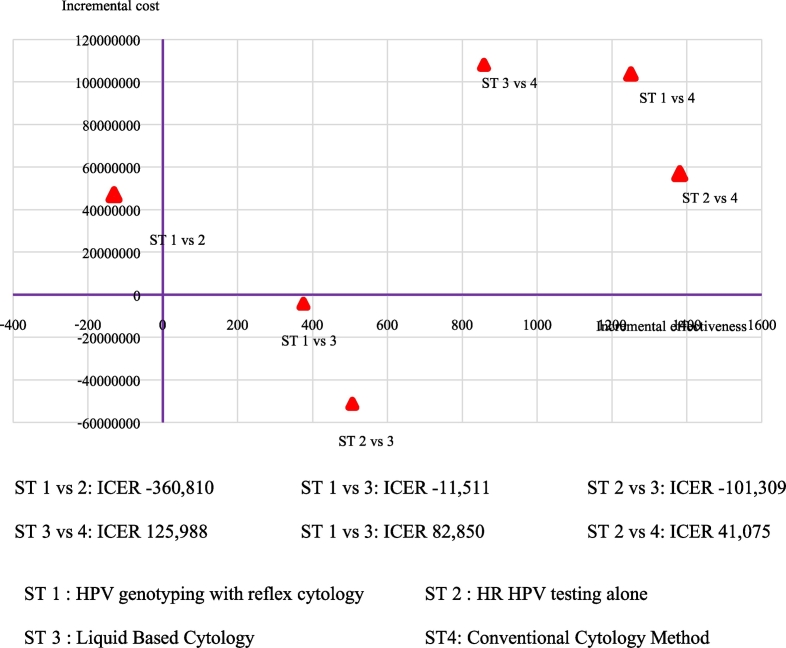
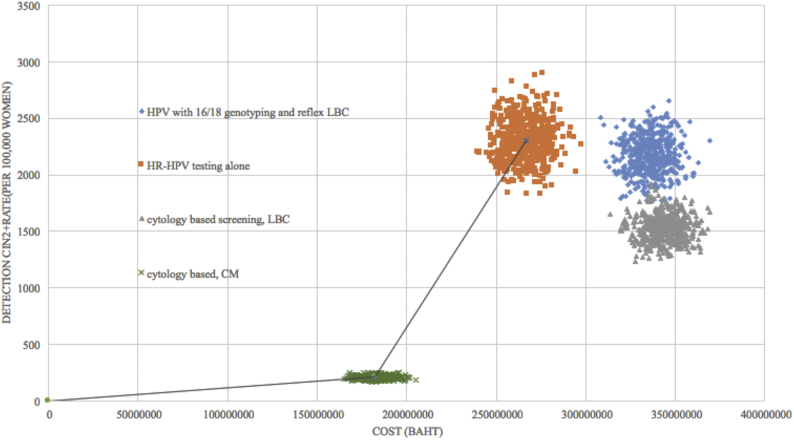
Model predictions indicated that, the most cost-effectiveness strategy is hrHPV testing alone by reducing cost and also increase CIN2 + detection rate. It identify an additional 130 cases and decrease cost by 46,950,840 THB (1,394,441 USD) per 100,000 women screened when compared to HPV 16/18 genotyping. Compared with cytology, hrHPV testing decrease cost by 51,279,781 THB (1,523,011 USD) and detected more 506 cases of CIN2 +. From sensitivity analysis, the cost of HPV testing, cost of colposcopy, incidence of HPV infection and sensitivity of cytology may affect the results. (1 USD = 33.67 Baht).
The results of this cost-effectiveness analysis support the full scale implementation of HPV testing as a primary cervical cancer screening in Thailand.
本研究旨在比较四种不同宫颈癌筛查策略的成本效益,这些策略包括原发性人乳头瘤病毒16/18基因分型、单独的高危型人乳头瘤病毒检测以及用于检测CIN2+的细胞学检查。
采用马尔可夫建模方法进行经济分析,以结合泰国国家癌症研究所当前基于人群研究的流行病学数据。在每种策略中模拟了一组100,000名30 - 65岁的假设女性人群。比较的策略包括HPV 16/18基因分型并进行细胞学检查、单独进行高危型人乳头瘤病毒检测后进行阴道镜检查、巴氏标准细胞学检查以及液基细胞学检查后进行阴道镜检查。筛查间隔为5年。主要结果定义为35年内每100,000名接受筛查女性中的CIN2+病例数和成本。
模型预测表明,最具成本效益的策略是单独进行高危型人乳头瘤病毒检测,该策略既能降低成本,又能提高CIN2+的检测率。与HPV 16/18基因分型相比,每100,000名接受筛查的女性中,它能额外识别130例病例,并降低成本46,950,840泰铢(1,394,441美元)。与细胞学检查相比,高危型人乳头瘤病毒检测降低成本51,279,781泰铢(1,523,011美元),并多检测出506例CIN2+病例。敏感性分析表明,人乳头瘤病毒检测成本、阴道镜检查成本、人乳头瘤病毒感染发生率和细胞学检查敏感性可能会影响结果。(1美元 = 33.67泰铢)
这项成本效益分析的结果支持在泰国全面实施人乳头瘤病毒检测作为主要的宫颈癌筛查方法。