Division of Health Systems and Public Health, Global Health Department, Faculty of Medicine and Health Sciences, Stellenbosch University, Stellenbosch, South Africa.
Health Economics, Division of Health Systems and Public Health, Global Health Department, Faculty of Medicine and Health Sciences, Stellenbosch University, Stellenbosch, South Africa.
Syst Rev. 2022 Aug 9;11(1):162. doi: 10.1186/s13643-022-02017-z.
The aims of this systematic review were to (1) identify primary- and model-based economic evaluations of cervical cancer screening methods and to (2) provide a contextual summary of valuation outcomes associated with three types of cervical cancer screening tests: visual inspection with acetic acid, human papillomavirus deoxyribonucleic acid, and Papanicolaou smear.
Cervical cancer screening is an important public health priority with the potential to improve the detection of precancerous lesions in high-risk females for early intervention and disease prevention. Test performance and cost-effectiveness differ based on the specific screening method used across different platforms. There is a need to appraise existing economic evaluations of cervical cancer screening methods.
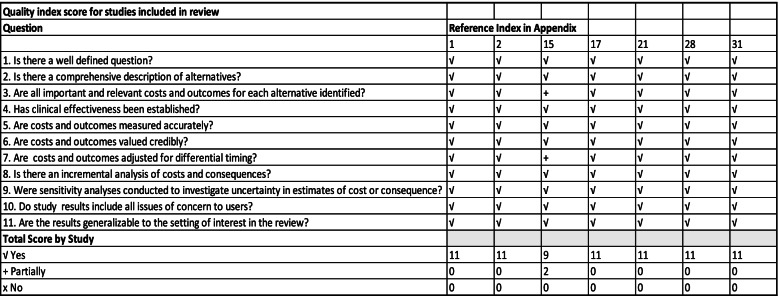
This review considered primary-based and model-based full economic evaluations of cervical cancer screening methods. The evaluation methods of interest included cost-effectiveness analysis, cost-utility analysis, cost-minimization analysis, cost-benefit analysis, and cost-consequence analysis. We searched Scopus, PubMed, National Health Economic Evaluation Database (NH EED), Cochrane, and the Health Economic Evaluation Database for full economic evaluations of cancer screening methods. No formal date restrictions were applied. Model-based and primary-based full economic evaluations were included. A critical appraisal of included studies was performed by the main investigator, while a second independent reviewer assessed critical appraisal findings for any inconsistencies. Data were extracted using a standardised data extraction tool for economic evaluations. The ultimate outcomes of costs, effectiveness, benefits, and utilities of cervical cancer screening modalities were extracted from included studies, analysed, and summarised.
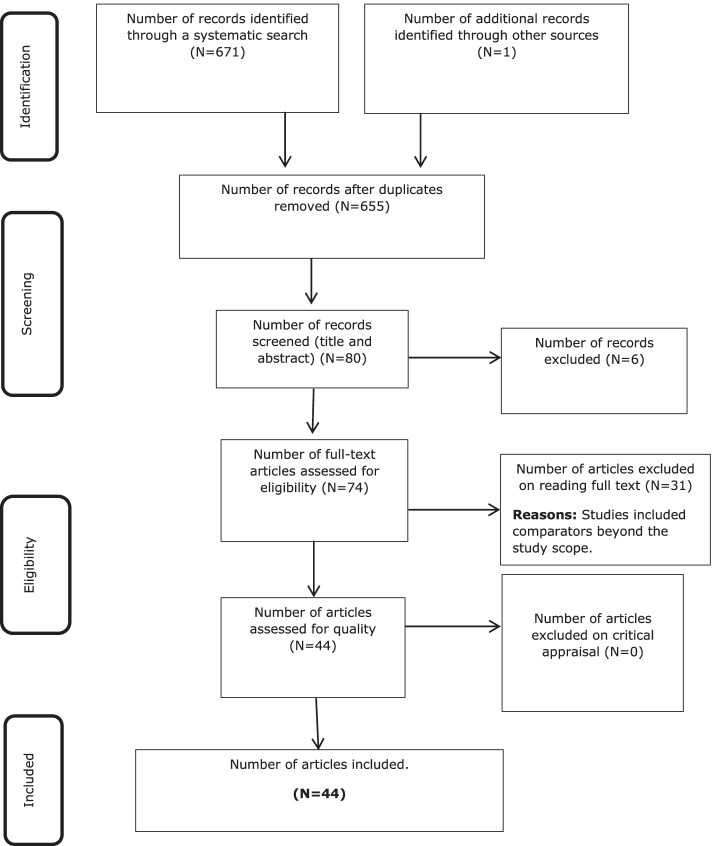
From a total of 671 screened studies, 44 studies met the study inclusion criteria. Forty-three studies were cost-effectiveness analyses, one study reported both cost-utility and cost-effectiveness outcomes, and another study reported cost utilities of cervical cancer screening methods only. Human papillomavirus (HPV) DNA testing was reported as a dominant stand-alone screening test by 14 studies, while five studies reported visual inspection with acetic acid (VIA) as a dominant stand-alone screening test. Primary HPV screening strategies were dominant in 21 studies, while three studies reported cytology-based screening strategies as the dominant screening method.
Existing evidence indicates that HPV-based and VIA testing strategies are cost-effective, but this is dependent on setting. Our review suggests the limited cost-effectiveness of cytology-based testing, which may be due in part to the need for specific infrastructures and human resources.
PROSPERO CRD42020212454 .
本系统评价的目的是:(1) 确定宫颈癌筛查方法的初级和基于模型的经济评估,以及 (2) 提供与三种宫颈癌筛查测试相关的估值结果的背景总结:醋酸视觉检查、人乳头瘤病毒脱氧核糖核酸和巴氏涂片。
宫颈癌筛查是一项重要的公共卫生重点,具有提高高危女性癌前病变检出率的潜力,以便早期干预和疾病预防。基于特定的筛查方法,不同平台的测试性能和成本效益存在差异。需要评估现有的宫颈癌筛查方法的经济评价。
本研究考虑了宫颈癌筛查方法的基于初级和基于模型的全经济评估。有兴趣的评估方法包括成本效益分析、成本效用分析、成本最小化分析、成本效益分析和成本后果分析。我们在 Scopus、PubMed、国家卫生经济评价数据库 (NH EED)、Cochrane 和卫生经济评价数据库中搜索了癌症筛查方法的全经济评价。未对研究日期施加任何正式限制。包括基于模型和基于初级的全经济评估。主要研究者对纳入研究进行了批判性评估,而第二位独立评审员则评估了批判性评估结果是否存在任何不一致。使用经济评估的标准化数据提取工具提取数据。从纳入的研究中提取宫颈癌筛查方式的成本、效果、效益和效用的最终结果,并进行分析和总结。
在总共 671 项筛选研究中,有 44 项研究符合研究纳入标准。43 项研究为成本效益分析,1 项研究同时报告了成本效用和成本效益结果,另一项研究仅报告了宫颈癌筛查方法的成本效用。14 项研究报告 HPV DNA 检测为独立筛查测试的优势,5 项研究报告 VIA 为独立筛查测试的优势。21 项研究报告原发性 HPV 筛查策略具有优势,3 项研究报告细胞学筛查策略为优势筛查方法。
现有证据表明,HPV 检测和 VIA 检测策略具有成本效益,但这取决于具体情况。我们的综述表明,基于细胞学的检测方法的成本效益有限,这可能部分是由于需要特定的基础设施和人力资源。
PROSPERO CRD42020212454。