Fadl Alyaa Elsaid Abdelaziz, Mahfouz Magdy Elsayed, El-Gamal Mona Mabrouk Taha, Heyland Andreas
Department of Integrative Biology, Faculty of Biological Science, University of Guelph, Guelph, Ontario, Canada.
Department of Zoology, Faculty of Science, University of Kafrelsheikh, Kafr Elsheikh, Egypt.
Heliyon. 2017 Oct 3;3(10):e00412. doi: 10.1016/j.heliyon.2017.e00412. eCollection 2017 Oct.
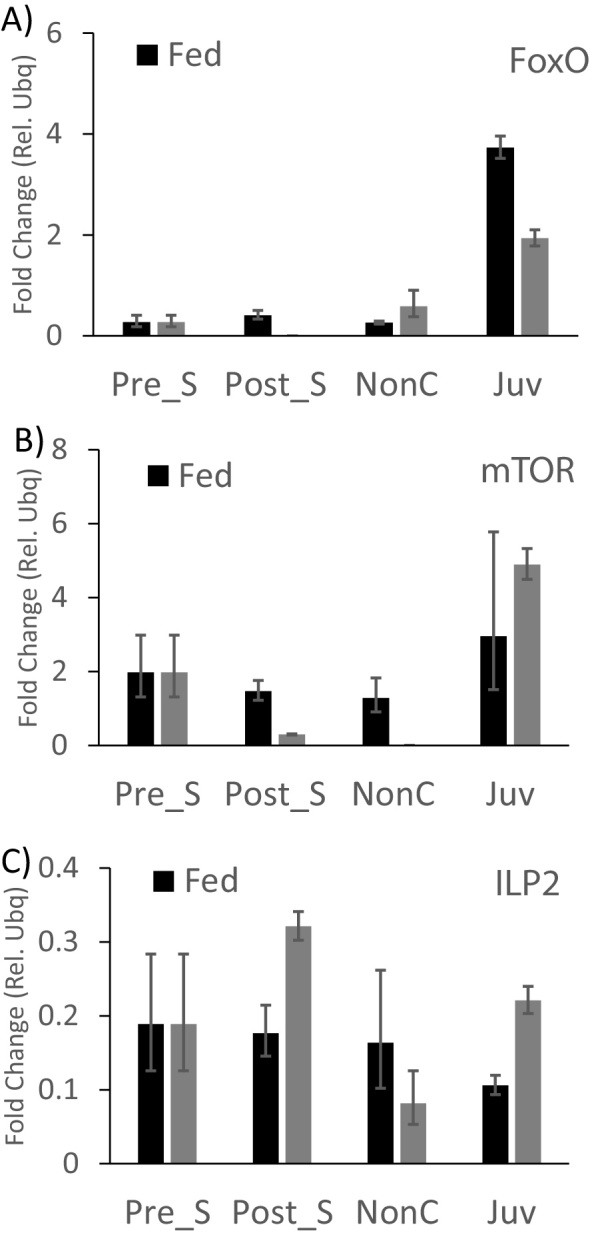
Some sea urchins, including the purple sea urchin have been successfully used in aquaculture, but their slow growth and late reproduction are challenging to overcome when developing efficient aquaculture production techniques. develops via an indirect life history that is characterized by a drastic settlement process at the end of a larval period that lasts for several weeks. During this transition, the bilateral larva is transformed into a pentaradial juvenile, which will start feeding and growing in the benthic habitat. Due to predation and other ecological factors, settlement is typically associated with high mortality rates in juvenile populations. Additionally, juveniles require several days to develop a functional mouth and digestive system. During this perimetamorphic period, juveniles use up larval resources until they are capable to digest adult food. Mechanisms underlying the onset of juvenile feeding and metabolism have implications for the recruitment of natural populations as well as aquaculture and are relatively poorly understood in . The insulin/insulin-like growth factor signalling (IIS)/Target of Rapamycin (TOR) pathway (IIS/TOR) is well conserved among animal phyla and regulates physiological and developmental functions, such as growth, reproduction, aging and nutritional status. We analyzed the expression of FoxO, TOR, and ILPs in post-settlement juveniles in conjunction with their early growth trajectories. We also tested how pre-settlement starvation affected post-settlement expression of IIS. We found that FoxO provides a useful molecular marker in early juveniles as its expression is strongly correlated with juvenile growth. We also found that pre-settlement starvation affects juvenile growth trajectories as well as IIS. Our findings provide preliminary insights into the mechanisms underlying post-settlement growth and metabolism in . They also have important implications for sea urchin aquaculture, as they show that pre-settlement nutrient environment significantly affects both early growth trajectories and gene expression. This information can be used to develop new biomarkers for juvenile health in sea urchin population ecology and aquaculture aquaculture.
一些海胆,包括紫海胆,已成功应用于水产养殖,但在开发高效水产养殖生产技术时,它们生长缓慢和繁殖较晚的问题难以克服。海胆通过间接的生活史进行发育,其特点是在持续数周的幼虫期结束时会经历剧烈的变态过程。在此转变过程中,两侧对称的幼虫会转变为五辐射对称的幼体,幼体将开始在底栖生境中摄食和生长。由于捕食和其他生态因素,变态通常与幼体种群的高死亡率相关。此外,幼体需要几天时间来发育功能性的口和消化系统。在这个变态前期,幼体消耗幼虫资源,直到它们能够消化成体食物。幼体摄食和代谢开始的潜在机制对自然种群的补充以及水产养殖都有影响,而在海胆中对此相对了解较少。胰岛素/胰岛素样生长因子信号通路(IIS)/雷帕霉素靶蛋白(TOR)途径(IIS/TOR)在动物门中高度保守,调节生长、繁殖、衰老和营养状况等生理和发育功能。我们结合早期生长轨迹分析了变态后幼体中FoxO、TOR和胰岛素样肽(ILPs)的表达。我们还测试了变态前饥饿如何影响变态后IIS的表达。我们发现FoxO在早期幼体中是一个有用的分子标记,因为其表达与幼体生长密切相关。我们还发现变态前饥饿会影响幼体生长轨迹以及IIS。我们的研究结果为海胆变态后生长和代谢的潜在机制提供了初步见解。它们对海胆水产养殖也具有重要意义,因为它们表明变态前的营养环境会显著影响早期生长轨迹和基因表达。这些信息可用于开发海胆种群生态学和水产养殖中幼体健康的新生物标志物。