Centre for Developmental Neurobiology, King's College London, New Hunt's House, 4th Floor, Guy's Hospital Campus, London, SE1 1UL, UK.
MRC Centre for Neurodevelopmental Disorders, King's College London, New Hunt's House, 4th Floor, Guy's Hospital Campus, London, SE1 1UL, UK.
J Neurosci Res. 2018 Mar;96(3):354-359. doi: 10.1002/jnr.24154. Epub 2017 Oct 16.
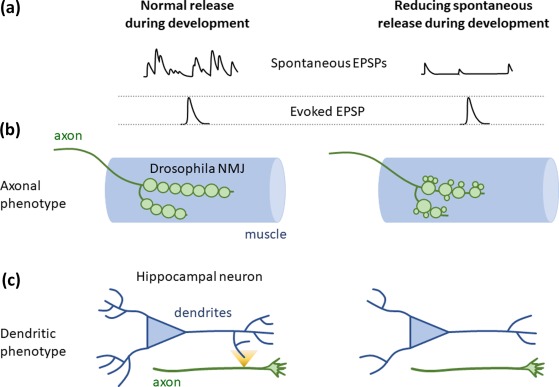
In the past, the spontaneous release of neurotransmitter from presynaptic terminals has been thought of as a side effect of evoked release, with little functional significance. As our understanding of the process of spontaneous release has increased over time, this notion has gradually changed. In this review, we focus on the importance of this form of release during neuronal development, a time of extreme levels of plasticity that includes the growth of dendrites and axons as well as the formation of new synaptic contacts. This period also encompasses high levels of neurotransmitter release from growing axons, and recent studies have found that spontaneous transmitter release plays an important role in shaping neuronal morphology as well as modulating the properties of newly forming synaptic contacts in the brain. Here, we bring together the latest findings across different species to argue that the spontaneous release of neurotransmitter is an important player in the wiring of the brain during development.
在过去,神经递质从突触前末梢的自发释放被认为是诱发释放的副作用,其功能意义不大。随着我们对自发释放过程的理解逐渐加深,这种观念也在逐渐改变。在这篇综述中,我们重点关注这种释放形式在神经元发育过程中的重要性,这是一个可塑性极高的时期,包括树突和轴突的生长以及新的突触连接的形成。这个时期也包括从生长轴突中释放出的大量神经递质,最近的研究发现,自发递质释放在塑造神经元形态以及调节大脑中新形成的突触连接的特性方面发挥着重要作用。在这里,我们汇集了不同物种的最新发现,认为神经递质的自发释放是发育过程中大脑连接的重要参与者。