Nakamura Kenta, Yaguchi Tomonori, Ohmura Gaku, Kobayashi Asuka, Kawamura Naoshi, Iwata Takashi, Kiniwa Yukiko, Okuyama Ryuhei, Kawakami Yutaka
Division of Cellular Signaling, Institute for Advanced Medical Research, Keio University School of Medicine, Tokyo, Japan.
Department of Dermatology, Shinshu University School of Medicine, Nagano, Japan.
Cancer Sci. 2018 Jan;109(1):54-64. doi: 10.1111/cas.13423. Epub 2017 Nov 9.
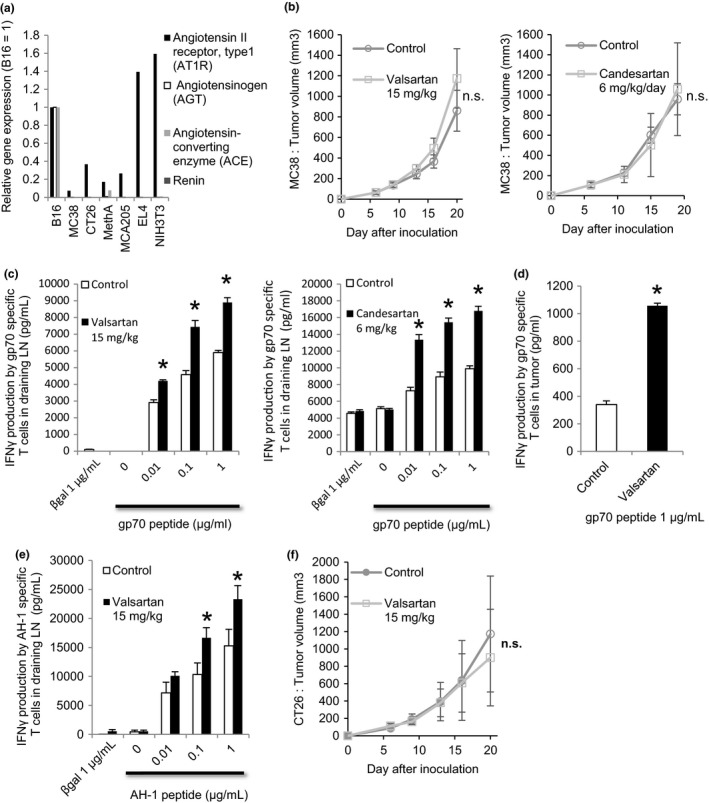
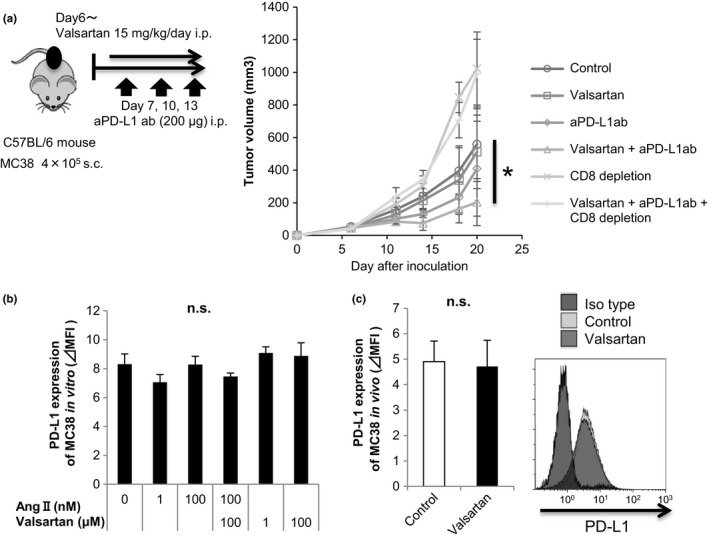
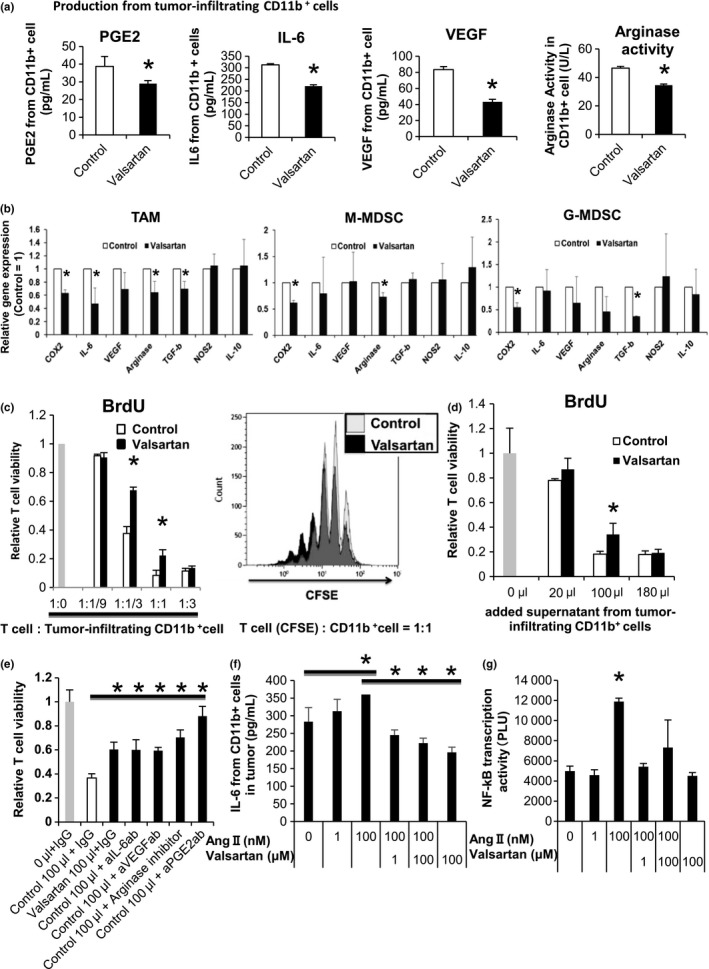
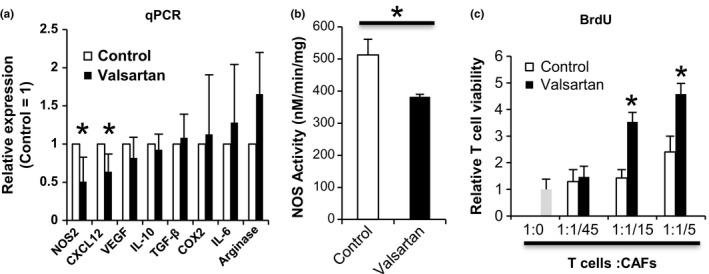
To improve current cancer immunotherapies, strategies to modulate various immunosuppressive cells including myeloid derived suppressor cells (MDSC) which were shown to be negative factors in immune-checkpoint blockade therapy, need to be developed. In the present study, we evaluated the role of the local renin-angiotensin system (RAS) in the tumor immune-microenvironment using murine models bearing tumor cell lines in which RAS was not involved in their proliferation and angiogenetic ability. Giving angiotensin II receptor blockers (ARB) to C57BL/6 mice bearing murine colon cancer cell line MC38 resulted in significant enhancement of tumor antigen gp70 specific T cells. ARB administration did not change the numbers of CD11b myeloid cells in tumors, but significantly reduced their T-cell inhibitory ability along with decreased production of various immunosuppressive factors including interleukin (IL)-6, IL-10, vascular endothelial growth factor (VEGF), and arginase by CD11b cells in tumors. ARB also decreased expression of immunosuppressive factors such as chemokine ligand 12 and nitric oxide synthase 2 in cancer-associated fibroblasts (CAF). Last, combination of ARB and anti-programmed death-ligand 1 (PD-L1) antibodies resulted in significant augmentation of anti-tumor effects in a CD8 T cell-dependent way. These results showed that RAS is involved in the generation of an immunosuppressive tumor microenvironment caused by myeloid cells and fibroblasts, other than the previously shown proliferative and angiogenetic properties of cancer cells and macrophages, and that ARB can transform the immunosuppressive properties of MDSC and CAF and could be used in combination with PD-1/PD-L1 immune-checkpoint blockade therapy.
为了改进当前的癌症免疫疗法,需要开发各种调节免疫抑制细胞的策略,包括髓源性抑制细胞(MDSC),其在免疫检查点阻断疗法中被证明是负面因素。在本研究中,我们使用携带肿瘤细胞系的小鼠模型评估了局部肾素-血管紧张素系统(RAS)在肿瘤免疫微环境中的作用,这些肿瘤细胞系的增殖和血管生成能力不涉及RAS。给携带小鼠结肠癌细胞系MC38的C57BL/6小鼠给予血管紧张素II受体阻滞剂(ARB),可显著增强肿瘤抗原gp70特异性T细胞。给予ARB并未改变肿瘤中CD11b髓样细胞的数量,但显著降低了它们的T细胞抑制能力,同时肿瘤中CD11b细胞产生的包括白细胞介素(IL)-6、IL-10、血管内皮生长因子(VEGF)和精氨酸酶在内的各种免疫抑制因子的产量也有所下降。ARB还降低了癌症相关成纤维细胞(CAF)中趋化因子配体12和一氧化氮合酶