Yamauchi Takaki, Fukazawa Aya, Nakazono Mikio
a Graduate School of Bioagricultural Sciences , Nagoya University, Furo-cho , Chikusa, Nagoya , Japan.
b UWA School of Agriculture and Environment , Faculty of Science, The University of Western Australia , 35 Stirling Highway, Crawley , Australia.
Plant Signal Behav. 2017 Nov 2;12(11):e1388976. doi: 10.1080/15592324.2017.1388976. Epub 2017 Oct 16.
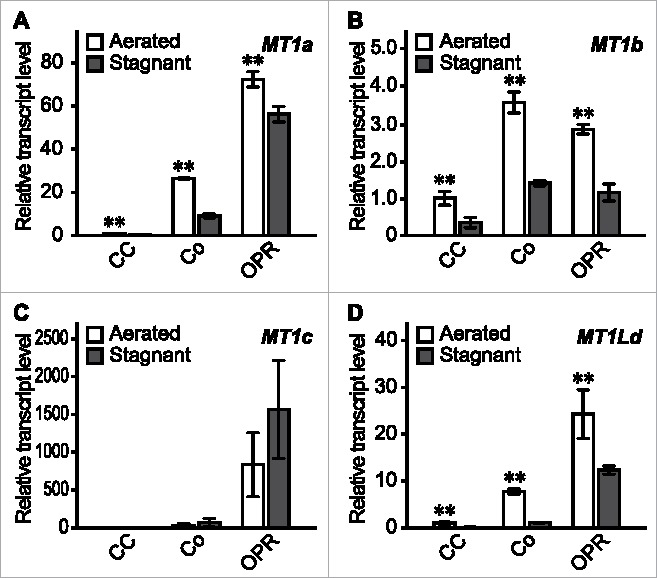
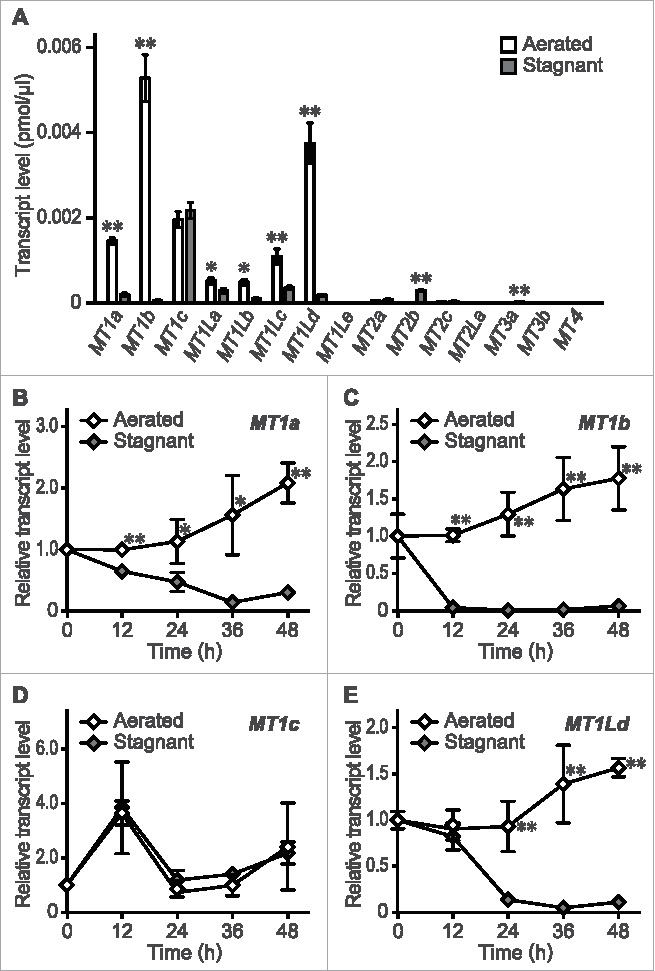
Under waterlogged conditions, roots of gramineous plants form lysigenous aerenchyma (internal gas spaces) by inducing the death of cortical cells. Rice (Oryza sativa) roots induce aerenchyma formation through ethylene- and reactive oxygen species (ROS)-mediated signaling. Metallothionein (MT) is a small, cysteine-rich protein that acts as a ROS scavenger. In rice roots, the expression of MT1a, MT1b, MT1c and MT1Ld were higher than those of the other MT genes. In the root cortex, where aerenchyma forms exclusively, the expression of MT1a, MT1b and MT1Ld was reduced prior to aerenchyma formation. These findings suggest that ROS accumulation in the cortex, which is aided by downregulation of MT1 genes, is needed for aerenchyma formation in rice roots.
在渍水条件下,禾本科植物的根通过诱导皮层细胞死亡形成溶生性通气组织(内部气体空间)。水稻根通过乙烯和活性氧(ROS)介导的信号传导诱导通气组织形成。金属硫蛋白(MT)是一种富含半胱氨酸的小蛋白,可作为ROS清除剂。在水稻根中,MT1a、MT1b、MT1c和MT1Ld的表达高于其他MT基因。在仅形成通气组织的根皮层中,MT1a、MT1b和MT1Ld的表达在通气组织形成之前降低。这些发现表明,MT1基因的下调有助于皮层中ROS的积累,这是水稻根通气组织形成所必需的。