Silverberg Sarah L, Zannella Vanessa E, Countryman Drew, Ayala Ana Patricia, Lenton Erica, Friesen Farah, Law Marcus
Faculty of Medicine, University of Toronto, Toronto, Ontario, Canada.
Department of Family and Community Medicine, Faculty of Medicine, University of Toronto, Toronto, Ontario, Canada.
Int J Med Educ. 2017 Oct 12;8:353-374. doi: 10.5116/ijme.59ba.2d47.
We reviewed the published literature on antimicrobial stewardship training in undergraduate and postgraduate medical education to determine which interventions have been implemented, the extent to which they have been evaluated, and to understand which are most effective.
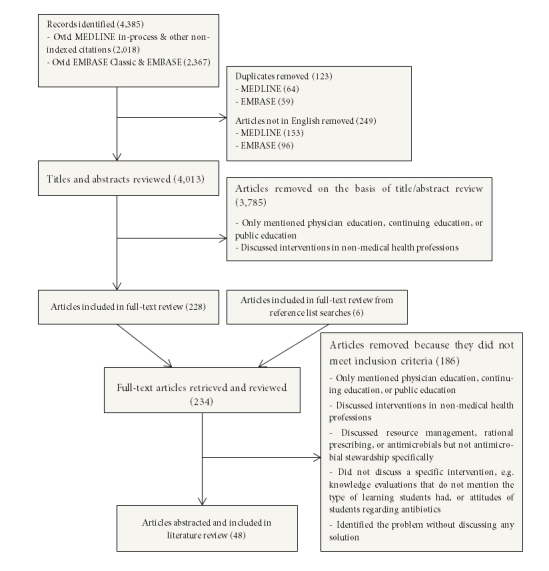
We searched Ovid MEDLINE and EMBASE from inception to December 2016. Four thousand three hundred eighty-five (4385) articles were identified and underwent title and abstract review. Only those articles that addressed antimicrobial stewardship interventions for medical trainees were included in the final review. We employed Kirkpatrick's four levels of evaluation (reaction, learning, behaviour, results) to categorize intervention evaluations.
Our review included 48 articles. The types of intervention varied widely amongst studies worldwide. Didactic teaching was used heavily in all settings, while student-specific feedback was used primarily in the postgraduate setting. The high-level evaluation was sparse, with 22.9% reporting a Kirkpatrick Level 3 evaluation; seventeen reported no evaluation. All but one article reported positive results from the intervention. No articles evaluated the impact of an intervention on undergraduate trainees' prescribing behaviour after graduation.
This study enhances our understanding of the extent of antimicrobial stewardship in the context of medical education. While our study demonstrates that medical schools are implementing antimicrobial stewardship interventions, rigorous evaluation of programs to determine whether such efforts are effective is lacking. We encourage more robust evaluation to establish effective, evidence-based approaches to training prescribers in light of the global challenge of antimicrobial resistance.
我们回顾了已发表的关于本科和研究生医学教育中抗菌药物管理培训的文献,以确定实施了哪些干预措施、对这些措施的评估程度,并了解哪些措施最有效。
我们检索了从创刊至2016年12月的Ovid MEDLINE和EMBASE数据库。共识别出4385篇文章,并对其标题和摘要进行了审查。最终审查仅纳入那些针对医学实习生的抗菌药物管理干预措施的文章。我们采用柯克帕特里克的四级评估法(反应、学习、行为、结果)对干预措施评估进行分类。
我们的综述纳入了48篇文章。全球范围内的研究中干预措施类型差异很大。在所有环境中都大量使用了讲授式教学,而针对学生的反馈主要用于研究生阶段。高级评估较少,22.9%的研究报告了柯克帕特里克三级评估;17项研究未报告评估情况。除一篇文章外,所有文章均报告了干预措施的积极结果。没有文章评估干预措施对本科实习生毕业后处方行为的影响。
本研究增进了我们对抗菌药物管理在医学教育背景下的程度的理解。虽然我们的研究表明医学院校正在实施抗菌药物管理干预措施,但缺乏对项目进行严格评估以确定这些努力是否有效的情况。鉴于抗菌药物耐药性这一全球挑战,我们鼓励进行更有力的评估,以建立有效的、基于证据的培训处方者的方法。