Asano Tomoyuki, Ito Hiromi, Kariya Yoshinobu, Hoshi Kyoka, Yoshihara Akioh, Ugawa Yoshikazu, Sekine Hideharu, Hirohata Shunsei, Yamaguchi Yoshiki, Sato Shuzo, Kobayashi Hiroko, Migita Kiyoshi, Ohira Hiromasa, Hashimoto Yasuhiro, Watanabe Hiroshi
Department of Rheumatology, School of Medicine, Fukushima Medical University, Fukushima, Japan.
Department of Biochemistry, School of Medicine, Fukushima Medical University, Fukushima, Japan.
PLoS One. 2017 Oct 16;12(10):e0186414. doi: 10.1371/journal.pone.0186414. eCollection 2017.
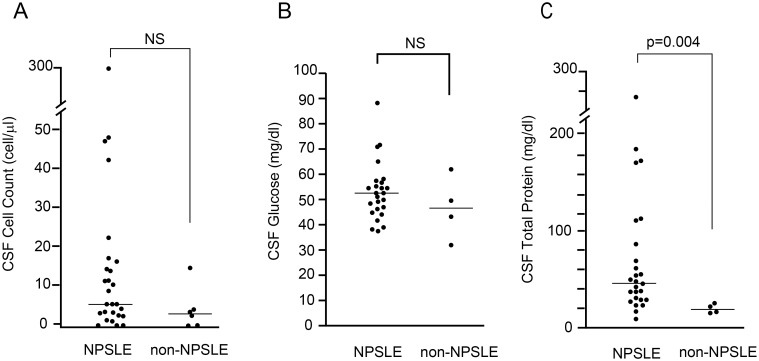
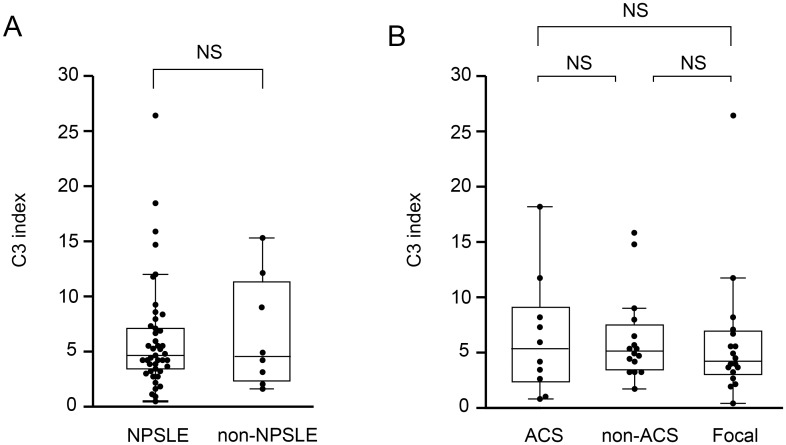
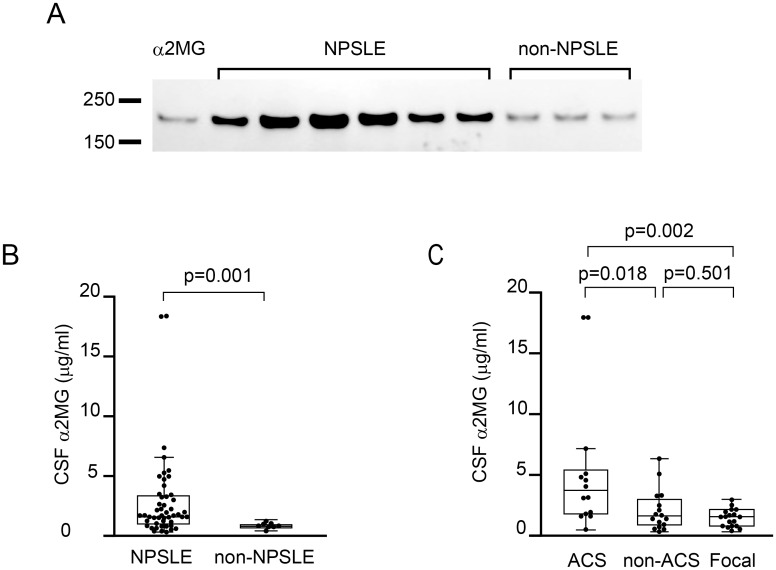
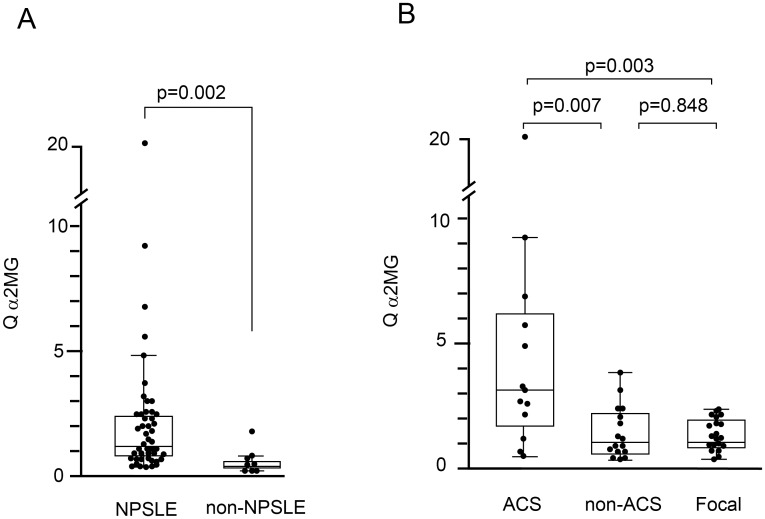
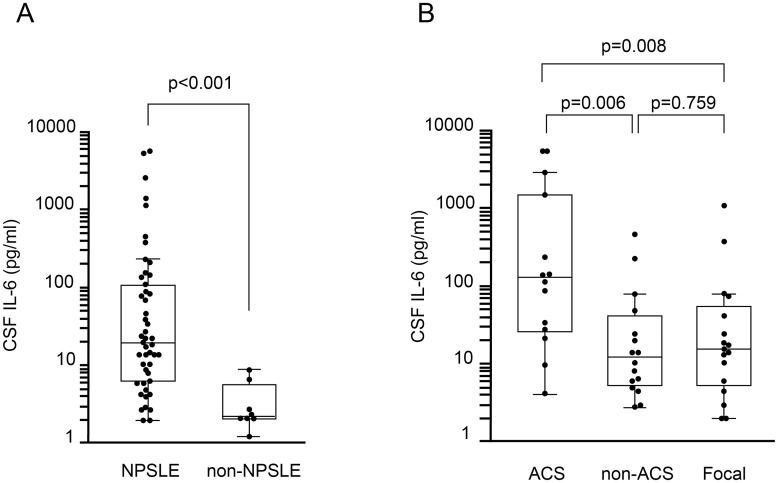
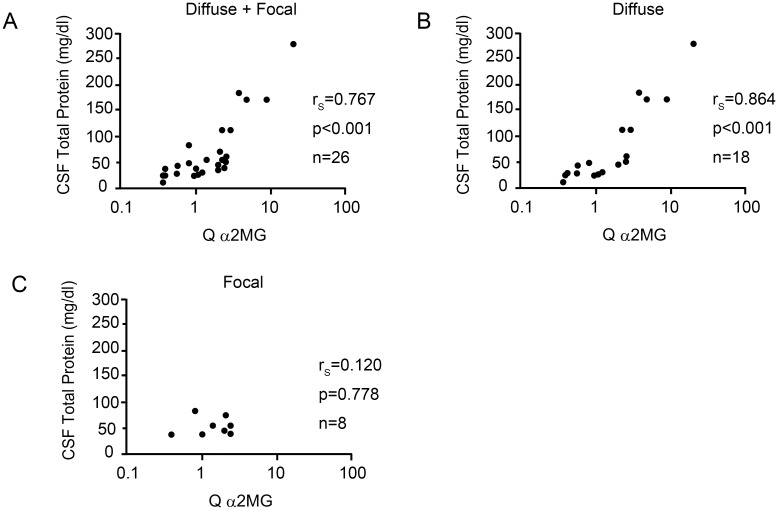
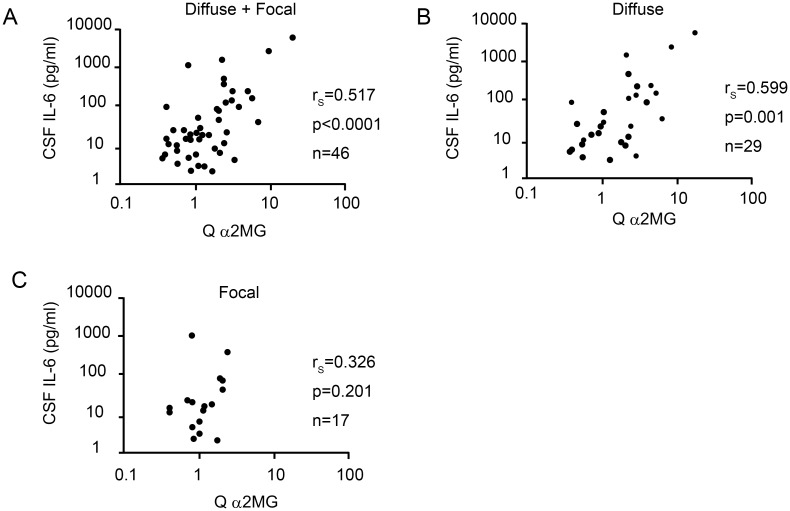
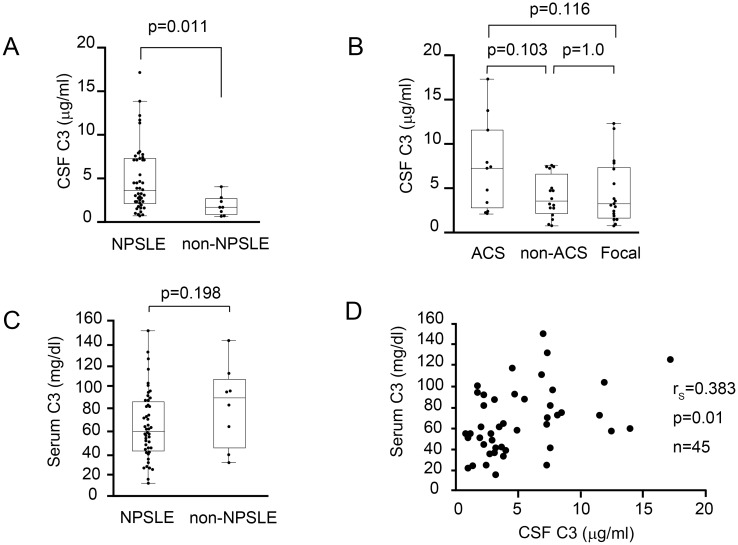
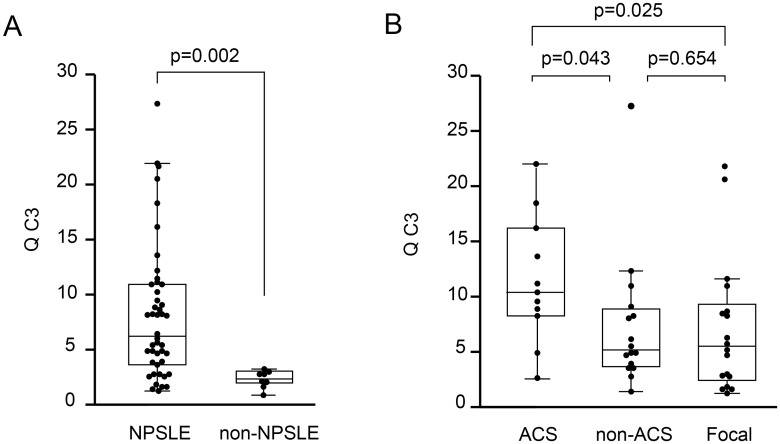
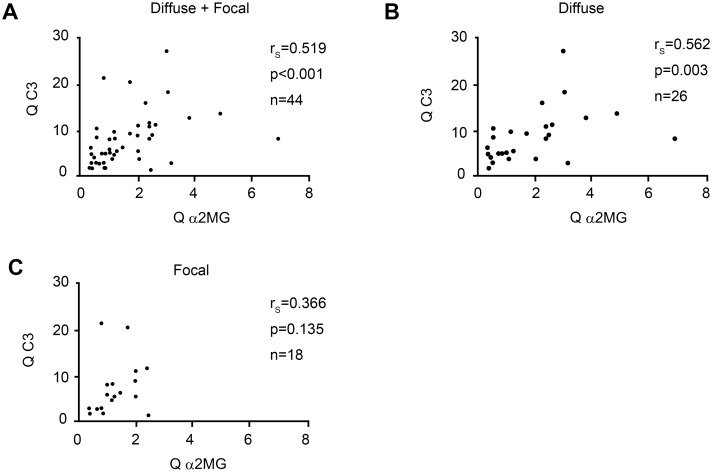
Although quotient of alpha2 macroglobulin (Qα2MG) was previously reported to be useful for the evaluation of blood-brain barrier (BBB) function, it is not commonly used. We therefore evaluated BBB function among the various subsets of neuropsychiatric systemic lupus erythematosus (NPSLE) using quotient Q α2MG. Furthermore, we determined the correlation between Q α2MG and cerebrospinal (CSF) interleukin (IL)-6 level and quotient complement component 3 (Q C3). To determine intrathecal production of C3, the C3 index (Q C3/Q α2MG) was also calculated. Fifty-six patients with SLE were included in this study. Of these, 48 were diagnosed with NPSLE, consisting of 30 diffuse NPSLE patients (acute confusional state (ACS): n = 14, non-ACS: n = 16) and 18 patients with focal NPSLE. CSF IL-6 concentration, and paired serum and CSF levels of α2MG and C3, were measured by enzyme-linked immuno solvent assay (ELISA). The Q α2MG, Q C3, and C3 index were then calculated. Q α2MG, Q C3, and IL-6 concentrations in the CSF were significantly elevated in NPSLE compared with non-NPSLE. Among the subsets of NPSLE, significant increases in Q α2MG, CSF IL-6, and Q C3 were observed in ACS compared with non-ACS or focal NPSLE. There was a positive correlation between CSF IL-6 level and Q α2MG, as well as between Q C3 and Q α2MG, in diffuse NPSLE. There were no significant differences in C3 index between NPSLE and non-NPSLE, as well as among the subgroups of NPSLE. Our study suggests that BBB disruption is present in ACS, and elevated levels of IL-6 and C3 in CSF in diffuse NPSLE, especially in ACS, might result from their entry to the CSF from the systemic circulation through the damaged BBB, as well as increased intrathecal production. Furthermore, Q α2MG might be useful for the evaluation of BBB integrity.
尽管先前有报道称α2巨球蛋白商(Qα2MG)可用于评估血脑屏障(BBB)功能,但它并不常用。因此,我们使用Qα2MG评估了神经精神性系统性红斑狼疮(NPSLE)各亚组中的血脑屏障功能。此外,我们还确定了Qα2MG与脑脊液(CSF)白细胞介素(IL)-6水平以及补体成分3商(Q C3)之间的相关性。为了确定鞘内C3的产生情况,还计算了C3指数(Q C3/Qα2MG)。本研究纳入了56例系统性红斑狼疮患者。其中,48例被诊断为NPSLE,包括30例弥漫性NPSLE患者(急性意识模糊状态(ACS):n = 14,非ACS:n = 16)和18例局灶性NPSLE患者。通过酶联免疫吸附测定(ELISA)测量CSF IL-6浓度以及配对的血清和CSF中α2MG和C3的水平。然后计算Qα2MG、Q C3和C3指数。与非NPSLE相比,NPSLE患者CSF中的Qα2MG、Q C3和IL-6浓度显著升高。在NPSLE各亚组中,与非ACS或局灶性NPSLE相比,ACS患者的Qα2MG、CSF IL-6和Q C3显著升高。在弥漫性NPSLE中,CSF IL-6水平与Qα2MG之间以及Q C3与Qα2MG之间存在正相关。NPSLE与非NPSLE之间以及NPSLE各亚组之间的C3指数无显著差异。我们的研究表明,ACS中存在血脑屏障破坏,弥漫性NPSLE尤其是ACS患者CSF中IL-6和C3水平升高可能是由于它们通过受损的血脑屏障从体循环进入CSF以及鞘内产生增加所致。此外,Qα2MG可能有助于评估血脑屏障的完整性。